
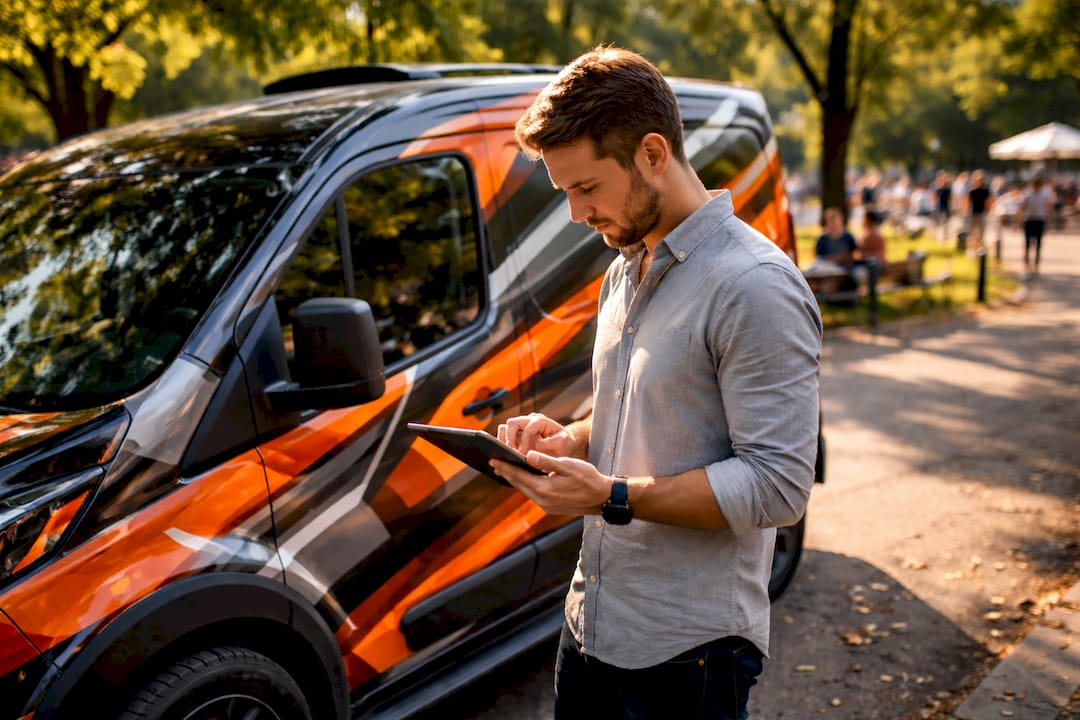
Mobile marketing with vehicles is defined as the practice of turning cars, trucks, trailers, and vans into moving advertisements that carry brand messages across multiple locations. Unlike a fixed billboard, a wrapped delivery van or a digital LED truck reaches entirely different audiences every day. This guide covers what is mobile marketing with vehicles, the main formats available, how it compares to static advertising, and the practical steps marketing professionals and business owners need to run a successful campaign.
What is mobile marketing with vehicles?
Vehicle advertising is the practice of applying vinyl wraps, decals, and window graphics to cars, trucks, and vans so they function as mobile billboards that reach thousands of potential customers daily along driver routes. The industry term is vehicle advertising, though most marketers search for it as mobile marketing with vehicles. Both phrases describe the same core strategy: the vehicle becomes the medium, not the product.
One distinction matters here. Vehicle advertising treats vehicles as advertising platforms. Automotive marketing promotes vehicles as products for sale. Confusing the two leads to misaligned goals and wasted budget. A plumber wrapping a fleet van in brand graphics is doing vehicle advertising, not automotive marketing.
The formats range from simple door decals to full wraps covering every panel of a tractor-trailer. Digital LED screens mounted on trucks add animated and real-time content to the mix. Experiential marketing tours take the concept further by turning branded trailers into interactive pop-up experiences at events and retail locations.
What are the main types of vehicle-based mobile marketing?
Three distinct formats define vehicle-based mobile marketing. Each serves a different budget, campaign goal, and audience type.
Static vehicle advertising
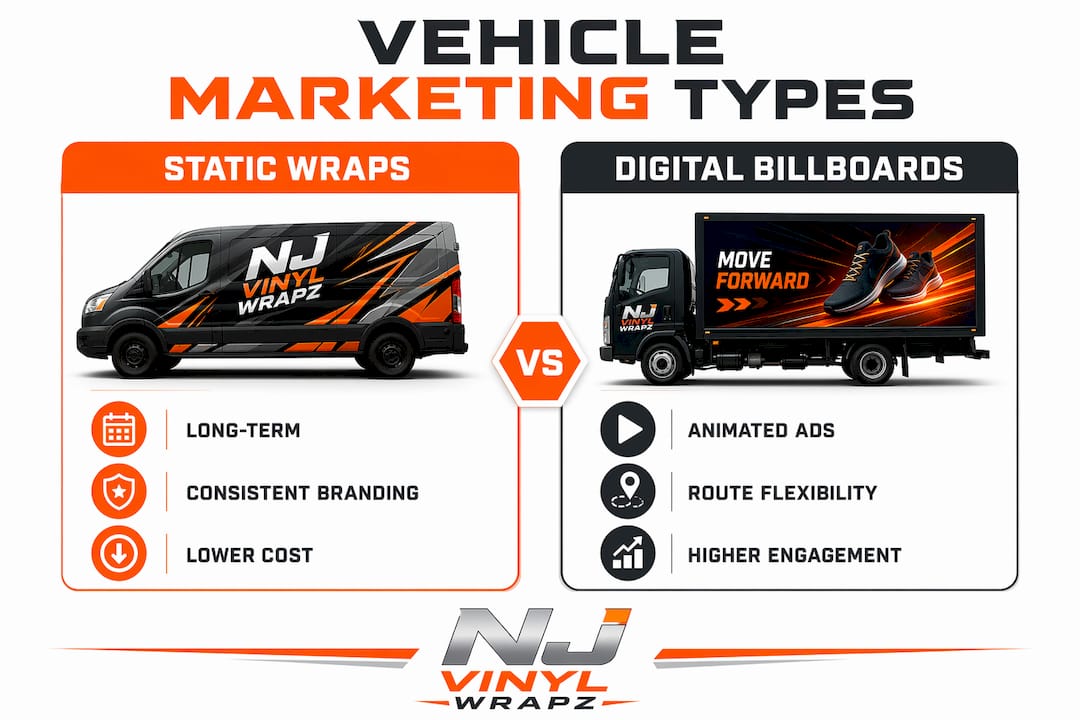
Static formats include full wraps, partial wraps, decals, magnetic signs, and window graphics. A full vehicle wrap covers every exterior panel with printed vinyl, turning the entire vehicle into a moving brand statement. Partial wraps cover specific panels, typically the doors and rear, at a lower cost. Magnetic signs offer the most flexibility since they attach and remove without adhesive, making them practical for vehicles shared between personal and business use.
Static wraps work best for long-term, consistent brand exposure. A delivery fleet running the same routes daily builds strong local brand recognition over months and years. Materials from 3M and Avery are the industry standard for durability, resisting UV fading and weather damage for five or more years with proper care.
Digital mobile billboards
Digital mobile billboard advertising uses street-legal trucks equipped with LED screens that display animated ads, routed in real time with GPS-verified impression reporting. The key advantage over static wraps is content flexibility. A single truck can display different ads for different clients throughout the day, or update messaging based on time, weather, or location.
Digital trucks can pause in high-visibility areas, such as outside a stadium before a game or near a competitor’s storefront. That targeting precision is not possible with a fixed billboard. The tradeoff is cost: digital mobile billboard campaigns carry higher day rates than static wrap campaigns.
Experiential mobile marketing vehicles
Experiential mobile marketing tours use branded vans, trailers, or custom-built vehicles to create interactive brand experiences at events, festivals, and retail hotspots. These tours include demos, sampling, giveaways, and digital integrations that build real-time brand connection and drive conversions. Research shows 18% of consumers engage significantly with experiential mobile marketing activations.
That engagement rate reflects a key difference from passive advertising. A person who samples a product from a branded trailer and scans a QR code is far more likely to convert than someone who sees a van drive past.
Pro Tip: Match your vehicle format to your campaign goal. Static wraps build awareness over time. Digital trucks create urgency around specific events. Experiential vehicles generate leads and first-party data on the spot.
| Format | Best Use | Content Type | Relative Cost |
|---|---|---|---|
| Static wrap | Long-term brand awareness | Printed vinyl graphics | Low to medium |
| Digital mobile billboard | Event-based or time-sensitive campaigns | Animated LED content | Medium to high |
| Experiential vehicle | Lead generation and product demos | Interactive, live engagement | High |
How does mobile vehicle marketing compare to static advertising?
Mobile billboard advertising reverses traditional out-of-home advertising by bringing ads to where the audience is, rather than waiting for the audience to pass a fixed location. A static billboard on a highway reaches whoever drives that road. A mobile campaign can target neighborhoods, events, and competitor locations on the same day.
Route planning is the core advantage. A business launching in a new zip code can concentrate vehicle impressions in that area for two weeks, then shift to another territory. A fixed billboard cannot do that. Geographic precision is the defining strength of vehicle-based mobile marketing strategies.
Cost and ROI comparisons favor vehicle advertising for local and regional campaigns. A full fleet wrap is a one-time production cost that delivers impressions every day the vehicle is on the road, with no recurring media fees. A static billboard lease runs monthly. For businesses with existing fleet vehicles, wrapping those vehicles is one of the lowest cost-per-impression formats in outdoor advertising.
Recall and engagement also favor mobile formats. A vehicle moving through a neighborhood or parked at a job site creates repeated exposure for the same local audience. That repetition builds brand familiarity faster than a single billboard placement.
- Geographic flexibility: Routes adjust daily to match audience locations, events, or competitor proximity.
- Cost structure: Wraps carry a one-time production cost with no recurring media fees.
- Content updates: Digital vehicle advertising allows real-time content changes; static wraps offer consistent, long-term messaging.
- Audience targeting: Route planning targets specific demographics, neighborhoods, and events with precision.
What are experiential mobile marketing tours?
Experiential mobile marketing tours are campaigns where a branded vehicle travels to specific locations to create direct, interactive experiences between a brand and its audience. The vehicle is not just a billboard. It is the venue.
A typical tour uses a custom-wrapped trailer or van that opens into a sampling station, product demo area, or branded photo opportunity. Brands in food and beverage, consumer electronics, and personal care have used this format extensively. The vehicle travels a planned circuit of festivals, sporting events, college campuses, and high-traffic retail areas over days or weeks.
Planning an experiential tour requires more than a wrapped vehicle. The logistics include:
- Vehicle design and build-out: The interior must support the activation, whether that means refrigeration for sampling, display screens for demos, or branded furniture for photo opportunities.
- Staffing: Brand ambassadors run the activation, engage attendees, and collect lead information.
- Permitting: Events and public spaces require permits. Skipping this step results in fines and forced shutdowns.
- Digital lead capture: QR codes and digital sign-ups connect physical engagement to measurable lead generation. Without these tools, conversion opportunities are lost despite high foot traffic.
- Reporting: Track attendance, leads collected, samples distributed, and social media mentions to calculate ROI.
Pro Tip: Build your QR code destination into the activation design from day one. A QR code added as an afterthought to a banner collects far fewer scans than one built into the natural flow of the experience.
Experiential tours produce the greatest ROI when they actively collect first-party customer data and drive real-time conversions, not just brand awareness. A tour that generates 500 qualified leads is more valuable than one that generates 5,000 impressions with no follow-up mechanism.
How to plan a vehicle marketing campaign that actually works
Campaign planning separates effective vehicle advertising from expensive vehicles driving around with no measurable result. The steps below apply whether you are wrapping a single van or managing a 50-vehicle fleet.
Vehicle selection and wrap design. The vehicle type affects design options. A box truck offers a large, flat canvas ideal for bold graphics. A sedan or SUV has more curves and panel breaks that require careful design work. Choosing a vehicle suited to commercial use before committing to a wrap saves costly redesigns later. Design should prioritize legibility at highway speeds: large logo, one clear message, and a phone number or URL visible from 50 feet.
Route planning and geographic targeting. Define the neighborhoods, corridors, and events where your audience concentrates. A restaurant chain targeting lunch crowds should route vehicles near office parks between 11 a.m. and 1 p.m. A home services company should prioritize residential neighborhoods during morning hours. Idle driving generates impressions, but strategic location pauses in high-traffic areas generate far more.
Legal and permitting requirements. Digital mobile billboard trucks require local permits in most cities. Some municipalities restrict LED truck advertising entirely. Check local ordinances before booking a campaign. Static wraps on commercial vehicles generally face no advertising-specific regulations, but vehicle registration and commercial insurance requirements still apply.
Measuring campaign success. GPS tracking and proof-of-performance reporting are the standard for mobile billboard campaigns. They verify that the vehicle ran the agreed routes and document impressions. For fleet wraps, track brand awareness through customer surveys, call tracking numbers, and unique landing page URLs printed on the wrap.
“Professional logistics management is critical to campaign success. Without GPS verification and route documentation, you cannot justify the spend to a client or a CFO.” — Mobile Billboard Advertising industry standard practice
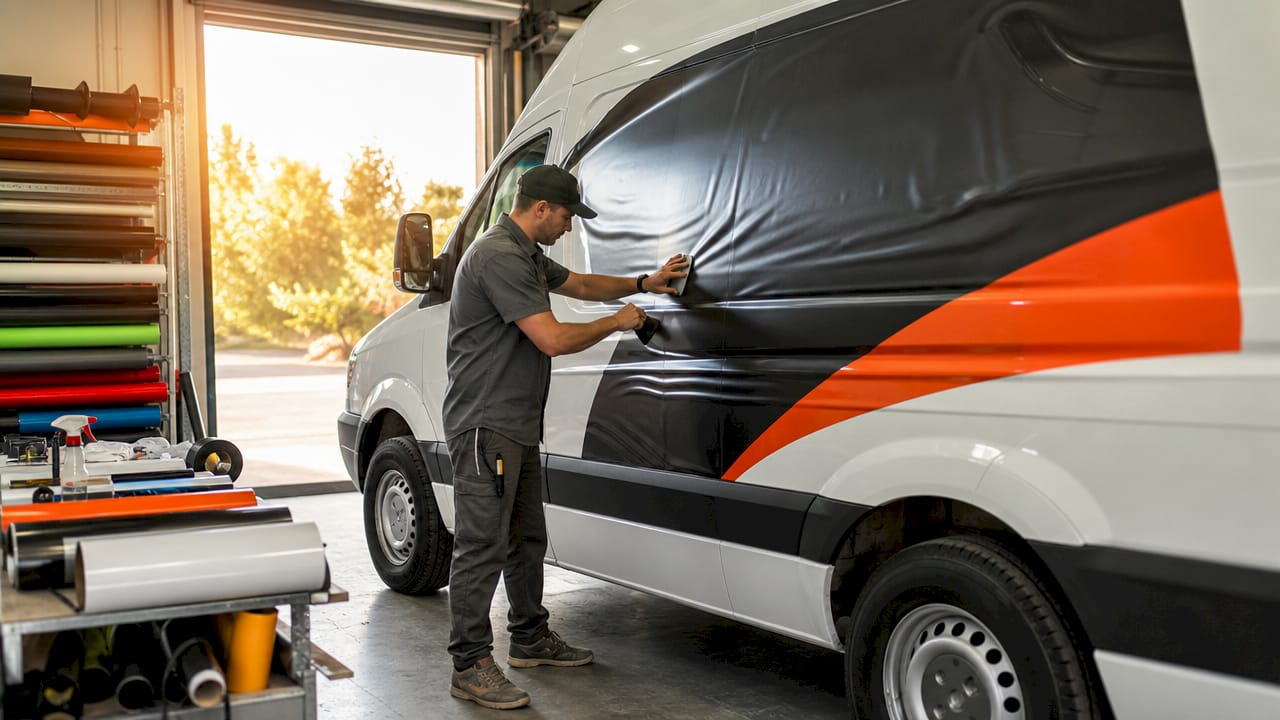
Working with professional installers. Wrap quality directly affects brand perception. A bubbled or peeling wrap signals poor quality to every person who sees it. Professional wrap installation in a climate-controlled facility, using materials like 3M or Avery, produces a finish that lasts and looks sharp for years.
Key Takeaways
Mobile marketing with vehicles works because it combines geographic flexibility, low recurring cost, and high daily impressions into a single, scalable advertising format.
| Point | Details |
|---|---|
| Three core formats | Static wraps, digital mobile billboards, and experiential vehicles each serve different campaign goals. |
| Route planning drives results | Targeting specific neighborhoods and events multiplies impressions compared to random driving. |
| GPS tracking is non-negotiable | Proof-of-performance reporting justifies spend and documents campaign delivery. |
| Experiential tours need lead capture | QR codes and digital sign-ups convert physical engagement into measurable ROI. |
| Wrap quality affects brand image | Professional installation with 3M or Avery materials protects both the vehicle and the brand. |
What I’ve learned after years of watching vehicle campaigns succeed and fail
The biggest mistake I see marketing professionals make is treating a vehicle wrap as a set-it-and-forget-it tactic. They wrap the van, hand the keys back to the driver, and assume impressions are happening. They are, but at a fraction of the potential.
Route optimization changes everything. A vehicle parked strategically outside a busy event for two hours generates more qualified impressions than the same vehicle driving suburban streets all day. The brands that understand this treat their wrapped vehicles like media placements, not just company cars.
The second mistake is confusing vehicle advertising with automotive marketing. I have seen marketing teams brief wrap designers with messaging about vehicle performance and fuel efficiency because someone conflated the two. Vehicle advertising is about your brand, not the vehicle carrying it.
The trend I am most interested in for 2026 is the convergence of digital LED truck campaigns with real-time data targeting. The ability to update ad content based on location, weather, or time of day brings vehicle advertising closer to programmatic digital advertising than most marketers realize. Combine that with fleet wrap visibility strategies for your static vehicles, and you have a full out-of-home program that covers both long-term awareness and short-term activation.
The brands winning with vehicle advertising right now are the ones treating it as a data-driven channel, not a creative exercise.
— Krunal
How Njvinylwrapz helps businesses build mobile advertising fleets
Njvinylwrapz has spent over 10 years transforming commercial vehicles into high-impact advertising platforms for businesses across New Jersey and beyond. The team handles everything from custom graphic design to premium printing and expert installation in climate-controlled facilities, using materials from 3M and Avery for durability that holds up through years of daily use.
Whether you need a single full vehicle wrap or a complete fleet branding program, Njvinylwrapz delivers consistent, professional results that make every vehicle on your route work harder for your brand. The company is licensed, insured, and built for commercial clients who need fast turnaround without sacrificing quality. Request a consultation at njvinylwrapz.com to get a quote for your next campaign.
FAQ
What is the definition of vehicle marketing?
Vehicle marketing, also called vehicle advertising, is the practice of using branded graphics on cars, trucks, and vans as moving advertisements. The vehicle becomes the medium, carrying brand messages across multiple locations daily.
How does mobile marketing with vehicles work?
A vehicle is fitted with vinyl wraps, decals, or digital LED screens displaying brand messaging, then driven or parked in targeted locations to generate impressions. GPS tracking documents routes and verifies delivery for campaigns using mobile billboards.
What types of vehicles work best for mobile advertising campaigns?
Box trucks, cargo vans, and trailers offer the largest flat surface area for graphics and are the most effective for high-visibility wraps. Sedans and SUVs work well for fleet branding when a business operates many vehicles in the same territory.
How do you measure the ROI of a vehicle advertising campaign?
Digital mobile billboard campaigns use GPS-verified impression reporting to document reach. For static wraps, marketers track results through call tracking numbers, unique URLs, and customer surveys that ask how the prospect heard about the business.
What is the difference between vehicle advertising and automotive marketing?
Vehicle advertising uses vehicles as the medium to promote any brand or product. Automotive marketing promotes vehicles themselves as products for sale. The two strategies have different goals, audiences, and creative approaches.