

Vehicle branding in 2026 is defined by bold minimalism, specialty finishes, and data-driven design. These are not aesthetic preferences. They are measurable strategies that determine whether a wrapped fleet generates leads or gets ignored. The vehicle wrap industry has shifted from decorative graphics to mobile advertising programs built on traffic-speed readability, modular systems, and digital integration. If you manage a fleet or set marketing budgets, understanding these vehicle branding trends 2026 is the difference between a wrap that pays for itself and one that fades into the background.
1. What are the most popular vehicle wrap colors and finishes in 2026?
The finishes dominating fleet graphics trends 2026 are matte, satin, chrome, brushed metal, and iridescent holographic films. Each finish sends a different brand signal, and choosing the wrong one for your industry is a real cost.
Deep matte greens and satin stealth grays are leading the premium segment. These finishes read as high-end and intentional, which is why luxury service brands and upscale contractors favor them. Gloss metallic blues and color-shift purples and teals are performing well for tech companies and consumer-facing brands that want social media attention. The color-shift effect photographs differently at every angle, which multiplies organic content potential.
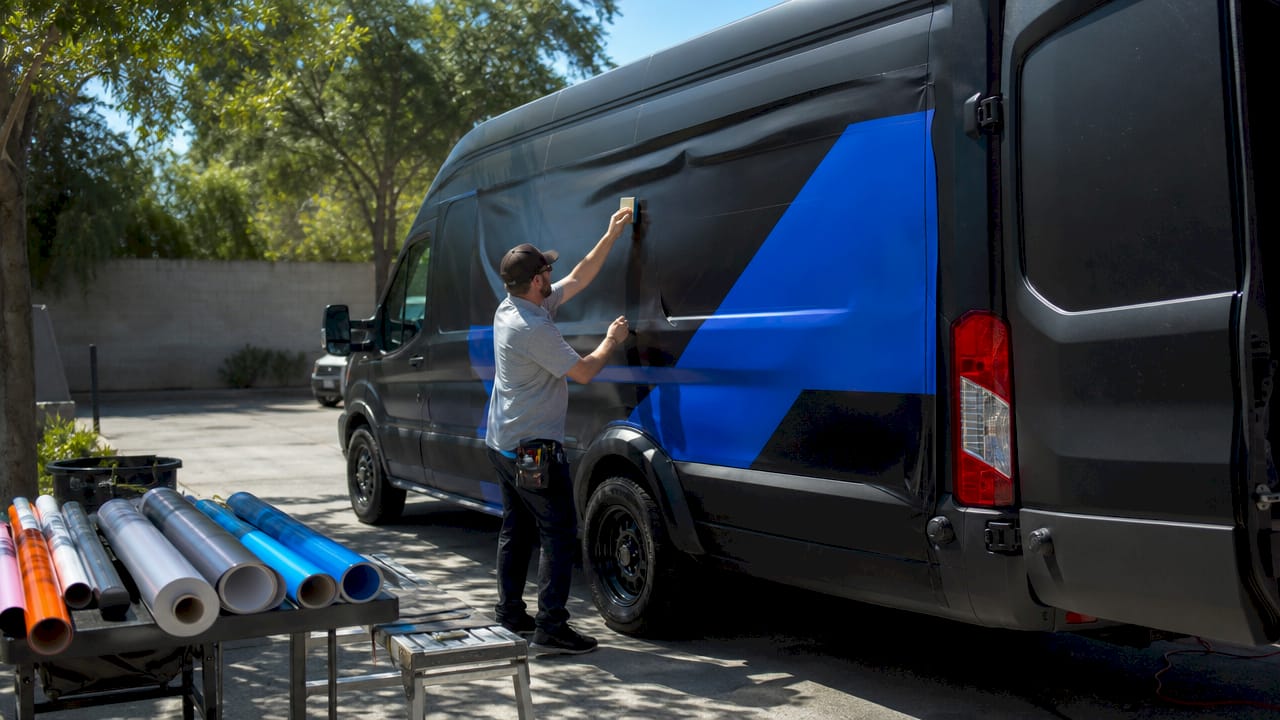
Holographic rainbow vinyl and mirror-like chrome films are among the fastest-growing market segments in 2026. These finishes enhance social media engagement and fleet brand recognition in ways that standard gloss simply cannot match. A single chrome-wrapped delivery van parked on a busy street generates more unsolicited photos and shares than a standard white van with a logo ever will.
Pro Tip: Matte and satin finishes reduce glare, which improves readability in direct sunlight. If your fleet operates in high-sun environments like parking lots or highways, these finishes outperform gloss for legibility.
Colors like blue, red, black, green, and yellow are chosen to evoke specific brand emotions. Blue signals trust and reliability. Red drives urgency. Black communicates authority. Matching your finish to your brand’s emotional positioning is not a design detail. It is a conversion decision.
2. How minimalist and high-contrast designs are shaping vehicle branding
High-contrast layouts with significant negative space are the defining visual strategy of 2026. The science is straightforward: a viewer traveling at 45 mph has roughly two seconds to register your brand. Cluttered designs fail that test every time.
Visual hierarchy, large readable fonts, strong contrast, and minimal text are the four pillars of high-converting vehicle wraps. Brands that strip their wrap down to a logo, a phone number, and one clear service statement consistently outperform those that try to list every offering. The wrap is not a brochure. It is a billboard moving through your customer’s neighborhood.
Bold typography is doing more work than ever in 2026. Sans-serif fonts at large point sizes, set against a contrasting background, are being tested using traffic-speed readability tools before a single panel gets printed. AI-assisted layout simulations now allow designers to preview how a graphic reads at 30 mph, 50 mph, and from a 45-degree angle. This removes guesswork and protects your investment.
“The biggest failure is treating vehicle wraps as static decorations rather than dynamic marketing assets requiring data-driven optimizations.” — ProWraps
Minimal details also reduce cognitive overload for viewers. When a person sees a clean, bold wrap, their brain processes the brand faster and retains it longer. That retention is what drives the brand familiarity that the American Trucking Associations and OAAA data confirm improves conversions.
3. Which technological innovations are driving vehicle branding effectiveness in 2026?
Technology has moved from a novelty to a core component of fleet branding best practices. The most impactful tools in 2026 are QR codes, AI design simulation, modular branding systems, and sustainable film materials.
QR codes placed on fleet vehicles generate 30 to 40% scan rates when the design is well-executed. That is a direct traffic channel requiring zero ongoing ad spend. For service businesses, a QR code linking to a booking page or a Google Business profile turns every parked vehicle into a lead generator. The key is placement: rear panels and passenger doors outperform front bumpers because viewers have more time to act.
AI-assisted layout simulations and traffic-speed readability testing now optimize vehicle graphic conversion performance before printing. Designers use eye-tracking principles and audience targeting data to determine where the eye lands first, second, and third on a moving vehicle. This means your phone number or call-to-action gets placed exactly where attention naturally falls, not where it looks balanced on a flat design file.
Adaptive Branding uses modular layouts to maintain brand consistency while fitting diverse fleet vehicle geometries. A sprinter van, a box truck, and a sedan all have different panel shapes. Modular systems create a master brand template that scales and adjusts without losing visual coherence. Local managers handle minor repairs while central teams manage major brand updates, keeping the entire fleet aligned.
Pro Tip: When adding a QR code to a fleet wrap, always link to a mobile-optimized landing page. A desktop-only page kills the conversion rate regardless of how many people scan.
Sustainable film materials are also reshaping top fleet branding solutions 2026. PVC-free films and easy-removal materials are gaining traction as companies face ESG reporting requirements and sustainability commitments. 3M and Avery both offer eco-conscious wrap films that perform comparably to standard vinyl in durability while reducing environmental impact. For brands with public sustainability pledges, the material choice is a brand statement in itself.
Emerging technologies worth watching include thin-film LED panels integrated into wrap designs, augmented reality experiences triggered by vehicle graphics, and glass bead-enhanced reflective films that improve nighttime visibility while reinforcing brand colors.
4. What best practices maximize ROI and brand impact with fleet wraps in 2026?
The fleet branding strategy guide that actually works in 2026 treats wraps as long-term growth infrastructure, not a one-time marketing expense. Here is how to execute that shift.
- Start with one or two vehicles. Test your design in the real world before committing to a full fleet rollout. Photograph the wrapped vehicles in your actual operating environment, gather feedback, and refine before scaling. This approach, detailed in commercial wrap design guides, consistently produces higher ROI than fleet-wide launches with untested designs.
- Build a modular design system. Create a master template that adapts to every vehicle type in your fleet. Consistent brand elements across diverse geometries build recognition faster than vehicle-specific one-off designs.
- Integrate regulatory markings by design. For logistics fleets, integrating regulatory markings into the design avoids awkward overlays and enhances professionalism. Reflective elements aligned with brand colors improve visibility and meet safety requirements simultaneously.
- Plan refresh cycles proactively. Fleet vehicle wraps typically last 5 to 7 years depending on quality, environment, and maintenance. Proactive inspection and refresh cycles maintain professional appearance and protect brand equity. A faded or peeling wrap signals neglect, which damages the brand it was meant to build.
- Use geographic and local data in your design strategy. Service businesses operating in specific zip codes or neighborhoods can incorporate local area references and QR codes that link to location-specific landing pages. This turns a general brand impression into a targeted lead capture tool.
| Strategy | Outcome |
|---|---|
| Pilot wrap before fleet rollout | Reduces design errors and wasted spend at scale |
| Modular design system | Maintains brand consistency across all vehicle types |
| Integrated regulatory markings | Improves professionalism and meets compliance requirements |
| Scheduled refresh cycles | Sustains brand quality and extends wrap ROI over time |
5. How brand colors, finishes, and tech combine for specific industries
Different industries extract different value from the same set of fleet branding trends in 2026. The combination of finish, color, and technology should map directly to your business model and customer psychology.
Logistics companies benefit most from reflective films and integrated regulatory markings. A fleet of delivery vehicles with reflective brand-colored accents is both safer and more visible at night, turning a compliance requirement into a branding asset. QR codes on rear panels can link to shipment tracking pages, adding functional value that reinforces the brand promise of reliability.
Luxury service brands, including high-end contractors, detailers, and hospitality companies, are investing in chrome and holographic finishes to drive experiential marketing. These finishes communicate premium positioning before a customer reads a single word. The social media effect is significant: a chrome-wrapped vehicle at a luxury event generates organic reach that no paid placement can replicate.
Eco-conscious companies and electric vehicle fleets are pairing high-tech color palettes, think electric blues, clean whites, and biophilic greens, with PVC-free wrap materials. The message is coherent from the outside in: the vehicle, the wrap material, and the color all reinforce the same brand value. This coherence is what separates brands that are remembered from those that are merely seen.
Service businesses in competitive local markets, such as HVAC, plumbing, and landscaping companies, are using fleet wraps for brand impact combined with QR codes and local area tagging to capture leads directly from the street. Vehicle advertising generates tens of thousands of daily brand impressions with no recurring cost, making it one of the highest-ROI channels available to local service businesses.
Custom textures like wood grain panels and geometric accent shapes are being used by interior design firms, boutique retailers, and food brands to create emotional connections before a customer ever steps inside. The wrap becomes the first sensory experience of the brand.
Key takeaways
Fleet branding in 2026 delivers maximum ROI when specialty finishes, minimalist design, and digital integration work together as a unified mobile advertising system.
| Point | Details |
|---|---|
| Specialty finishes drive recognition | Matte, chrome, and holographic films outperform standard gloss for brand recall and social engagement. |
| Minimalism improves conversion | High-contrast layouts with minimal text are read and retained faster at traffic speed. |
| QR codes create direct traffic | Well-placed QR codes on fleet vehicles generate 30 to 40% scan rates with zero ongoing ad spend. |
| Modular systems protect consistency | Adaptive Branding templates maintain visual coherence across all vehicle types in a diverse fleet. |
| Refresh cycles protect brand equity | Wraps lasting 5 to 7 years require proactive maintenance schedules to sustain professional appearance. |
Why I think most businesses are still underusing their fleet as a media channel
I have worked with enough fleet managers and marketing directors to see the same pattern repeat. The wrap gets approved, the vehicles look great on launch day, and then the program goes on autopilot for five years. No measurement, no refresh plan, no iteration. The wrap becomes wallpaper.
The businesses getting real returns from fleet branding in 2026 treat their vehicles the way a media buyer treats a billboard contract. They track which routes generate the most impressions, they test QR code landing pages, and they refresh designs when a campaign or service offering changes. That is a fundamentally different mindset than “let’s wrap the vans.”
The shift to modular branding systems is the most underappreciated development in this space right now. When you build a design system instead of a one-off wrap, you gain the ability to update one element across an entire fleet without reprinting everything. That is cost control and brand agility in the same decision. Most businesses I speak with have never been offered this approach. They should ask for it by name.
My honest recommendation: if you have not reviewed your fleet wrap program in the last 18 months, you are almost certainly leaving impressions and leads on the table. The materials, the design tools, and the measurement capabilities available in 2026 are categorically better than what existed even three years ago. The question is not whether to invest. It is whether you are investing with a strategy or just spending on aesthetics.
— Krunal
How Njvinylwrapz brings 2026 fleet branding trends to life
Njvinylwrapz has spent over 10 years helping New Jersey businesses turn their fleets into high-performing mobile advertising platforms. From custom design and premium material selection to expert installation in climate-controlled facilities, every project is built to perform at traffic speed and last for years.
Whether you need full vehicle wraps for a single flagship vehicle or a modular branding system for a 50-unit fleet, Njvinylwrapz works with trusted materials from 3M and Avery to deliver results that hold up in the field. The team also handles fleet wrap programs including color change wraps, vehicle lettering, partial wraps, and specialty finishes. Contact Njvinylwrapz today for a personalized consultation and a quote tailored to your fleet size and marketing goals.
FAQ
What are the top vehicle wrap finishes for 2026?
Matte, satin, chrome, brushed metal, and holographic iridescent films are the leading finishes in 2026. Chrome and holographic options are among the fastest-growing segments due to their social media engagement and brand recognition impact.
How long do fleet vehicle wraps last?
Fleet vehicle wraps typically last 5 to 7 years depending on material quality, climate exposure, and maintenance. Proactive inspection and scheduled refresh cycles are the most effective way to protect that investment.
Do QR codes on fleet vehicles actually work?
Yes. Well-designed QR codes on fleet vehicles generate 30 to 40% scan rates, directing viewers to booking pages, contact forms, or location-specific landing pages. Placement on rear panels and passenger doors produces the highest engagement.
What is Adaptive Branding in fleet wraps?
Adaptive Branding is a modular design system that maintains visual brand consistency across different vehicle types and sizes within a fleet. It allows central teams to push brand updates while local managers handle minor repairs independently.
How do I maximize ROI from a fleet wrap program?
Start with a pilot wrap on one or two vehicles, test the design in real operating conditions, then scale. Combine a modular design system with QR code integration and a proactive maintenance schedule to sustain brand quality and lead generation over the full wrap lifespan.