

Company car wraps are printed or colored vinyl films applied over a work vehicle to put your brand, phone number and service list on the road every day. For a New Jersey contractor or fleet manager, the best result comes from one shop handling design, printing and installation under one roof, using cast vinyl from 3M or Avery Dennison, with the required USDOT markings planned into the artwork from the start. At NJ Vinyl Wrapz in Tinton Falls, all of that happens in-house, and you can reach us at (732) 486-1000.
This guide covers the wrap types, how to choose between them, the federal marking rules that catch fleets out, how to design for more than one vehicle, how to care for a wrap, and what removal involves.
TL;DR
- A company car wrap is vinyl film applied to a work vehicle. It can be a full wrap, a partial wrap or simple lettering, and the right choice depends on budget, brand and how many vehicles you run.
- If a vehicle crosses state lines for business, the carrier’s name and USDOT number must be on both sides, readable from 50 feet. Plan this into the design, not after it.
- For fleets, phased installs keep most vehicles working, and design files kept on record make reorders fast.
- Hand washing and a rinse-first routine keep the film in shape; plan for removal before a rewrap so the paint and the film are handled properly.
- Call (732) 486-1000 or request a free quote through our contact page.
Table of Contents
- What a company car wrap actually is
- Full wrap, partial wrap or lettering: how to choose
- The federal marking rule many fleets overlook
- Designing for one vehicle versus a whole fleet
- What installation looks like
- Caring for a company wrap
- Removal and what it means for your paint
- Beyond the wrap: protecting the vehicle
- Our perspective
- Ordering company car wraps in New Jersey
- FAQ
- Sources
What a company car wrap actually is
A wrap is a set of large vinyl panels, printed or solid color, fitted over the body of a car, van, pickup, box truck or trailer. It is not paint. The film sits on top of the factory finish and can be removed later. Business owners usually search for “business car wraps” or “company car wraps” when they want one of three things: advertising, a consistent look across several vehicles, or a way to make a plain white van look like a professional operation.
The appeal is simple. The vehicle is already on the road for your jobs, so the branding travels with it to every neighborhood you serve. A van parked outside a customer’s house in Freehold or Red Bank tells the neighbors who is working there and how to reach you. An unmarked van tells them nothing.
Two materials matter most when you compare quotes:
- Cast vinyl is manufactured as a thin, flexible sheet that conforms to curves, rivets and recesses. It is the film type used for full vehicle wraps. All our work uses 3M and Avery Dennison cast films.
- Printed graphics with a laminate carry your artwork. The laminate is the clear top layer that protects the print from sun and washing.
Solid-color films are used for color change wraps, which some owner-operators and company executives choose when they want a vehicle in a different finish without any printed branding.
Full wrap, partial wrap or lettering: how to choose
The three options sit on a ladder of coverage. Pick the one that matches what the vehicle has to do for you.
| Option | What it covers | Best fit |
|---|---|---|
| Vehicle lettering | Company name, phone number, license or USDOT details, services | Owner-operators, vehicles that mostly need to be identified and compliant |
| Partial wrap | Rear doors, lower body, hood or sides, often with the van’s color as part of the design | Trades and service businesses that want strong branding on a measured budget |
| Full wrap | Every painted surface from bumper to bumper | Brands that want maximum visibility, or a vehicle that needs a total new look |
You can see our options on the wrap options page and the dedicated pages for full vehicle wraps and vehicle lettering.
Lettering
Lettering is the lowest-coverage choice. It works well when the vehicle needs a clean, readable identity: your name, your number, your license information. It is also the right choice for the legally required markings on a commercial truck.
Partial wraps
A partial wrap uses the vehicle’s own color as part of the design. A white van with a bold graphic across the back doors and sides can look intentional rather than half-finished, as long as the layout is designed around the body lines. Partial wraps are a common pick for HVAC, plumbing, electrical and landscaping crews.
Full wraps
A full wrap turns the whole vehicle into one design. It suits food trucks, delivery brands and any business whose look is part of the product. It also gives you the most flexibility to cover scratches and faded paint, since the film covers the body panels.
A useful test: look at your vehicle from 30 feet away in traffic. If a stranger cannot name what you do and how to call you in three seconds, you need more coverage or a simpler layout, not more text.
The federal marking rule many fleets overlook
If you run commercial vehicles, branding is not only a marketing question. The Federal Motor Carrier Safety Administration (FMCSA) requires motor carriers in interstate commerce to display their legal name or single trade name and their USDOT number on the vehicle. The FMCSA’s marking rule summary says the name must match the one on the carrier’s Form MCS-150 registration, and that city and state markings are not required but are not prohibited.
The practical standard is legibility. According to Carrier Atlas’s report on the rule, the information must appear on both sides of every self-propelled commercial vehicle in interstate commerce, be readable from 50 feet in daylight, and contrast sharply with the background. The same report notes that in June 2026 the FMCSA published a notice renewing the marking requirements. It was a renewal under the Paperwork Reduction Act, not a new rule.
What that means when you order a wrap:
- Confirm whether you need a USDOT number. If you are unsure whether your vehicles fall under interstate rules, check with the FMCSA or your compliance advisor before artwork is approved.
- Keep the marking on solid contrast. A number laid over a busy photo or a gradient is the classic way to fail the 50-foot test.
- Never let the design cover the marking. A full wrap has to leave the number readable and in place on both sides.
- Do not cover safety equipment. Lighting, reflectors and required devices must stay visible, and opaque film does not belong on the windshield or front side windows.
We handle DOT numbers and vehicle lettering as part of our work, so the compliant marking is built into your layout during design.
For New Jersey intrastate work, rules can differ from the federal ones, so confirm your own requirements with the state before finalizing.
Designing for one vehicle versus a whole fleet
One wrapped van is a design project. Ten wrapped vehicles are a system. The questions change.
Build a master template
Every vehicle model has different panel shapes: a Ford Transit, a Ram ProMaster, a Sprinter and a box truck all need their own layout of the same brand. Good fleet design starts with one master identity, logo placement rules, colors, a phone number size and a list of what is always on the vehicle, then adapts it to each body.
Keep the layout simple enough to read
A few things work every time:
- One main message, one phone number or web address, at a size you can read from a distance.
- A logo placed where it is not broken by door gaps or handles.
- A color scheme that holds up in sun, rain and road grime.
- Equal treatment on both sides, with the rear used for your strongest call to action.
Plan the rollout
Taking a whole fleet off the road at once is costly. Our approach is phased installs that keep most vehicles on the road, with a typical install time of 1 to 3 days per vehicle. A fleet of eight can be sequenced so that two or three vehicles are in the shop at a time.
Store the files
When you add a truck next year or replace one that was in an accident, you want an exact match. We keep your design files on record for fast reorders, so a new vehicle goes into the same system rather than starting over. We also offer fleet volume discounts. Our fleet wraps page explains how fleet projects are handled, and the rewrapping aging fleets checklist is useful when you already have wraps that are due for replacement.
What installation looks like
Quality shows up in the details that are hard to see in a photo: edges tucked cleanly, seams in sensible places, relief cuts hidden and no trapped dust under the film. Those results depend on the environment as much as the installer. All our design, printing and installation is done in-house in a climate-controlled facility, which keeps temperature and dust under control while the film goes on.
Before a vehicle goes in, expect these steps:
- Consultation and measurements. We talk through the goal, the vehicles and the compliance needs.
- Design and proof. You approve the layout before anything is printed.
- Printing on cast film. Your artwork is printed on 3M or Avery Dennison film.
- Installation. A typical install runs 1 to 3 days per vehicle.
- Delivery and care instructions. You leave knowing how to wash and look after the film.
Every installation comes with a 1-year labor warranty from NJ Vinyl Wrapz. Material warranties come from the film manufacturer and vary by product, with printed wrap film and color change film covered differently.

Caring for a company wrap
A wrap lasts longer when it is washed gently and promptly. The manufacturer guidance is straightforward. 3M’s maintenance FAQ for its 2080 wrap film says dirt, dust and road salt come off with a water rinse followed by drying, and that stubborn contamination can be treated with hot soapy water and then other approved cleaners in order.
For a New Jersey fleet, road salt in winter is the one to watch. A few habits help:
- Rinse salt off regularly in winter instead of waiting for a full wash.
- Hand wash with a soft mitt and a gentle soap when you can.
- Keep high-pressure nozzles away from seams and edges.
- Look over edges and corners every few weeks, and bring in any lifting spot early.
If a panel is damaged, 3M’s FAQ cautions that a replaced section can look different from the rest because of film lot differences and the aging of the surrounding wrap. That is a good reason to keep your design files on record and to repair soon after damage rather than letting it spread.
Our article on how to reach a 5 to 7 year wrap lifespan goes deeper on what extends the life of a wrap.
Removal and what it means for your paint
At the end of a wrap’s life, the film comes off. How that goes depends on the film, how long it has been on, the vehicle’s condition and the paint underneath. 3M publishes its own removal guidance for its wrap films, and it states that its performance claims apply when the film is applied, maintained and removed according to its instructions. In plain terms, removal is a technical job, not a quick peel.
For business vehicles, plan removal as part of the cycle:
- Schedule it before the film is badly cracked or baked on. Older film is harder to take off in one piece.
- Have the paint inspected before the wrap goes on, so you know what was there before.
- Treat removal and rewrap as one project so the vehicle is out of service once.
The cost breakdown, extra charges and timing are covered in our guide to what wrap removal costs.
Beyond the wrap: protecting the vehicle
Some businesses and many owners of executive or showroom vehicles pair a wrap with protection. We offer paint protection film, ceramic coating, window tinting and chrome delete through our automotive services. If you want a new color instead of branding, our color change wraps cover that. For job-site equipment, we also wrap heavy machinery, and for your office, shop or showroom there are window, wall and floor graphics that match the vehicles.
Our perspective
Most fleet owners come to us thinking about the graphic. What decides whether the wrap pays off is everything around it: whether the layout fits each vehicle model, whether the USDOT number is readable, and whether the install is done in a clean, controlled space.
That is why we keep design, printing and installation under one roof in Tinton Falls. The designer who drew your layout and the installer who fits it work in the same building, so problems get solved before they reach your vehicle.
We use 3M and Avery Dennison cast vinyl because a work vehicle goes through salt, sun and constant washing. We back each install with a 1-year labor warranty, and we keep your files on record so the tenth truck matches the first.
For a fleet, we schedule installs in phases so most of your vehicles keep working while others are in our bay.
NJ Vinyl Wrapz
Ordering company car wraps in New Jersey
We serve businesses throughout New Jersey, especially Monmouth, Ocean and Middlesex counties, from our shop at 3212 Shafto Rd, Units 10 & 11, in Tinton Falls. Whether your vehicles are based in Toms River, Freehold, Red Bank or farther afield, the process is the same: tell us what you drive and what the vehicle needs to say, and we design, print and install it.
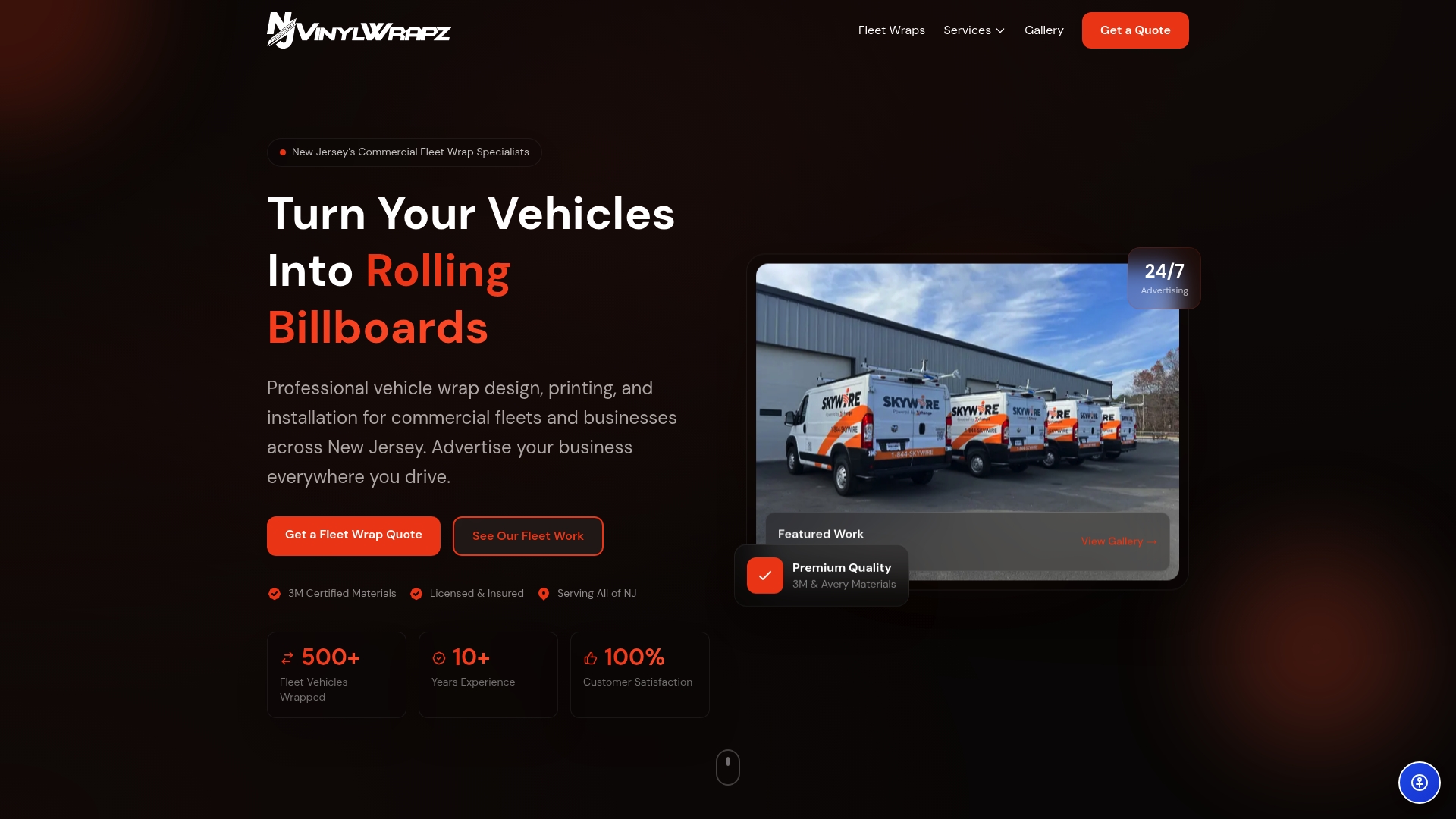
We are open Monday to Saturday, 9am to 5pm. Call (732) 486-1000, see the fleet wraps page, or visit our homepage to see our commercial work. We do not publish set prices because each project depends on vehicle count, coverage and design, so a quote is where the numbers start.
FAQ
Can a wrapped company car go through a car wash?
Hand washing is the best routine. If you use a car wash, keep high-pressure nozzles away from seams and edges, and rinse off road salt often in winter. Ask us for care instructions when your vehicle is delivered.
How long does it take to wrap a company vehicle?
Our typical install time is 1 to 3 days per vehicle. Fleet jobs are phased so most of your vehicles stay on the road while others are in the shop.
Do I need a USDOT number on my wrapped vehicle?
If the vehicle is a commercial motor vehicle operating in interstate commerce, the carrier’s name and USDOT number must appear on both sides and be readable from 50 feet. We handle DOT numbers and lettering, so we build them into the design. Confirm whether your operation needs one with the FMCSA.
Is a full wrap or a partial wrap better for a business vehicle?
A partial wrap gives strong branding on a measured budget, especially on a white van. A full wrap gives the most visibility and a complete new look. We can show you both on your vehicle model before you decide.
What warranty comes with a wrap?
Every installation carries our 1-year labor warranty. Material warranties come from the film manufacturer and vary by product, with printed wrap film and color change film covered differently.
Ready to price your vehicles? Request a free quote on our contact page or call (732) 486-1000.
Sources
- FMCSA: Highlights of the Commercial Motor Vehicle Marking Final Rule
- Carrier Atlas: FMCSA renews USDOT marking rules and what 50-foot legibility means
- 3M Wrap Film Series 2080: Wrapped Vehicle Maintenance FAQ