

Vehicle wrap designs are visual branding elements applied directly to fleet vehicles, turning every service call, delivery route, and commute into a mobile advertising opportunity. Fleet wraps deliver a cost-per-thousand impressions as low as $0.04 and can generate over 2,500% ROI across a five-year lifecycle. For fleet managers and business owners, that math is hard to ignore. The right design choices determine whether your vehicles build brand authority or blend into traffic.
1. Full vehicle wraps for total brand immersion
Full wraps cover every panel of a vehicle, from hood to bumper, creating a moving billboard with no dead space. They deliver maximum brand exposure and work best for fleets with high daily traffic and multiple service stops. The investment runs $2,500–$5,000 per vehicle depending on size and design complexity. That cost spreads across a 5–7 year lifespan with premium vinyl materials from brands like 3M and Avery.
2. Partial wraps for budget-conscious fleets
Partial wraps target the sides and rear of a vehicle, leaving the factory paint on less visible areas. They cost 40–60% of a full wrap but deliver 70–80% of the visual impact. For small fleets with 2–5 vehicles, partial wraps across all units often outperform one fully wrapped vehicle in total impressions. The savings can fund professional design services or a second vehicle wrap.
3. Spot graphics and decals for targeted messaging
Spot graphics are individual vinyl elements placed on specific vehicle panels, such as a logo on the door or a phone number on the tailgate. They run $500–$1,500 per vehicle and work well for older vehicles nearing replacement or businesses testing wrap advertising for the first time. Decals also supplement existing wraps when a promotion, new service, or contact update needs to be added without a full redesign.
4. Bold, high-contrast typography that reads at speed
Typography is the most functional element of any fleet wrap. Large sans-serif fonts in high-contrast color combinations allow drivers and pedestrians to read your brand name from 50 feet or more. Limit your message to your company name, one core service, and a phone number. Anything beyond three lines of text competes with itself and reduces recall.
Pro Tip: Test your design by printing it at scale and viewing it from 30 feet away. If you cannot read it in three seconds, simplify it.
5. Consistent branding across every vehicle in the fleet
Consistency across fleet vehicles builds brand recognition faster than unique designs per vehicle. When every van, truck, and car shares the same color palette, logo placement, and font, the fleet functions as a unified campaign rather than a collection of individual ads. Fleet managers should establish a master design template and apply it across all vehicle types with minor adjustments for panel size. This approach also reduces per-vehicle design costs significantly.
6. Specialty finishes that stop traffic
Holographic, reflective, and textured vinyl finishes add a physical dimension that flat-printed wraps cannot replicate. Specialty finishes increase costs by 20–40% over standard vinyl, but they generate disproportionate attention in competitive urban markets. Reflective wraps are especially effective for service vehicles that operate at night, turning headlights into free advertising. For businesses in crowded New Jersey markets, the premium is often justified by the added visibility.
You can see the range of commercial wrap applications, including specialty finishes, in the trailer wrap gallery at IPD Racing, which illustrates how bold design choices translate across large vehicle surfaces.
7. QR codes and NFC for digital engagement
Interactive elements like QR codes printed directly on a wrap connect physical advertising to digital destinations. A viewer stopped at a red light can scan a rear-door QR code and land on a booking page, a portfolio, or a promotional offer. QR codes bridge physical and digital engagement without adding significant cost to the wrap itself. This approach works best in urban and suburban markets where stop-and-go traffic gives viewers time to interact.
8. Eco-friendly vinyl materials for sustainability-focused brands
Sustainable vinyl options appeal to clients and customers who factor environmental responsibility into their vendor choices. Several premium vinyl manufacturers now offer PVC-free and low-VOC formulations that perform comparably to standard materials in durability and print quality. For businesses in industries like landscaping, food service, or healthcare, eco-friendly wrap materials reinforce brand values at every touchpoint. The cost difference over standard vinyl is minimal at the fleet scale.
9. Custom wrap patterns using geometric and abstract designs
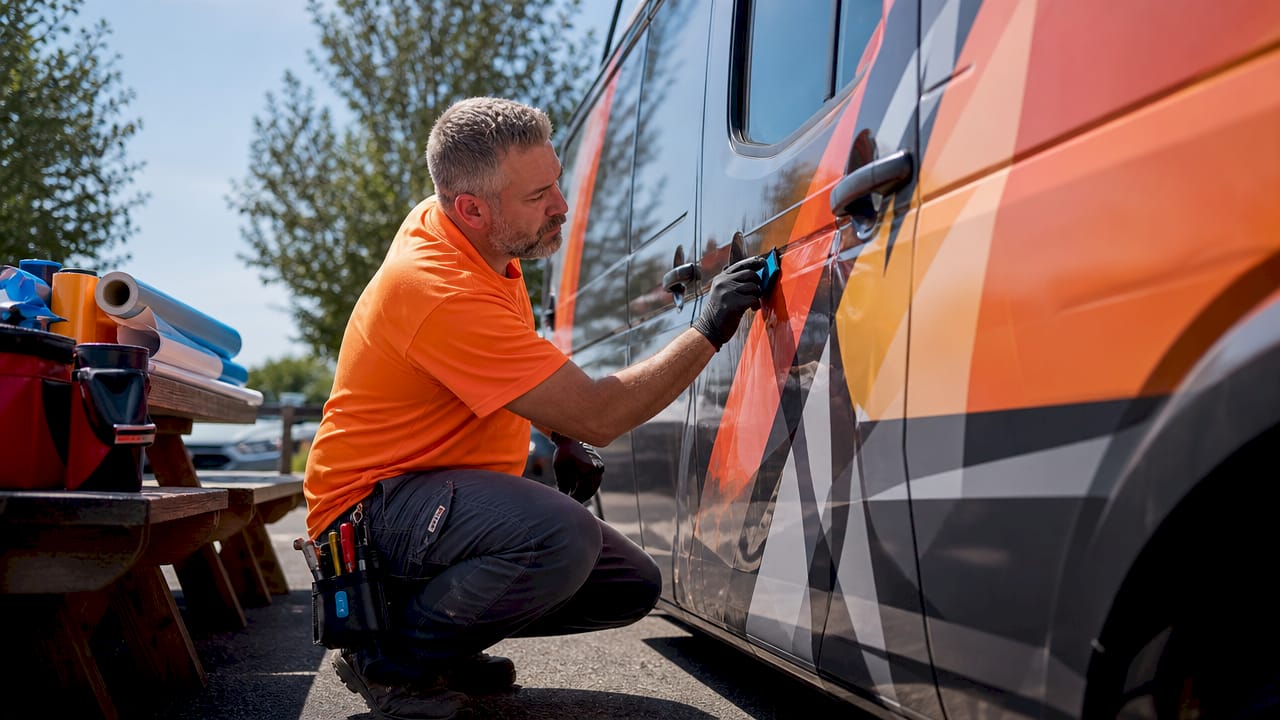
Custom wrap patterns, including geometric grids, abstract color fields, and camo-inspired textures, create visual energy that plain color wraps cannot. These patterns work best as background elements that frame, rather than compete with, the brand name and contact information. A well-executed geometric pattern on a white van makes the vehicle memorable without sacrificing readability. Businesses in creative industries, fitness, or tech often use abstract patterns to signal personality before a prospect reads a single word.
10. Strategic rear-door placement for maximum dwell time
Viewers at a red light can hold attention on a wrapped vehicle’s rear for 30–90 seconds. That dwell time is longer than most digital ad exposures. Placing your phone number, website, and primary call to action on the rear doors captures that attention at its peak. Front and side panels build awareness, but the rear converts it into contact.
Pro Tip: Use a dedicated phone number on your rear wrap panel. It lets you track exactly how many calls come from fleet advertising and calculate your actual cost per lead.
How to design wraps that work on moving vehicles
The 2-to-3-second rule governs every effective fleet wrap design. A viewer in motion has roughly two to three seconds to absorb your brand message before the vehicle passes. Every design decision must serve that constraint.
The core principles for readable, high-impact wraps are:
- Font choice: Use large, bold sans-serif typefaces. Script and decorative fonts fail at speed.
- Color contrast: Pair light text on dark backgrounds or dark text on light backgrounds. Mid-tone combinations disappear.
- Message limit: Show your company name, one primary service, and one contact method. Three items maximum.
- Visual hierarchy: Company name largest, phone number second, service descriptor smallest.
- Layout consistency: Apply the same layout grid across all vehicle types in the fleet.
Overly creative designs that prioritize aesthetics over clarity dilute brand recall. A viewer who finds a wrap visually interesting but cannot identify the company name in three seconds has seen an art project, not an advertisement. Professional design services ranging $300–$1,000 produce print-ready templates scaled correctly for each vehicle’s contours and panel breaks. That investment prevents costly reprints caused by distortion or misaligned graphics.
Cost considerations and lifecycle management for fleet wraps
Fleet wrap budgets must account for more than the vinyl and installation. Add 10–15% of the wrap cost for pre-installation prep, ongoing maintenance, and eventual removal. Skipping proper surface preparation is the leading cause of premature wrap failure, including lifted edges and adhesive loss.
| Wrap type | Cost per vehicle | Lifespan | Best for |
|---|---|---|---|
| Spot graphics | $500–$1,500 | 3–5 years | Older vehicles, budget fleets |
| Partial wrap | $1,500–$3,000 | 5–7 years | Small fleets, cost-conscious brands |
| Full wrap | $2,500–$5,000 | 5–7 years | High-traffic fleets, full brand immersion |
Maintenance directly affects lifespan. Washing every 1–2 weeks and conducting monthly inspections prevent the edge lifting and surface degradation that force early replacement. Schedule installations during planned vehicle maintenance windows to avoid pulling vehicles from service unexpectedly.
For large fleets, volume discounts of 15–25% are available when ordering 10 or more vehicles from a single installer. Reusing a base design template across the fleet reduces per-vehicle design fees further. Track wrap ROI using dedicated call-tracking numbers and vanity URLs printed on each vehicle. That data tells you which routes, vehicle types, and design placements generate the most leads.
Fleet wraps should be managed as infrastructure, not decoration. Businesses that schedule maintenance, track leads, and plan replacements in advance consistently outperform those that treat wraps as a one-time purchase.
Situational recommendations by fleet size and marketing goal
The right wrap strategy depends on your fleet size, vehicle age, and what you need the advertising to accomplish.
- Single vehicle: A full wrap delivers the highest return per vehicle. Every panel works for you on every route.
- Small fleet (2–5 vehicles): Partial wraps across all vehicles generate broader geographic coverage than one fully wrapped unit. Consistency across the set matters more than individual impact.
- Large fleet (6+ vehicles): Prioritize template consistency and negotiate volume pricing. A unified look across dozens of vehicles builds brand authority that no single vehicle can achieve alone.
- Older or near-replacement vehicles: Use spot graphics and decals. Full wraps on vehicles with less than two years of service life rarely recover their cost.
- Eco-focused brands: Specify sustainable vinyl materials. The material choice reinforces brand positioning with every viewer.
- Lead generation goal: Add QR codes, vanity URLs, and dedicated phone numbers. Make every wrap trackable.
- Pure brand awareness goal: Invest in specialty finishes and bold custom wrap patterns. Memorability matters more than direct response.
Interactive features like QR codes and NFC tags perform best in urban markets with frequent stop-and-go traffic. Rural routes with higher speeds favor simpler designs with larger text and fewer interactive elements. Explore fleet vehicle customization ideas to see how design choices shift across different fleet contexts.
Key takeaways
The most effective fleet wrap designs combine message clarity, material quality, and consistent branding across every vehicle to generate measurable returns over a 5–7 year lifecycle.
| Point | Details |
|---|---|
| Prioritize the 2-to-3-second rule | Design every wrap so the brand name and contact info read in under three seconds. |
| Match wrap type to fleet size | Full wraps for single vehicles; partial wraps for small fleets; templates for large fleets. |
| Budget for the full lifecycle | Add 10–15% for prep, maintenance, and removal beyond the base wrap cost. |
| Track ROI with dedicated numbers | Use unique phone numbers and vanity URLs to measure leads from each vehicle. |
| Maintain wraps on a schedule | Wash every 1–2 weeks and inspect monthly to protect a 5–7 year lifespan. |
What I’ve learned from years of fleet wrap consulting
After working with dozens of fleet managers across New Jersey, the single most common mistake I see is prioritizing creativity over clarity. A business owner falls in love with a bold abstract design, and the installer delivers exactly what was requested. Six months later, the client wonders why the phones are not ringing. The wrap looks great in photos. It fails on the road because nobody could read the company name at 40 miles per hour.
The businesses that get the best results treat their wraps like infrastructure. They set a maintenance schedule on day one. They use a dedicated tracking number on every vehicle. They reuse the same design template across the entire fleet so the brand compounds with every vehicle added. When I see a fleet of ten vans all wearing the same clean, readable design, I know that company has figured it out.
The other lesson that surprises most fleet managers: rear placement is worth more than they expect. Putting your phone number and website on the rear doors, where a driver behind you at a red light stares for 30–90 seconds, consistently outperforms the same information on the side panels. That one placement decision can double the number of trackable leads from a wrap campaign.
Invest in professional design from the start. A $500 design fee that prevents one reprint pays for itself immediately. And treat the wrap as a five-year brand asset, not a one-time expense. The businesses that think that way are the ones still running the same fleet wraps five years later because they maintained them properly and the ROI never stopped.
— Krunal
Njvinylwrapz can put your brand on every road in New Jersey
Njvinylwrapz has spent over 10 years wrapping commercial fleets and business vehicles across New Jersey, using premium materials from 3M and Avery with expert installation in climate-controlled facilities. Whether you need spot graphics for a single van or a unified design template rolled out across a 20-vehicle fleet, the team handles design, printing, and installation under one roof.
Flexible scheduling keeps your vehicles on the road and out of the shop for the minimum time possible. From full vehicle wraps to partial coverage and vehicle lettering, every solution is built to generate impressions and trackable leads from day one. If your fleet is not working as a branding asset yet, explore wrap options and see what a professional installation delivers.
FAQ
What do wrap designs typically cost for a commercial vehicle?
Spot graphics run $500–$1,500, partial wraps cost $1,500–$3,000, and full wraps range from $2,500–$5,000 per vehicle. Add 10–15% of the wrap cost for preparation, maintenance, and eventual removal.
How long do vehicle wraps last on fleet vehicles?
Premium vinyl wraps from materials like 3M and Avery last 5–7 years with proper care. Washing every 1–2 weeks and monthly inspections are the primary factors that determine whether a wrap reaches its full lifespan.
What is the most effective wrap design for brand recognition?
Consistent branding across all fleet vehicles, using the same color palette, logo placement, and font, builds recognition faster than unique designs per vehicle. The 2-to-3-second rule applies to every design: the brand name and contact info must read clearly in under three seconds.
How do I measure ROI from fleet wrap advertising?
Use dedicated call-tracking phone numbers and vanity URLs printed on each vehicle. These tools attribute leads directly to specific vehicles and routes, giving you a clear cost-per-lead figure to compare against other advertising channels.
Are volume discounts available for large fleet wrap orders?
Fleets of 10 or more vehicles qualify for volume discounts of 15–25% when negotiating with professional installers. Reusing a base design template across the fleet reduces per-vehicle design costs further.