

Mobile billboard marketing puts your message on a vehicle and drives it to the people you want to reach. A business can rent a billboard truck by the day, or it can wrap the vehicles it already runs, so every job, delivery and service call carries the brand. If you already own vans, box trucks or trailers, the second route turns vehicles you are paying for anyway into advertising that works every day they are on the road. We wrap commercial fleets from our shop in Tinton Falls and can walk you through it at (732) 486-1000.
TL;DR
- A mobile billboard is an ad on a moving vehicle. You choose where and when it appears instead of relying on one fixed sign location.
- Rented billboard trucks are priced per day and route. One 2026 U.S. guide lists roughly $800 to $3,000 per day.
- A wrapped work vehicle is a mobile billboard that runs on your normal schedule, through the neighborhoods where your customers already live.
- Good mobile ads share the same rules: one message, big type, strong contrast and a clear next step.
- Parked advertising vehicles are regulated in some cities, so plan around local rules.
Table of Contents
- What mobile billboard marketing is and how it works
- Two ways to get a mobile billboard
- What mobile billboard advertising costs
- Where a fleet wrap fits in your marketing
- Design rules that make a mobile ad work
- Plan the route, or let your routes plan themselves
- Measuring what a mobile billboard delivers
- Rules and permits: know the local picture
- Full wrap, partial wrap or lettering?
- Why fleet managers choose a single shop
- Promo: put your fleet to work as a billboard
- Our perspective
- FAQ
- Sources
What mobile billboard marketing is and how it works
The Out of Home Advertising Association of America (OAAA), the trade body for outdoor advertising, describes mobile billboards as poster panels fixed to aerodynamically designed vehicles, with electronic and video-screen units also available. Advertisers can set the routes and buy as little as one truck for a day or a week.
That is the real advantage over a roadside sign: controllable mobility. A fixed billboard waits for traffic to pass it. A mobile one goes to the traffic: the rush-hour corridor, the shopping district, the job site neighborhood.
The same OAAA page says these units reach motorists and pedestrians in virtually any metropolitan market, and that they are used for conventions, concerts, sports, special sales and product introductions.
There are three common formats:
- Static trucks. A printed design on a large panel or on the vehicle body. The OAAA lists an approximate display size of 10 feet high by 22 feet wide on a 30-foot truck.
- Digital or LED trucks. Screens that can rotate messages or show video.
- Wrapped vehicles and trailers. The vehicle body itself carries the design. This is the format that fits a business with its own fleet.
Two ways to get a mobile billboard
The first is renting a dedicated advertising truck for a campaign. The second is making your own vehicles the media. The difference is mostly about time and cost.
| Rented billboard truck | Wrapped work vehicles | |
|---|---|---|
| Who drives it | A driver hired to circle a route | Your own crew, on real jobs |
| How you pay | Per day, route and campaign | One project, then the vehicle works for you |
| When it runs | Only the days you book | Every day the vehicle is on the road |
| Where it goes | Routes you plan | Your actual service area |
| Customer trust | An ad on a truck | A working crew at a real address |
A wrapped van parked outside a house in Freehold tells the neighbors that you are the company doing the work, and that carries more weight than a message from a stranger’s truck.
What mobile billboard advertising costs
AdQuick’s 2026 U.S. buying guide lists mobile billboards at roughly $800 to $3,000 per day, priced per route and day. It names market, location, format, flight length, seasonality, production and installation as the factors that move billboard costs.
Here is a simple example using those figures. A 20-day campaign at the low end of that range comes to $16,000. At the high end it comes to $60,000. Those are our calculations from the published daily range, not a quote from any provider. When the booked days end, the truck leaves.

A vehicle wrap is a different shape of spend. It is a one-time project for each vehicle, and the wrap then runs on every route the vehicle drives. We don’t publish wrap prices because the cost depends on vehicle size, coverage and design. Call us at (732) 486-1000 for a quote on your vehicles.
Where a fleet wrap fits in your marketing
One wrapped truck drives past thousands of people in a week. A fleet multiplies that, and the vehicles are already moving to jobs across Monmouth, Ocean and Middlesex counties. The audience is the one you actually sell to: homeowners, property managers and local businesses in your service area.
Here is how that looks by trade:
- HVAC, plumbing and electrical. The van is parked at the customer’s house for hours. A clear name, phone number and service line gets read by every neighbor.
- Landscaping and construction. Trucks and trailers sit at job sites for days, which gives sustained visibility on one street.
- Delivery, moving and food trucks. These vehicles cover many stops in a day and sit in traffic in towns like Red Bank and Toms River.
- Heavy equipment. Machinery on a site is visible to everyone passing by, and heavy machinery wraps put your name on it.
For more ideas on this approach, see our guide on fleet marketing ideas that turn vehicles into mobile ads.
Design rules that make a mobile ad work
The vehicle moves and the viewer has seconds. Planning guidance for mobile billboards, such as this advertising guide, comes down to one message, large type, strong contrast and a clear next step. These rules apply equally to a wrapped van.
- One message. Decide what the vehicle should say: your trade, your area and how to reach you.
- Large, readable type. Your company name and phone number should read from a car length away.
- High contrast. Light text on dark panels, or the reverse. Avoid busy backgrounds behind lettering.
- One clear next step. A phone number, a website or a QR code. Pick one or two, not five.
- Consistency across vehicles. The same colors, logo and layout on every unit makes a fleet recognizable.
Where a wrap goes wrong is usually the design, not the film. A crowded layout, a tiny phone number or a logo that disappears on a door handle seam wastes the vehicle. We design, print and install everything in-house, so the layout is built around the actual vehicle, including its panels, windows and door lines.
Plan the route, or let your routes plan themselves
With a rented truck, planning means picking corridors, venues and hours: rush-hour roads, arenas, festivals, campuses and retail zones. With your own fleet, your service routes decide where the ad runs. A useful exercise is to map where your vehicles spend the most time and ask whether the design suits those places.
For example, a lawn care company working around Toms River needs a design legible from a driveway and a street. A delivery fleet crossing Middlesex County on busy roads needs larger type and fewer words. If your vehicles also work in the New York and Pennsylvania tri-state area, keep the design simple enough to read at highway speed.
Measuring what a mobile billboard delivers
Outdoor advertising can be measured, though not always with a click counter. Two examples from the OAAA show what is possible when the budget supports it.
The OAAA reports that a McDonald’s campaign using more than 300 billboards with Waze geofencing generated 6.4 million mobile impressions and reached 1.9 million unique consumers over eight weeks, with more than 8,400 navigations. An OAAA case study for Nordstrom Rack used test-and-control methods and location data, and reported that a four-week campaign in Lancaster, Pennsylvania produced 454 incremental walk-ins and a 9.17% overall lift.
Those are national-brand campaigns with large budgets, so don’t expect their numbers for a local contractor. What carries over is the method: give people a way to tell you where they saw you.
- Put a dedicated phone number or a short web address on the vehicles.
- Add a QR code that points to a specific landing page.
- Ask every new caller, “How did you hear about us?” and log the answer.
- Compare inquiry counts in the weeks before and after the vehicles are wrapped.
Those four habits cost almost nothing. They tell you more than any generic reach estimate.

Rules and permits: know the local picture
Rules for mobile billboards vary a lot by city. Los Angeles, for example, prohibits parking mobile billboard displays on public streets or public land, with violations after the warning process punishable as misdemeanors with fines of $250 to $1,000. Austin’s ordinance on mobile billboards defines them as vehicle signs advertising a business unrelated to the vehicle owner’s primary business, and prohibits them within the city’s full-purpose jurisdiction.
The distinction in those rules matters for you. They target vehicles used mainly as advertising. A work vehicle carrying its own company’s branding, driving to and from real jobs, is a different thing. Still, rules differ by town, so if you plan to park a vehicle in a high-visibility spot for advertising rather than work, check with the municipality first. For a commercial vehicle, lettering and DOT numbers are also part of getting the vehicle road-ready, and we handle vehicle lettering alongside wraps.

Full wrap, partial wrap or lettering?
You don’t have to wrap every inch. Choose coverage by how much attention you need and how many vehicles you are branding.
- Full wraps cover the whole body in your design. They give the strongest impact, and on a box truck or trailer they create the largest billboard-style surface.
- Partial wraps cover selected areas, such as the rear and doors, with a smaller footprint.
- Lettering puts your name, phone number, license and DOT numbers on the vehicle in a clean, simple format.
For a growing business, one common path is to start with partial wraps on every vehicle so the fleet looks uniform, then move the highest-exposure vehicles to full wraps. You can see all the options on our wrap options page, and our 2026 wrap design ROI guide goes deeper on design choices.
Why fleet managers choose a single shop
The hard part of wrapping a fleet is not one vehicle. It is keeping ten or thirty looking identical while the trucks keep earning. Our process is set up around that:
- Phased installs keep most vehicles on the road while others are in the shop.
- A typical install takes 1 to 3 days per vehicle.
- Fleet volume discounts are available on larger orders.
- We keep your design files on record, so adding a new truck later is a quick reorder instead of a redesign.
- Design, printing and installation all happen in-house in a climate-controlled facility, using 3M and Avery Dennison cast vinyl.
Every install carries our 1-year labor warranty, and the film manufacturer’s material warranty applies on top of it. Material warranties vary by product, for example between printed wrap film and color change film. Details on how we run fleet projects are on our fleet wraps page.
Promo: put your fleet to work as a billboard
If you want the reach of mobile billboard advertising without booking a truck by the day, start with the vehicles you already own. We design, print and install fleet wraps, partial wraps, lettering and heavy machinery wraps for New Jersey businesses, and we’re licensed and insured with 10+ years of experience. See our fleet wraps service, or call (732) 486-1000 and tell us how many vehicles you run.
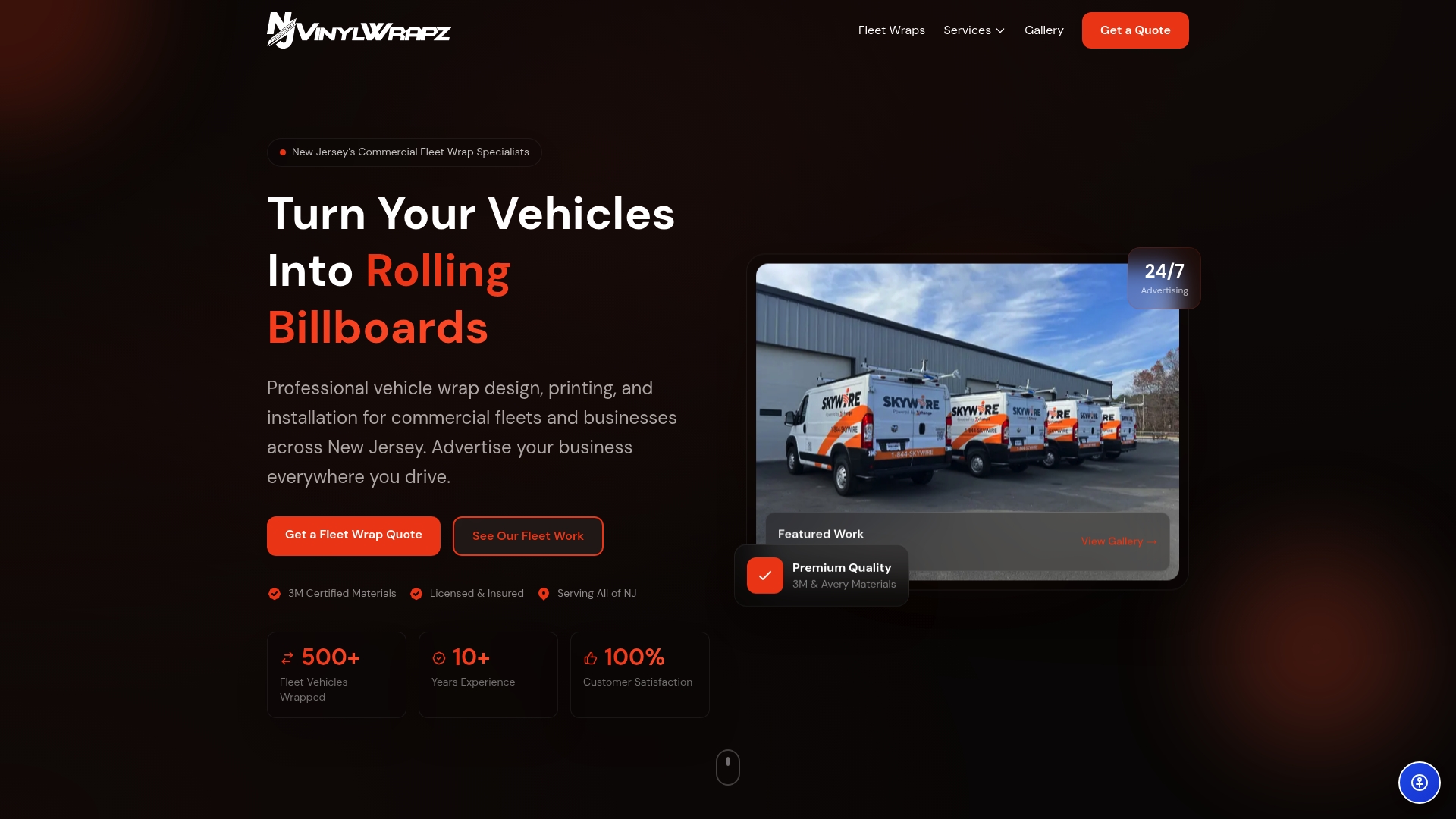
Contractors can also see how this works for their trades on our contractor van and truck wraps page.
Our perspective
We think of a wrapped vehicle as the most practical form of mobile billboard marketing a local business can run. A rented truck makes an impression on the days you pay for. A wrapped fleet makes one on every job, in front of customers you already serve.
What matters most is the design and the install. A layout built around the shape of the vehicle, printed and installed in one place, looks sharp for years. That is why we keep design, printing and installation in-house, and why we use 3M and Avery Dennison cast vinyl.
For fleets, consistency matters as much as the design itself. Phased installs keep most of your trucks working, and keeping your files on record means your next vehicle matches the last one.
NJ Vinyl Wrapz
FAQ
What is the difference between mobile billboard marketing and mobile billboard advertising?
They describe the same thing. Mobile billboard advertising is the ad format, a message carried on a vehicle. Mobile billboard marketing is how you use it: choosing the goal, the routes, the design and the way you measure the results.
How much does a mobile billboard cost?
One 2026 U.S. guide lists rented mobile billboards at roughly $800 to $3,000 per day, priced per route and day. A wrap on your own vehicle is a one-time project instead of a daily fee. We quote by vehicle and coverage, so call (732) 486-1000 for a number.
Do mobile billboards work for small businesses?
They work best when the message is simple and the audience is local. A contractor, cleaner or delivery business that wraps its vans puts its name and number in front of the neighborhoods it serves, every working day.
How long does it take to wrap a fleet vehicle?
The typical install is 1 to 3 days per vehicle. For larger fleets we phase the work so most vehicles stay on the road. We are open Monday to Saturday, 9am to 5pm, and you can request a free quote any time.
Sources
- Out of Home Advertising Association of America: Mobile Billboards
- AdQuick: Billboard Advertising guide
- Mobile billboard advertising planning guide
- OAAA: McDonald’s OOH Ads Geofenced to Waze
- OAAA: Nordstrom Rack OOH case study
- Los Angeles Municipal Code, Sec. 87.53
- City of Austin ordinance on mobile billboards