
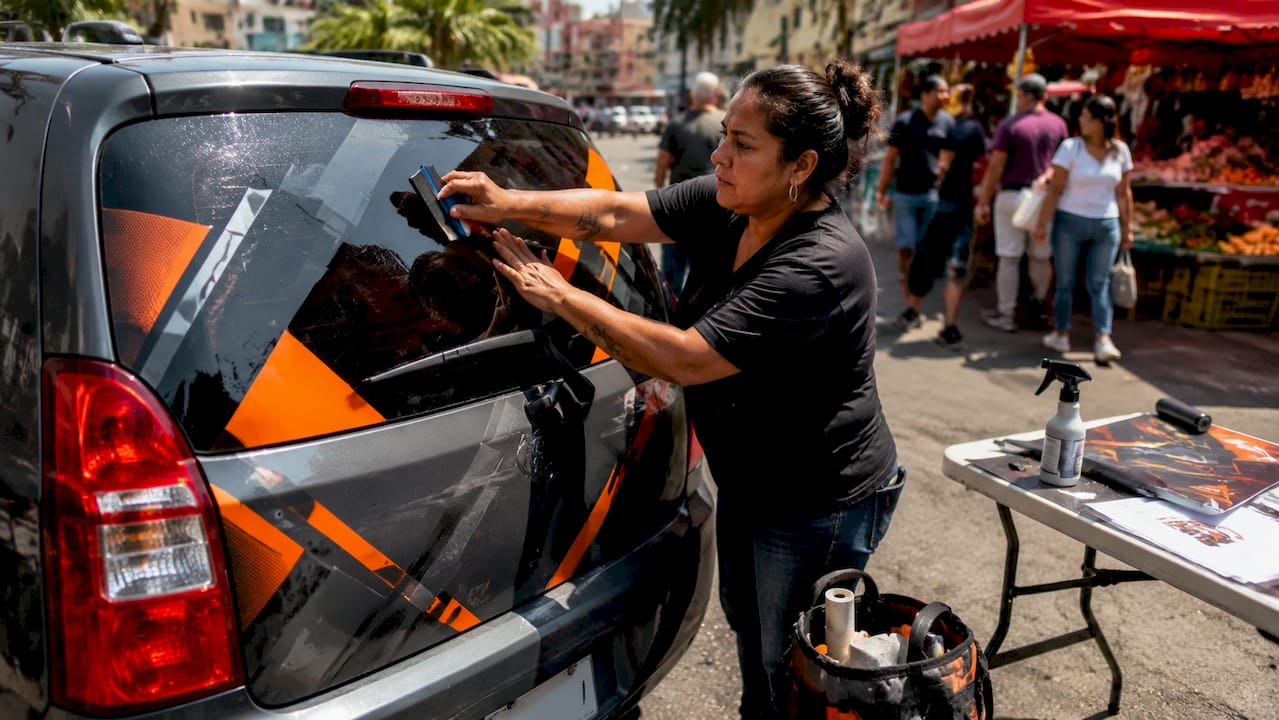
Custom decals are defined as adhesive graphics applied to vehicles, storefronts, packaging, and other surfaces to create persistent brand impressions without recurring ad spend. The role of decals in marketing goes far beyond slapping a logo on a bumper. Decals made from cast vinyl with UV lamination function as durable, mobile advertisements that work 24 hours a day, 7 days a week. A single vehicle decal costing under $5 delivers daily brand exposure to hundreds of potential customers with no ongoing cost. For small business owners and marketing managers, that math is hard to ignore.
How do decals enhance brand visibility vs. digital ads?
Decals in advertising occupy a unique position that paid digital channels cannot replicate. Physical decals reach customers in their natural environments rather than interrupting them mid-scroll. That distinction matters because digital ad fatigue is real. Consumers have trained themselves to ignore banner ads and skip pre-roll video. A decal on a delivery van parked outside a coffee shop does not trigger that same defensive reflex.
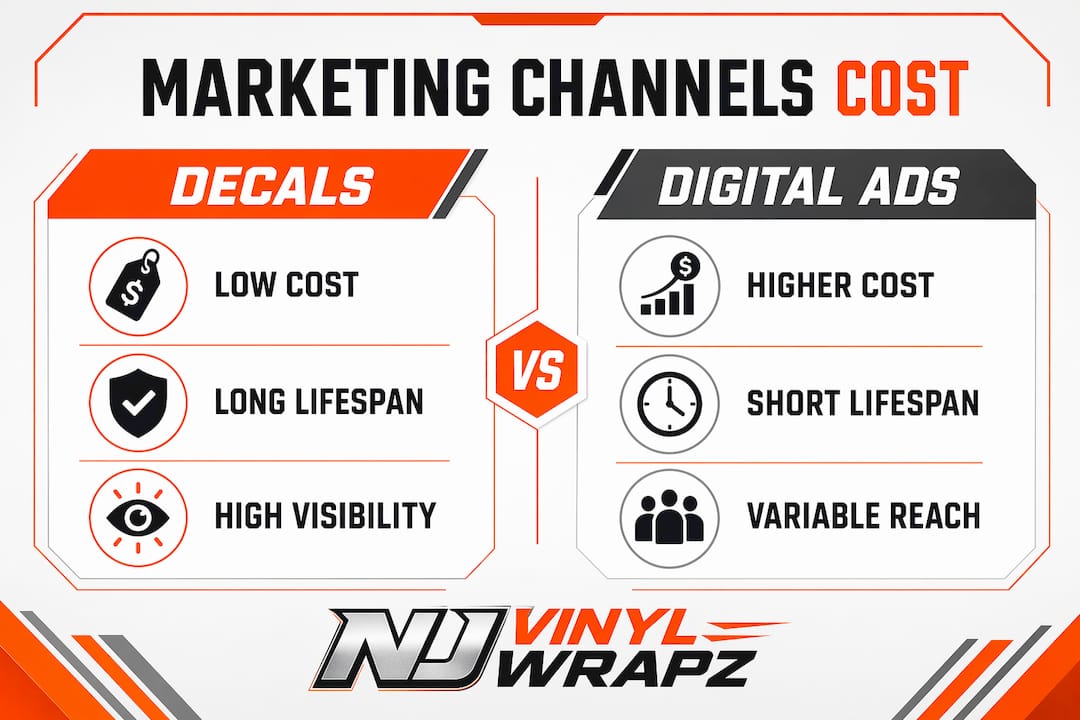
The cost comparison is equally striking. Small-format decals cost under $0.20 per unit at volume, producing a cost-per-thousand-impressions (CPM) that undercuts most paid social media placements by a wide margin. That gap widens further when you factor in the lifespan of a quality decal versus a 24-hour paid post.
Placement strategy amplifies these numbers significantly. Decals in high-dwell areas trigger organic social sharing, multiplying impressions by 3–10 times beyond the original placement. A well-placed window graphic on a busy New Jersey street corner does not just reach foot traffic. It gets photographed, shared, and seen by audiences the brand never paid to reach.
| Channel | Avg. CPM | Lifespan | Recurring Cost |
|---|---|---|---|
| Paid social media ads | $5–$30+ | 24–72 hours | Yes, per campaign |
| Digital display ads | $2–$10 | Days to weeks | Yes, per impression |
| Vehicle decal | Under $0.20/unit | 5–7 years | None after install |
| Window/storefront decal | Under $0.20/unit | 3–5 years | None after install |
Pro Tip: Place vehicle decals on your highest-mileage fleet vehicles first. Those units generate the most daily impressions per dollar spent and give you the fastest return on your investment.
Decal campaigns designed around audience movement and dwell time achieve deeper brand memory than simple exposure. A driver who sees your branded van at three different locations in one week builds a mental association that a single digital ad cannot create. Repetition through physical presence is one of the most underrated tools in a local marketing strategy.
What materials and design factors drive decal effectiveness?
Material choice is the single biggest variable in whether a decal campaign succeeds or fails. Cast vinyl and UV lamination double the lifespan of decals compared to standard options. That is not a minor upgrade. It is the difference between a graphic that looks sharp for five years and one that peels and fades after eighteen months.
Here is how the two primary vinyl types compare in practice:
- Cast vinyl conforms to complex curves and vehicle contours without lifting at the edges. It is the correct choice for full vehicle wraps and any application where the surface is not perfectly flat.
- Calendared vinyl is stiffer and less conformable. It works well on flat surfaces like windows, walls, and packaging but should not be used on curved vehicle panels.
- UV protective lamination adds a clear coat over the printed graphic, blocking ultraviolet light that causes color fading and surface degradation.
- Adhesive selection matters as much as the face material. Removable adhesives suit short-term promotions and rental fleets. Permanent adhesives are the right call for long-term fleet branding.
High-quality decals convey professionalism and brand authority, directly influencing consumer trust and perceived quality. This is what industry professionals call the “silent promise of quality.” When a consumer sees a crisp, well-finished graphic on a commercial vehicle, they draw conclusions about the business behind it before a single word is spoken.
Design decisions carry equal weight. Logos alone rarely perform well as standalone decals. The most effective custom decals for marketing go beyond the logo to create a visual artifact people actually want to display. Think bold typography, unexpected color combinations, or a clever visual concept tied to the brand’s personality. Voluntary display on laptops and water bottles extends brand reach organically, turning customers into unpaid brand ambassadors.

Pro Tip: Commission a designer to create a decal version of your brand that works as a standalone graphic, not just a logo lockup. Decals people find visually interesting get displayed voluntarily, generating earned media at zero additional cost.
What are the practical applications of decals for small businesses?
Vinyl decals are versatile marketing tools usable across vehicles, storefronts, floors, packaging, and trade shows. Each surface type serves a different function in the overall brand visibility strategy.
- Vehicle wraps and lettering. A company vehicle becomes a mobile billboard the moment a decal or wrap goes on. A single branded van traveling 30,000 miles per year in a metro area like New Jersey generates millions of impressions annually. Fleet managers who brand every vehicle in their fleet multiply that reach proportionally. You can explore fleet decal ROI in detail to understand the financial case.
- Window and storefront graphics. Window decals sustain brand visibility over time while also communicating hours, services, and promotions to foot traffic. A well-designed window graphic turns passive storefront space into active advertising real estate.
- Floor graphics. Floor decals in retail environments, trade show booths, and event spaces direct foot traffic and reinforce brand messaging at eye level when customers look down. They are particularly effective at point-of-sale locations.
- Packaging decals. Adding a branded decal to product packaging creates a tactile brand touchpoint that customers interact with directly. It also gives them a shareable artifact they may choose to display elsewhere.
- QR code integration. Custom stickers with QR codes connect offline decal marketing to online engagement, tracking campaign performance and driving traffic to landing pages or social profiles.
| Application | Primary Benefit | Best Surface | Typical Lifespan |
|---|---|---|---|
| Vehicle wrap/lettering | Mobile impressions | Painted vehicle panels | 5–7 years |
| Window graphics | Foot traffic conversion | Glass storefronts | 3–5 years |
| Floor graphics | Point-of-sale engagement | Smooth floor surfaces | 1–2 years |
| Packaging decals | Customer touchpoint | Cardboard, plastic | Single use |
| Event/trade show decals | Short-term brand presence | Walls, floors, tables | Days to weeks |
The most overlooked application is the promotional giveaway. Handing a well-designed decal to a customer at a trade show or event costs under $0.20 per unit. When that customer puts it on their laptop or water bottle, your brand travels with them into environments you could never buy access to through paid advertising.
How does decal marketing ROI compare to other ad channels in 2026?
Decal marketing ROI is best measured through cost-per-meaningful-impression (CPMI) rather than raw CPM. CPMI outperforms digital display ads and social media for local activation because it accounts for the quality and context of each impression, not just the volume. A person who sees your branded vehicle parked outside their gym three mornings a week has a fundamentally different experience than someone who scrolls past your ad in a feed.
The financial case for decals becomes clearer when you look at the full cost picture:
- A single vehicle decal or partial wrap costs a fraction of a monthly paid social budget and generates impressions for years without additional spend.
- A mobile business decal under $5 provides daily brand exposure to hundreds of potential customers with no recurring cost. Over a five-year lifespan, the cost per impression approaches zero.
- Full vehicle wraps require a higher upfront investment but deliver the highest impression volume of any single decal format. For fleet operators, the per-vehicle cost amortizes quickly across daily route mileage.
- Digital ad budgets reset to zero at the end of every billing cycle. A quality decal installed today is still generating impressions in 2031.
Understanding business vehicle decal costs and benefits helps marketing managers build a realistic budget case for decal campaigns. The key metric to track is not click-through rate. It is total impressions delivered over the full lifespan of the graphic divided by the one-time production and installation cost.
For local businesses in competitive markets, decal marketing fills a gap that digital channels leave open. Paid ads reach people online. Decals reach people in the physical spaces where they live, work, and make purchasing decisions.
Key takeaways
Decals deliver the lowest cost-per-meaningful-impression of any advertising format available to small businesses and fleet operators in 2026, with no recurring spend after installation.
| Point | Details |
|---|---|
| Cost efficiency is unmatched | Decals under $0.20 per unit generate years of impressions with zero recurring ad spend. |
| Material quality determines lifespan | Cast vinyl with UV lamination doubles decal lifespan compared to standard calendared vinyl. |
| Placement multiplies ROI | High-dwell locations increase organic social sharing, extending impressions by 3–10 times. |
| Design beyond the logo earns media | Visually compelling decals get voluntarily displayed, creating unpaid brand ambassador reach. |
| CPMI beats CPM for local marketing | Measuring meaningful impressions shows decals outperform digital display and social ads locally. |
What most marketers get wrong about decal campaigns
I have seen marketing budgets that allocate thousands of dollars to paid social ads and zero to vehicle graphics, even when the business runs a fleet of five vans through a densely populated market every single day. That is a missed opportunity that compounds over time.
The mistake I see most often is treating decals as an afterthought rather than a media channel. Businesses order a basic logo decal, slap it on the back of a vehicle, and call it done. That approach generates some impressions, but it leaves most of the value on the table. The brands that get real results from decal marketing treat it the same way they treat a paid campaign: with intentional design, strategic placement, and a clear goal for each surface.
The other underrated factor is earned media. Decal marketing is uniquely positioned as a form of earned media that customers choose to display voluntarily. No other advertising format works that way. When someone puts your sticker on their laptop, they are endorsing your brand to everyone who sees it. That is worth designing for deliberately.
My honest recommendation: treat your fleet vehicles as a media buy. Calculate the daily route mileage, estimate the impressions per mile in your market, and compare that number to what you are spending on digital ads. Most businesses find the math shifts their priorities quickly. For professional automotive photography that showcases your branded fleet at its best, resources like automotive commercial photography can help you document and amplify the visual impact of your decal investment.
— Krunal
Turn your fleet into a moving billboard with Njvinylwrapz
Njvinylwrapz has spent over 10 years transforming commercial vehicles across New Jersey into high-impact mobile advertising platforms. Every project uses premium 3M and Avery materials, installed in climate-controlled facilities by licensed professionals who understand what durable, brand-accurate graphics require.
Whether you need full vehicle wraps for your entire fleet or targeted vehicle lettering for a single van, Njvinylwrapz delivers graphics that hold up through New Jersey winters and high-mileage daily routes. You can also explore the full range of wrap options to find the format that fits your budget and brand goals. Contact Njvinylwrapz today to get a quote and put your fleet to work as a 24/7 advertising asset.
FAQ
What is the role of decals in marketing?
Decals function as durable, physical brand touchpoints that generate impressions on vehicles, storefronts, and packaging without recurring ad spend. They bypass digital ad fatigue by reaching consumers in real-world environments where they are more receptive to brand messaging.
Why use decals for branding instead of digital ads?
Decals cost under $0.20 per unit at volume and generate impressions for years, making their cost-per-impression far lower than most paid digital channels. They also reach audiences in physical spaces that digital ads cannot access.
What is the difference between cast vinyl and calendared vinyl for decals?
Cast vinyl conforms to curved surfaces like vehicle panels and lasts significantly longer, making it the correct choice for vehicle wraps and complex applications. Calendared vinyl is better suited to flat surfaces like windows and walls where conformability is not required.
How do you measure ROI for a decal marketing campaign?
The most accurate metric is cost-per-meaningful-impression (CPMI), which accounts for the quality and context of each impression rather than raw volume. Divide the total one-time production and installation cost by the estimated impressions delivered over the full lifespan of the graphic.
Can decals work alongside digital marketing campaigns?
Custom stickers with QR codes connect physical decal placements directly to online destinations, tracking engagement and driving measurable digital traffic. This integration lets you measure offline-to-online conversion and tie decal placements to specific campaign goals.