
Most fleet operators think of decals as finishing touches. Slap on the logo, add a phone number, and call it done. But that framing misses about 80% of why decals for fleets actually matter. Beyond the visual branding, fleet decals carry legal weight. They determine whether your vehicles pass roadside inspections, whether your company name is visible from the distance regulators require, and whether your trailers are conspicuous enough to avoid nighttime collisions. This guide covers all of it: what fleet decals are, what the law requires, how to design them well, and how to calculate real return on investment.
Table of Contents
- Key takeaways
- Why decals for fleets go beyond branding
- What are custom fleet decals
- Regulatory compliance and fleet decals
- Branding and marketing advantages
- How to design and maintain fleet decals
- Cost comparison: decals versus other fleet graphics
- My take on decals after a decade in fleet graphics
- Get your fleet decals done right with Njvinylwrapz
- FAQ
Key takeaways
| Point | Details |
|---|---|
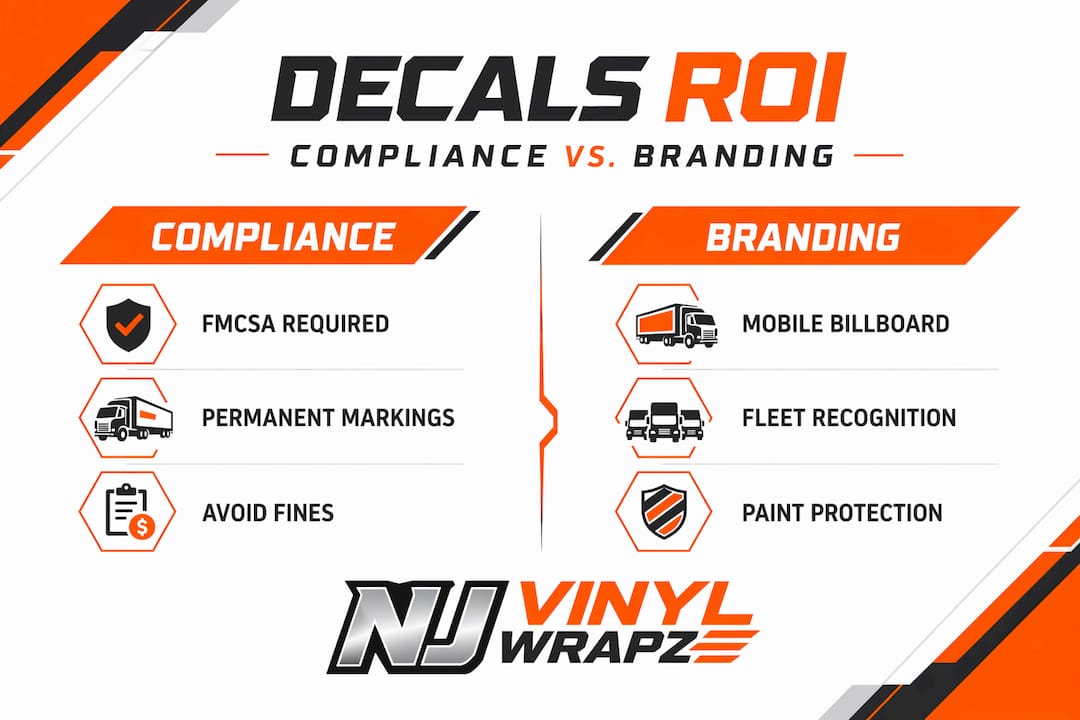
| Decals are compliance tools | FMCSA requires permanent markings with your DOT number and company name visible from 50 feet. |
| Magnetic signs don’t cut it | Removable signs fail DOT inspections because federal law requires permanent vehicle markings. |
| Design choices affect legality | Font size, color contrast, and placement are regulated, not just aesthetic preferences. |
| Decals protect your paint | High-quality vinyl shields vehicle surfaces from UV damage, extending resale value. |
| ROI goes beyond marketing | Avoided fines, lower accident risk, and longer vehicle life all factor into the financial case. |
Why decals for fleets go beyond branding
When fleet managers ask about decals for business vehicles, the conversation usually starts with logos and colors. That’s understandable. Brand consistency across a 10, 20, or 50-vehicle fleet is genuinely valuable. But the question of why to use fleet stickers runs deeper than marketing.
FMCSA regulations mandate that every commercial motor vehicle operating in interstate commerce display the carrier’s legal name (or DBA) and USDOT number on both sides of the vehicle. That lettering must be legible from 50 feet during daylight. That’s a federal compliance requirement, not a branding choice. Vehicles that skip this, or use removable magnetic signs instead of permanent markings, are operating illegally.
The advantages of fleet graphics, then, cover three distinct territories: marketing and brand recognition, regulatory compliance, and vehicle safety. The best fleet decal programs address all three at once. That’s the frame you should carry through every decision you make about your fleet’s graphics.
What are custom fleet decals
A fleet decal is a cut or printed vinyl graphic applied directly to a vehicle’s painted surface. What is custom fleet decals as a category? It covers everything from a single logo on a door panel to a multi-panel graphic system that includes company name, USDOT number, service information, and reflective safety tape, all designed to work together as a cohesive system.
Understanding how decals compare to other vehicle graphics helps you make smarter choices:
- Full vehicle wraps cover the entire painted surface with a printed vinyl film. They deliver the most visual impact and the most paint protection but cost significantly more per vehicle.
- Partial wraps cover specific panels, typically the hood, sides, or rear. They balance visual impact and cost, making them a popular option for service fleets.
- Fleet decals cover specific graphic elements such as logos, lettering, DOT numbers, and safety markings. They’re the most targeted and cost-effective option for compliance-focused applications.
- Magnetic signs attach to the vehicle temporarily and are easy to swap between vehicles. However, magnetic signs fail DOT inspections because federal standards require permanent markings.
For most commercial fleets, the smartest approach combines elements. Full fleet wraps on high-visibility vehicles, partial wraps or premium decals on utility vehicles, and consistent DOT compliance markings across every unit. Custom fleet decals give you the flexibility to apply the right solution to each vehicle type without rebuilding your entire graphics program from scratch.
Regulatory compliance and fleet decals
This is where many operators get into trouble, and it’s one of the strongest arguments for using professional, permanent decals on every commercial vehicle you operate.
FMCSA-required lettering must be at least 2 inches tall and must contrast sharply with the vehicle background. That’s not optional and it’s not a suggestion. Here’s what compliance actually requires across your fleet:
- USDOT number displayed on both sides of the vehicle cab
- Legal name or DBA name, also on both sides
- Minimum 2-inch letter height with strong color contrast against the background
- Characters legible from 50 feet during daylight hours
- For trailers 80 inches wide or wider with a GVWR above 10,001 lbs: DOT-C2 reflective tape on the sides and rear, covering at least 50% of trailer side length in alternating red and white patterns
That last point matters more than most operators realize. Using generic reflective tape instead of DOT-C2 certified material is a compliance violation on its own. Non-certified reflective tape lacks the micro-prismatic technology required under FMVSS 108 standards. It looks similar but fails inspections.
Pro Tip: When ordering reflective tape or decals for trailer marking, always verify that the supplier provides DOT-C2 certified material. Ask for the certification documentation before purchasing, especially when sourcing from unfamiliar vendors.
The compliance case for quality fleet decals goes further. Reflective conspicuity tape improves trailer visibility from up to 700 feet away, significantly reducing nighttime crash risk. Federal mandates around this have been in place since the 1990s for exactly that reason. A decal program that gets this right isn’t just keeping your fleet legal. It’s reducing the chance that one of your drivers is involved in a preventable collision.
Fleet decals also serve as safety and compliance assets that reduce fleet downtime and avoid fines. An Out of Service violation at a weigh station doesn’t just cost the fine. It takes that vehicle off the road until the violation is corrected, which means delayed deliveries, driver idle time, and administrative headaches.

Branding and marketing advantages
Now for the part most operators are more comfortable discussing. The benefits of fleet decals for marketing are real and they’re measurable in ways that most advertising channels can’t match.
A branded fleet vehicle is a mobile billboard that works every hour the vehicle is on the road. Unlike a paid ad that stops running when the budget runs out, a well-applied decal keeps generating impressions for years. For service businesses operating in specific geographic areas, this kind of local visibility is exceptionally efficient. Your customers see your trucks in their neighborhoods, at job sites, and in traffic. That repetition builds recognition.
Consistent branding across your fleet reinforces that recognition. When every vehicle carries the same colors, logo placement, and typography, you’re communicating organizational scale and reliability without saying a word. That consistency signals to potential customers that yours is a serious, professional operation.
Pro Tip: Don’t treat decal placement as an afterthought. The same graphic applied to different vehicle types (vans, trucks, box trucks) often requires re-sizing and repositioning to look intentional. Work with a designer who understands vehicle templates before you print anything.
High-quality vinyl also carries a benefit that operators rarely account for upfront. Vinyl decals and wraps protect vehicle paint from UV damage, scratches, and minor surface abrasions. For a fleet that keeps vehicles for five to ten years, that protection translates into better resale values. The premium vinyl benefits for fleet vehicles compound over time, making the initial graphics investment return value through the vehicle’s working life.
How to design and maintain fleet decals
The practical side of running a successful fleet decal program comes down to three stages: design, installation, and ongoing maintenance. Getting any one of these wrong undermines the others.
Design fundamentals:
- Start with compliance requirements as your design constraints, not your afterthoughts. Know your minimum letter heights, placement zones, and contrast requirements before you choose a color palette.
- Choose fonts that read clearly at distance. Arial or Helvetica style fonts at 2 to 3.5 inches are widely used for USDOT compliance lettering because they maximize legibility.
- Test your designs at scale before printing. A logo that looks great on screen can lose detail when printed at 12 inches across a door panel.
- Specify material in your design brief. Reflective vinyl for safety-critical markings, cast vinyl for curved surfaces, calendered vinyl for flat panel applications.
Installation:
- Clean and prepare surfaces before application. Adhesion failure almost always traces back to surface contamination, wax residue, or temperature issues during installation.
- Follow manufacturer temperature guidelines. Most vinyl adhesives require application between 50°F and 90°F for proper bonding.
- Document placement measurements for each vehicle type in your fleet. This ensures replacements go back in exactly the right position.
Maintenance:
- Inspect decals quarterly. Look for lifting edges, fading, cracking, and any lettering that’s become illegible.
- Clean with pH-neutral soap and water. Avoid high-pressure washers directed at decal edges, which accelerates lifting.
- Replace compliance markings as soon as degradation is visible. A faded USDOT number is still a violation, even if the number is technically present.
Pro Tip: Build decal inspection into your regular vehicle maintenance schedule, not as a separate task. When the vehicle goes in for its 6-month service, the technician checks tires, fluid, and decal condition together. It takes five minutes and keeps you ahead of compliance issues.
Cost comparison: decals versus other fleet graphics
Understanding where decals fit financially helps you allocate your graphics budget across a mixed fleet.
| Solution | Approximate cost per vehicle | Lifespan | Best for |
|---|---|---|---|
| Compliance decals only | $50–$200 | 3–5 years | Vehicles needing DOT markings only |
| Partial wrap with decals | $500–$1,500 | 5–7 years | Delivery vans, service trucks |
| Full vehicle wrap | $2,500–$5,000+ | 5–7 years | High-visibility marketing vehicles |
| Magnetic signs | $50–$150 | 1–3 years | Fails DOT compliance; not recommended |
A few things to note from that comparison. Magnetic signs cost almost the same as compliance decals upfront but fail regulatory standards and need more frequent replacement. Temporary markings fail many DOT inspections outright. The apparent savings disappear when you factor in the risk of fines and the cost of repeated replacement.
For most fleets, the smart strategy is layered. Use compliance decals on every vehicle as a non-negotiable baseline. Add partial wraps or full graphics packages to your highest-visibility vehicles, where marketing ROI justifies the investment. That approach lets you maintain full compliance across the fleet while concentrating branding spend where it generates the most impact.
My take on decals after a decade in fleet graphics
I’ve worked with fleet operators at every scale, from owner-operators running two trucks to regional companies managing 80-vehicle fleets. And the pattern I keep seeing is the same one in both directions: operators who treat decals as a box-checking exercise, and operators who treat them as a real management tool.
The ones who get it right aren’t necessarily spending more money. They’re spending it more deliberately. They know which vehicles need reflective tape for trailer compliance. They’ve got a maintenance schedule that catches fading USDOT numbers before an inspection catches them first. And they’ve designed their branding graphics to work with their compliance requirements rather than around them.
The misconception that consistently causes problems is the belief that “something is better than nothing.” I’ve seen fleets that had magnetic signs on vehicles doing interstate hauls, assuming that having a company name visible at all was sufficient. It isn’t. The standard is permanent, legible, and regulation-sized. Anything short of that is a liability, not a branding asset.
The operators I respect most treat their vehicle lettering and decal program as part of fleet identity, the same way they treat uniforms, dispatch protocols, and maintenance schedules. It’s not decorative. It’s operational.
— Krunal
Get your fleet decals done right with Njvinylwrapz
If this article has made one thing clear, it’s that fleet decals carry real operational stakes. Getting the design, materials, and installation wrong doesn’t just look bad. It can put your vehicles out of service.

Njvinylwrapz has spent over 10 years helping New Jersey fleets get their graphics right the first time. From DOT compliance lettering to full fleet wrap packages, the team handles custom design, premium material sourcing (3M and Avery certified), and expert installation in climate-controlled facilities. Whether you’re outfitting one vehicle or sixty, Njvinylwrapz delivers consistent results with fast turnaround times. Reach out today for a consultation and get a quote that covers your entire fleet.
FAQ
What is a fleet decal?
A fleet decal is a vinyl graphic applied permanently to a commercial vehicle, typically displaying company branding, contact information, and regulatory markings such as USDOT numbers. Unlike magnetic signs, fleet decals meet federal permanence requirements for commercial vehicle markings.
Are decals required by law on commercial vehicles?
Yes. FMCSA regulations require interstate commercial vehicles to display the carrier’s name and USDOT number on both sides in lettering at least 2 inches tall, visible from 50 feet. Permanent decals are the standard method for meeting this requirement.
Can I use magnetic signs instead of decals for DOT compliance?
No. Magnetic signs fail DOT compliance standards because federal regulations require permanent markings. Removable signs can detach at highway speeds and may be illegible, making them a citation risk at roadside inspections.
How long do fleet decals last?
Quality vinyl fleet decals typically last between three and seven years depending on material grade, installation quality, and environmental exposure. Compliance markings should be inspected quarterly and replaced as soon as lettering becomes faded or illegible.
What reflective tape is required for trailers?
Trailers 80 inches or wider with a GVWR above 10,001 lbs must display DOT-C2 certified tape in alternating red and white patterns covering at least 50% of the trailer’s side length. Generic reflective tape does not meet FMVSS 108 standards and will result in violations.