
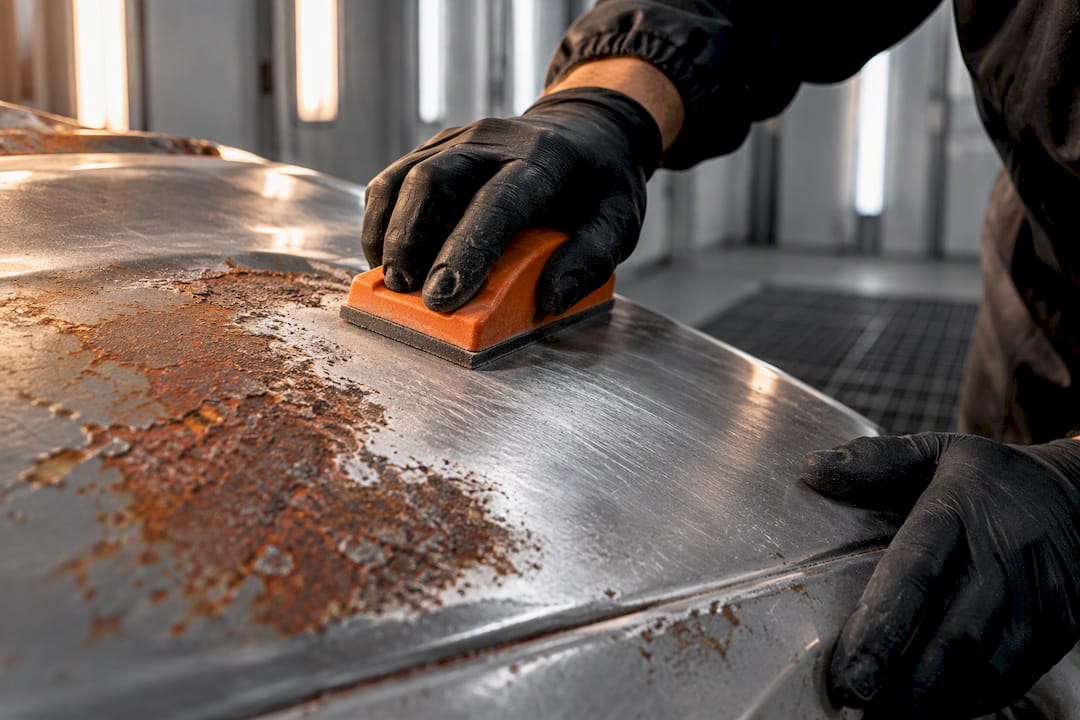
You can’t wrap over active rust, full stop. Vinyl needs a smooth, high-energy surface to bond to, and corrosion is porous, flaky, and chemically hostile to adhesive. Once you sand down to sound metal, treat what’s left, and lay down proper epoxy primer with full cure time, that same panel becomes wrap-ready. Skip the repair and the film traps moisture against the metal, which speeds up the very corrosion you’re trying to hide.
TL;DR:
- Rust must be fully removed or converted and sealed with epoxy primer before wrapping, or the film will fail prematurely due to inadequate adhesion.
- Wrapping over active rust or unprepared corrosion voids manufacturers’ warranties and causes the vinyl to lift, bubble, and peel within months.
- Proper surface preparation involves sanding to clean, sound metal, applying rust converter if applicable, and respecting primer cure times for longevity.
- Covering a repaired panel with a high-quality primer can enable a wrap to last five to seven years, provided moisture and residue are carefully managed beforehand.
- Inspections should verify absence of soft spots, bubbling, or lifting, and include proper priming and curing steps to avoid early failure and costly repairs later.
Table of Contents
- Why Rust Stops a Wrap From Working
- What Manufacturers and Technical Bulletins Say
- How Do You Prep a Rusty Spot Before Wrapping?
- How Long Will a Wrap Last Over a Repaired Panel?
- Repair, PPF, or Wrap: Which Fix Actually Makes Sense?
- What Pros Check Before Saying Yes to a Wrap
- Why Most Rust Advice Online Gets This Backwards
- Get Your Panels Inspected Before You Commit to a Wrap
- Technical Bulletins and Resources Worth Reading
- Sources
- FAQ
Why Rust Stops a Wrap From Working
Vinyl adhesive is built to grip a smooth, high-energy substrate, like factory paint or a properly primed panel. Rust is the opposite: rough, low-energy, and full of microscopic pits. Instead of wetting out evenly across the surface, the adhesive beads up on the loose oxide layer and grabs a texture that’s already failing on its own.
That mismatch causes three predictable problems:
- Poor initial adhesion. The film never fully bonds, so edges lift within weeks instead of years.
- Trapped moisture. Vinyl seals the surface like plastic wrap on a sandwich, and any moisture caught underneath has nowhere to go, which accelerates the corrosion already in progress.
- Delamination during removal. When the wrap finally gets pulled, chunks of paint and primer come with it, often exposing corrosion that had spread further than anyone realized.
Installers call this “paint pull,” and it’s one of the most common reasons a simple wrap job turns into an unplanned bodywork bill. The film essentially becomes a lid on a slow-cooking problem.
What Manufacturers and Technical Bulletins Say
3M’s own installation guidance is direct on this point: films should never go over corrosion or bare carbon steel, and doing so is grounds for a voided warranty. That’s not a suggestion buried in fine print. It’s a core installation rule that shows up in the vehicle preparation guide every certified installer is trained on.
A few things installers watch closely because of this:
- Substrate condition. Bare steel or active corrosion disqualifies a panel from film application until it’s repaired.
- Cure and outgassing windows. Fresh primer and paint release solvent vapor for a period after application, and applying film too soon traps that vapor under the vinyl, causing bubbles days or weeks later.
- Minimum substrate temperature. Cold panels won’t let adhesive activate properly, which matters as much on a repaired spot as anywhere else on the car.
Manufacturer bulletins also specify pre-install cleaning with 70% isopropyl alcohol immediately before film goes down, removing any wax, oil, or residue left from bodywork. Skip that step and even a well-repaired panel can fail early.
How Do You Prep a Rusty Spot Before Wrapping?
Small, cosmetic rust spots are fixable in an afternoon or two if you follow the right sequence. Deep or structural corrosion is a different matter entirely, but here’s the process for a legitimate surface repair.
- Classify the damage. Surface rust (light discoloration), scale (flaking with texture), and penetrating rust (holes or crumbling metal) each demand a different response. If you can push a screwdriver through it, this isn’t a sanding job anymore.
- Remove mechanically. Use a grinder or 80 to 120 grit sandpaper to strip heavy scale down to clean, sound metal, then step through finer grits, 180, then 320, then 400 or higher, to smooth the surface before priming.
- Decide on a rust converter. Converters work for light, shallow surface rust, but they still need sanding smooth afterward and sealing under primer. They are not a substitute for grinding out scale or structural corrosion.
- Apply epoxy primer. Epoxy seals bare metal with a non-porous base, block sand it level, and respect the manufacturer’s cure and outgassing window before touching it with film.
- Extend the vinyl past the repair edge. Overlapping the wrap slightly beyond the repaired area, with a clean seal, keeps moisture from creeping back in at the boundary.
Pro Tip: Never treat body filler as a rust fix on its own. Most fillers are porous, and without an epoxy seal underneath, they invite the same moisture problems you were trying to avoid.
How Long Will a Wrap Last Over a Repaired Panel?
Done right, a repaired and properly primed panel can hold a wrap for roughly the same 5 to 7 years you’d expect anywhere else on the car. That number assumes the repair actually reached bare, sound metal, and that primer cure times were respected before the film went on.
Cut corners on prep and that lifespan drops fast, sometimes to months instead of years. Removal is where things get ugly if the repair wasn’t solid: pulling a wrap off a still-compromised panel frequently causes paint pull and can reveal corrosion that has spread well beyond the original patch.
After installation, a quick visual check every few months catches problems early:
- Bubbling or lifting right at seam lines.
- Edges peeling away from the panel instead of lying flat.
- Soft or spongy spots under light pressure.
- Texture showing through the film that wasn’t visible at installation.
A good maintenance routine built around these checks will flag a failing repair long before it becomes a bigger problem.
Repair, PPF, or Wrap: Which Fix Actually Makes Sense?
The right call depends entirely on how deep the corrosion goes. Structural rust, holes, or anything affecting frame integrity needs panel repair or replacement first. No coating of any kind belongs on that until a body shop has addressed it.
For smaller cosmetic spots, the choice comes down to budget and goals:
- Repair, prime, then wrap. Best when you want a color change or branding alongside the fix, and you’re comfortable with the prep timeline.
- Repair, prime, then paint. Better for spot color matching on an otherwise stock vehicle.
- Paint Protection Film. PPF does not remediate rust; it protects a surface that’s already sound. Treat it as prevention, not a cure.
All three routes require the same non-negotiable first step: a clean, sealed substrate before anything goes on top of it.
What Pros Check Before Saying Yes to a Wrap
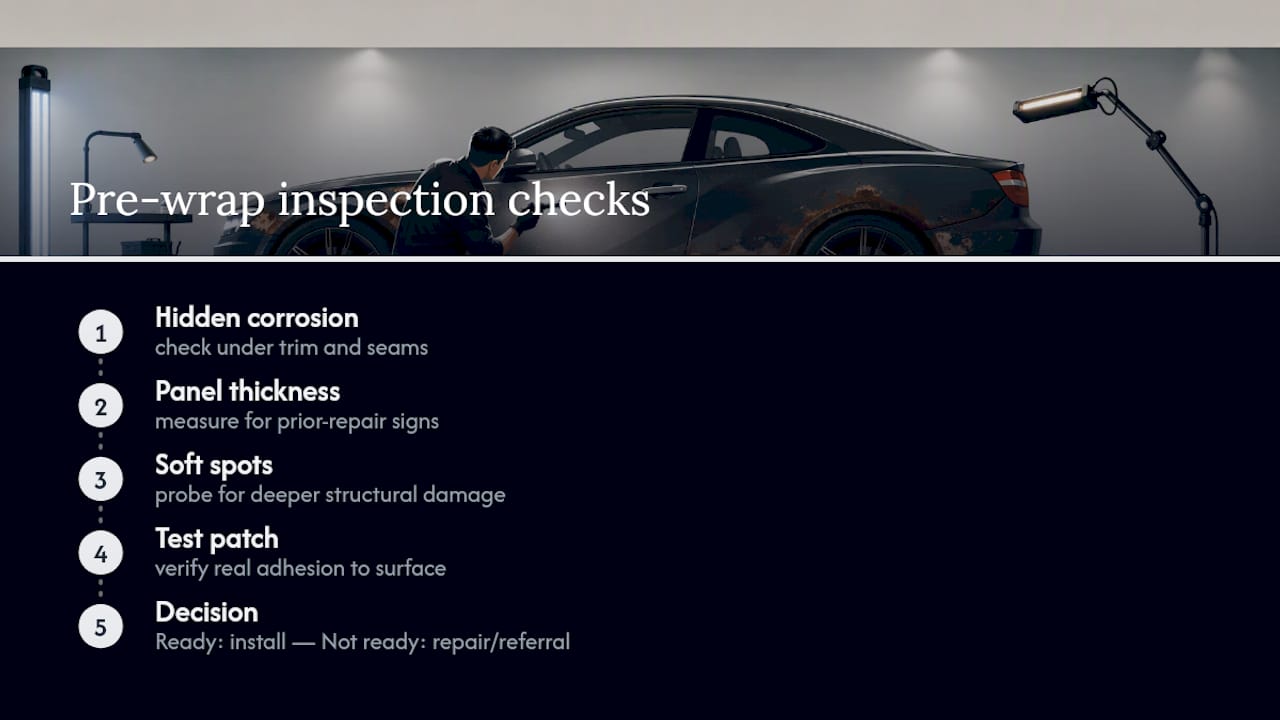
A pre-wrap inspection isn’t a formality. It’s the difference between a job that holds up for years and one that turns into a warranty dispute. Installers check for hidden corrosion under trim and seams, panel thickness that might signal prior repairs, soft spots that indicate deeper damage, and how well a test patch actually adheres to the surface.
Climate-controlled installation matters here too. Manufacturer materials from brands like 3M and Avery are engineered around specific cure windows and application temperatures, and an uncontrolled environment introduces exactly the variables those bulletins warn against.
When a panel isn’t ready, the honest answer is to say so. NJ Vinyl Wrapz can coordinate repair referrals, epoxy priming, and PPF alongside warranty-backed wrap installs, so the sequence happens in the right order instead of skipped for the sake of a faster turnaround.
Why Most Rust Advice Online Gets This Backwards
Most guides treat rust like a cosmetic inconvenience that a thick enough wrap can hide. That’s backwards. Rust is an active chemical process, and vinyl film doesn’t slow it down; it seals in moisture and speeds it up. Salt exposure over a winter can turn minor surface rust into something structural, and once film goes over that, you’ve hidden the evidence rather than solved the problem. Diamond Brite’s breakdown of salt-driven corrosion makes the same point from the maintenance side of the industry.
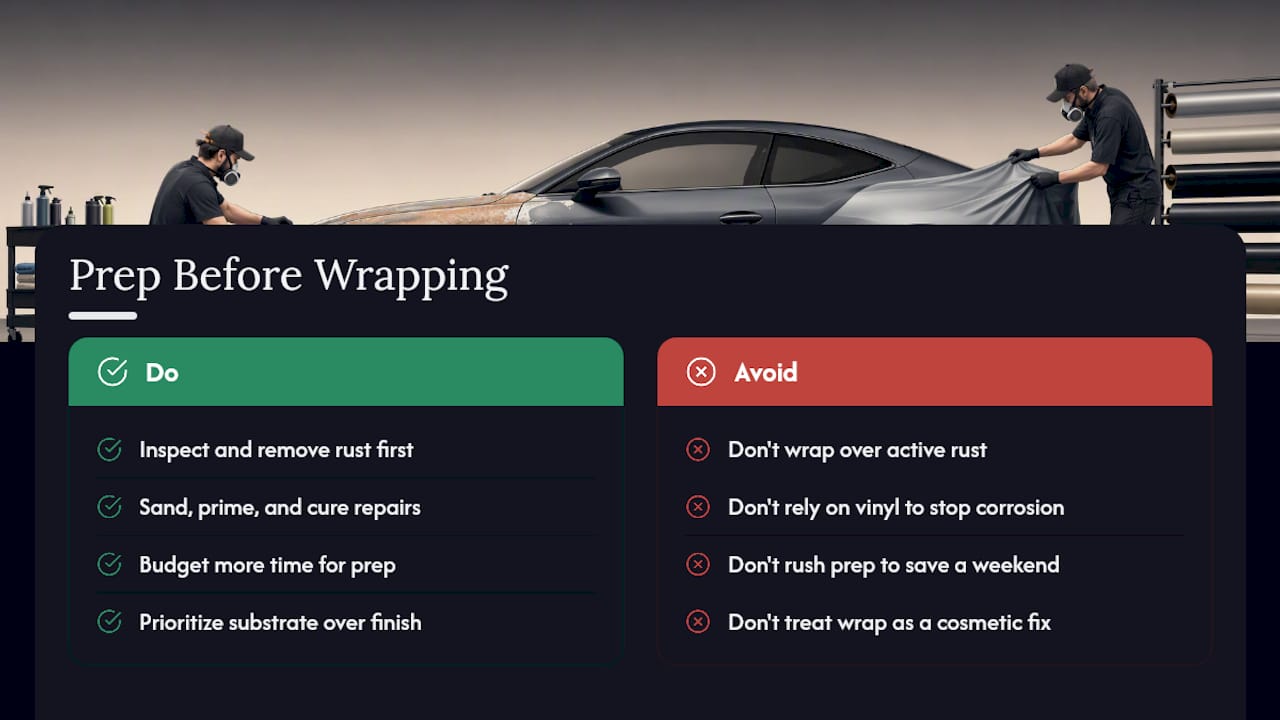
The prep work is the actual project, not a footnote before the fun part. Anyone budgeting for a wrap on a car with rust spots should expect the sanding, priming, and cure time to take longer than the vinyl install itself. Rushing that sequence to save a weekend is how a $300 repair turns into a $3,000 refinish job later.
Prioritize the substrate first, every time. A flawless wrap over a bad repair is still a bad repair, just a more expensive one to fix once it fails.
— NJ Vinyl Wrapz
Get Your Panels Inspected Before You Commit to a Wrap
Skip the guesswork on whether your rust spot is wrap-ready. Panels can be inspected in a climate-controlled facility, with coordination for any needed repair or epoxy priming, followed by installation using premium materials backed by warranty coverage, so customers are not left guessing whether a rushed repair will hold.

Bring photos of the affected area, and if you know it, roughly how long the rust has been visible. That helps our team determine on the spot whether you’re looking at a straightforward partial wrap after minor repair, a full wrap for a broader color change, or whether Paint Protection Film makes more sense once the repair is done. Request an inspection and estimate through NJ Vinyl Wrapz and get a straight answer on what your vehicle actually needs before any vinyl touches the panel.
Technical Bulletins and Resources Worth Reading
The rules in this guide come straight from manufacturer documentation and installer field experience, not guesswork. 3M’s vehicle preparation guide lays out substrate and cleaning requirements in detail. TeckWrap’s breakdown of wrapping over rust and EngineerSkill’s technical explanation of adhesion failure both cover the mechanics further if you want to go deeper before starting a project.
Sources
- Vehicle Preparation for Success Guide (3M technical bulletin)
- Wrapping a Rusty Car: Is It Possible? - TeckWrap
- Engineerskill
- Can You Wrap A Car With Rust? - YourAutoSpace
FAQ
What paint can go directly over rust?
No paint is designed to go directly over untreated rust and hold up long term. Surface rust needs mechanical removal or a rust converter first, followed by an epoxy primer that seals the metal before any topcoat, including vinyl film, goes on.
Will rust continue if painted over?
Yes, rust that isn’t fully removed or converted keeps spreading underneath paint or film. Sealing over active corrosion traps moisture against the metal, which speeds up the corrosion process instead of stopping it.
Can you wrap an old rusty car?
You can wrap an older vehicle with rust, but only after every corroded area is properly repaired, primed, and cured. Cosmetic surface rust on an otherwise solid panel is workable; deep or structural corrosion needs panel repair or replacement before a wrap installation is even considered.
Can I paint over rust without sanding it?
No, skipping sanding leaves loose oxide and scale that prevent primer and paint from bonding properly. Mechanical removal down to sound metal, starting with coarse grit and working finer, is a required step, not an optional one.
How much does it cost to fix rust before wrapping?
Costs vary widely based on rust depth and panel size, ranging from a simple sand and prime job on a small spot to full panel replacement for structural corrosion. NJ Vinyl Wrapz can coordinate repair referrals as part of an inspection, with pricing for the wrap portion available once the panel is assessed.