
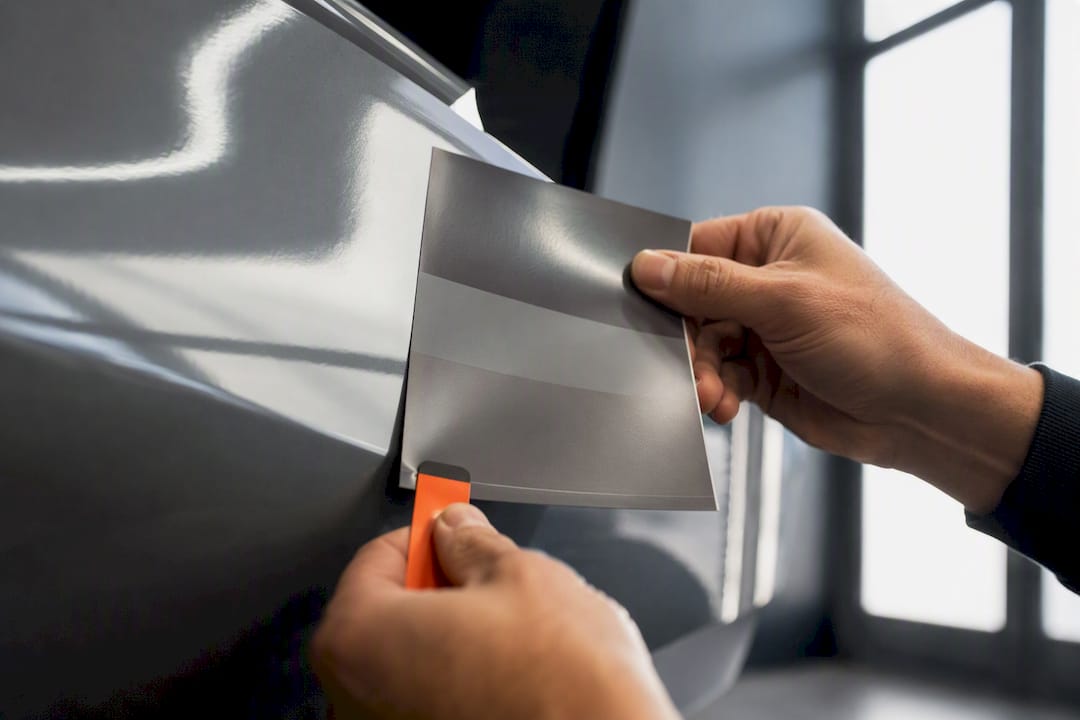
Yes, a professionally installed vinyl wrap can match automotive paint closely enough that most people can’t tell the difference at a glance, with skilled shops landing in the 90 to 98 percent visual match range. It won’t be pixel-perfect under every light source, though. If a single panel needs to disappear next to factory paint, a full wrap or careful partial repair beats a small patch every time.
TL;DR:
- Physical swatches from reputable film brands and printed proofs on the actual material are crucial to accurately match wrap colors within a 90 to 98 percent visual similarity range.
- Digital scans of paint are more reliable than paint codes alone for older vehicles with faded or mismatched finishes, especially beyond a few years of age.
- Testing color samples outdoors at different times of day and under varying light sources helps identify metamerism issues that can cause mismatches in different lighting conditions.
- Proper surface preparation, including avoiding wrapping over unresolved dents or primer variations, significantly influences the final color consistency and appearance.
- Choosing between wrap and repaint depends on project scope, with wraps suited for reversibility and aesthetic accents, while repainting is best for seamless, long-lasting color matching on damaged or complex finishes.
Table of Contents
- What Makes Wrap Color Matching So Tricky
- How Pros Get the Closest Possible Match
- Step-by-Step: Ordering and Confirming a Color-Match Wrap
- Wrap vs. Repaint: Which One Actually Solves Your Problem
- Shop Proof: What a Real Color-Match Process Looks Like
- Where Most Color Match Projects Go Wrong
- How Aging Paint Changes the Matching Game
- Does the Panel Underneath Affect the Final Color?
- What Actually Matters in Wrap Color Matching (And What Doesn’t)
- Ready for a Wrap That Actually Matches? Here’s How to Start
- Sources
- FAQ
What Makes Wrap Color Matching So Tricky
Vinyl and paint are fundamentally different materials, and that difference is the whole story behind why wrap color matching takes real skill instead of just picking a swatch. Paint is built in layers: a base coat carries the pigment, a separate layer holds metallic flake or pearl particles, and a clearcoat seals it all with depth and shine. Vinyl film, by contrast, is printed. A printer lays down ink to simulate that same visual effect on a flat surface, and printed film is genuinely good at color stability. Premium lines like 3M 2080 and Avery Dennison SW900 are industry leaders for consistency batch to batch, but they were never engineered to physically duplicate paint chemistry.
That gap shows up most in a phenomenon called metamerism, where two colors that look identical under one light source split apart under another. A wrap that matches perfectly under a showroom’s LED panels can look noticeably off in direct sunlight or under sodium streetlights, and vice versa. Metallic flake makes this worse because it scatters light at different angles than a printed metallic pattern ever will.
Finish and prep compound the problem. A few factors matter most:
- Gloss level. High-gloss vinyl reflects light more aggressively than factory clearcoat, which can make a “matching” color read slightly brighter or flatter depending on the angle.
- Surface condition. Glossy film is unforgiving. It amplifies body waves, old dents, and rough prep work that paint would have masked.
- Panel geometry. Curved panels catch light differently than flat ones, so a color that reads true on a hood might shift on a rounded fender.
None of this means matching is a lost cause. It means the people doing it need a process, not just a paint code.
How Pros Get the Closest Possible Match
The gap between an amateur wrap job and a genuinely close match almost always comes down to process, not talent. Shops that consistently nail color matching lean on three tools: physical swatches from proven film brands, digital color scanning, and printed proofs on the actual material.
1. Start with brand-name swatch books. Lines like 3M’s 2080 series and Avery Dennison’s SW900 each render color slightly differently because of how their base films and adhesives interact with ink. A shop that stocks physical swatches from multiple lines, rather than relying on a screen or a catalog photo, can compare texture and sheen side by side against your actual vehicle.
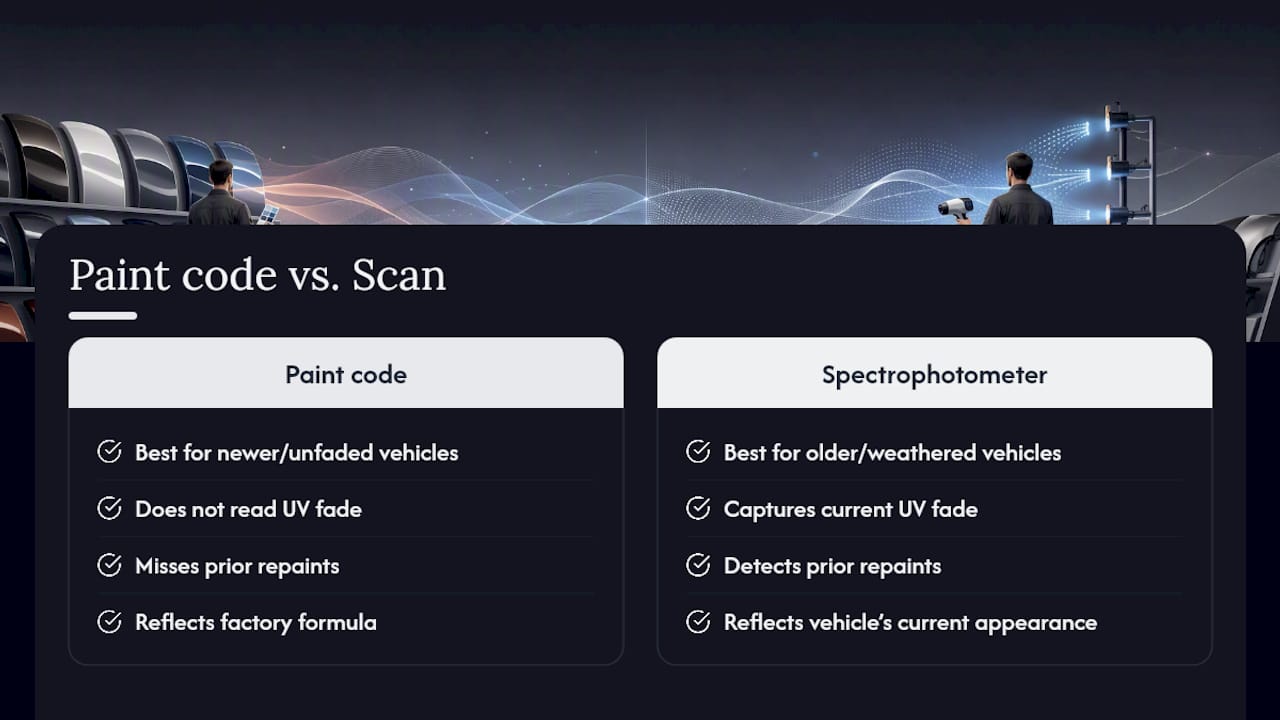
2. Decide between a paint code and a digital scan. Working from the factory paint code is fast and works well on newer vehicles with unfaded finish. But a spectrophotometer scan, the same kind of tool colorimeter systems use to read reflected light across the visible spectrum, captures how the paint actually looks today, including years of UV fade or a prior repaint that drifted from the OEM formula. For anything older than a few years, scanning beats code lookup.
3. Insist on a printed proof before full production. A digital rendering on a monitor tells you almost nothing useful. Ink behaves differently once it’s actually printed and laminated onto film, so a proof printed on the specific film series you’re ordering is the only real way to judge a metallic or pearl effect before committing.
Digital color-capture apps have gotten better, and they’re useful for narrowing down a starting point. But they’re only reliable when paired with a physical proof viewed in real daylight, not as a standalone verdict.
Pro Tip: Ask any shop quoting a color match whether they archive their print profiles. Shops that log calibration settings and save the exact profile used for your job can reproduce that same color months or years later for a repair panel or fleet add-on, without starting the matching process from scratch.
Step-by-Step: Ordering and Confirming a Color-Match Wrap
Getting a wrap that reads true against your paint isn’t complicated, but skipping a step is how most disappointing results happen. Here’s the sequence worth following, whether you’re doing the coordinating yourself or making sure your installer is.
- Define the project scope first. A single-panel repair after a fender bender has almost zero tolerance for mismatch, since it sits directly next to factory paint in every lighting condition. A full-vehicle color change or a themed fleet wrap has much more forgiveness, since there’s no adjacent paint to compare against directly.
- Gather your starting reference. If your paint is recent and unfaded, your factory paint code (usually on a door jamb sticker) is a solid starting point. If the paint has years of sun exposure, a repair history, or you simply want the highest odds of a true match, request a digital scan or ship a small painted sample to the shop.
- Order more than one swatch. Pull physical samples from a few brand lines. Compare them against your vehicle outdoors, not under shop fluorescents.
- Test across real conditions. Hold swatches against the panel at multiple times of day, morning, midday, and dusk, and check them in both direct sun and shade. Colors with metallic or pearl content shift the most between these conditions.
- Request a printed proof on the actual film. Before any material gets cut for your vehicle, ask for a small printed sample using the exact film series and finish you’re ordering. This is the single best way to confirm a metallic or chameleon effect before it’s on your car.
- Confirm the shop’s technical practices. Ask about print calibration frequency, whether they keep archived color profiles for reorders, and what their policy is if the final result doesn’t match the approved proof.
A few things to nail down before signing off on any quote:
- Does the shop calibrate its printers on a regular schedule, or only when something looks off?
- Will they commit the finish (gloss, satin, matte) in writing along with the color?
- What’s the reprint policy if the installed panel doesn’t match the approved sample?
- Is installation happening in a climate-controlled space, where temperature swings won’t affect adhesive behavior or film stretch?
Vehicles with surface damage need one more step before any of this matters: proper prep. Wrapping over unresolved dents, scratches, or filler work guarantees the flaws show through the film, color match or not.
Wrap vs. Repaint: Which One Actually Solves Your Problem
Color matching gets easier once you’re honest about which tool actually fits the job. Vinyl wrap and repainting solve different problems, and picking the wrong one creates headaches no amount of swatch-testing can fix.
Wrap makes sense when:
- You want a color change that’s reversible if you sell the car or change your mind.
- You’re adding protective or aesthetic accents rather than replacing an entire finish.
- You’re doing a full-theme reskin, like a fleet vehicle where the whole exterior becomes one branded surface with no adjacent factory paint to compare against.
- Budget and timeline matter more than achieving flawless metallic fidelity.
Repaint makes more sense when:
- A single damaged panel needs to disappear next to untouched factory paint in every lighting condition. Repainting remains the only method that guarantees an invisible repair across all lighting, because it uses the same pigment and clearcoat chemistry as the original finish.
- The color involves complex tri-coat or pearlescent layering that vinyl printing can approximate but not physically reproduce.
- You need the color baked permanently into the vehicle’s resale value story, rather than treated as a removable feature.
Warranties and lifespan differ too. Quality vinyl film typically holds up five to seven years with proper care, and it’s removable without damaging factory paint underneath, assuming that paint was in good condition at install. A quality repaint can last far longer but comes with a real cost and zero reversibility. If you’re weighing finish types as part of that decision, comparing gloss, satin, and matte options upfront will save you a second round of quotes later.
Shop Proof: What a Real Color-Match Process Looks Like
Talk is cheap in this industry. What separates a shop that can actually deliver on wrap color matching from one that’s guessing is a documented process, and NJ Vinyl Wrapz built its workflow around exactly that.
Every color-match project starts with physical swatch testing against the vehicle itself, not a screen comparison. From there, the team runs proof prints on the specific film series being ordered, so you’re approving an actual printed sample rather than a digital mockup. Those settings get archived, print profile, calibration data, and film batch, so a fleet reorder six months later doesn’t drift from the original job.
A few specifics worth knowing before you book:
- NJ Vinyl Wrapz installs 3M and Avery film exclusively for color-critical work, both established lines with strong color stability track records.
- All work is performed by a licensed and insured shop, in a climate-controlled facility that keeps temperature and humidity from warping film during application.
- Printer calibration is checked on a regular schedule rather than only when a job looks off.
Realistic accuracy sits in the 90 to 98 percent visual match range for most projects, with turnaround depending on scope and whether custom scanning is involved. If an installed panel doesn’t match the approved proof, that’s a shop error worth raising immediately, not something you should have to live with.
Where Most Color Match Projects Go Wrong
Most mismatched wraps trace back to a handful of predictable mistakes, not bad luck. Skipping the physical swatch step is the biggest one. Approving a color off a phone screen or a printed catalog photo instead of a real material sample under real light sets you up for a surprise the moment the wrap goes on.
Lighting inconsistency during approval is another common trap. A swatch checked only under shop fluorescents can look completely different once the vehicle is parked outside, because fluorescent and LED sources render color differently than sunlight, sometimes dramatically so with metallics.
Rushing the proof stage causes trouble too. Some shops skip printing an actual sample on the ordered film and instead show a digital rendering, which tells you almost nothing about how ink and laminate will interact once applied. Metallic and pearl effects are the worst offenders here, since simulated sparkle on a screen rarely behaves like real light-scattering flake.
Finally, treating “close enough” as good enough on a single-panel repair causes the most visible failures. A slight mismatch that would go unnoticed on a full wrap becomes glaringly obvious the second it sits inches from untouched factory paint. Setting the right tolerance for the project type before ordering material prevents most of these disputes before they start.
How Aging Paint Changes the Matching Game
A five-year-old paint job rarely looks like the day it left the factory, and that fact alone derails more color-match projects than any printing error does. UV exposure fades pigment gradually, clearcoat can yellow or haze over time, and prior touch-up work sometimes introduces a slightly different formula than the original factory batch.
This is exactly why matching against a factory paint code alone gets riskier the older a vehicle gets. A code-based match targets the paint’s original, factory-fresh formula. Slap that onto a car with a decade of sun exposure, and the new wrap will often look noticeably brighter or cleaner than the surrounding panels, an obvious tell rather than a seamless match.
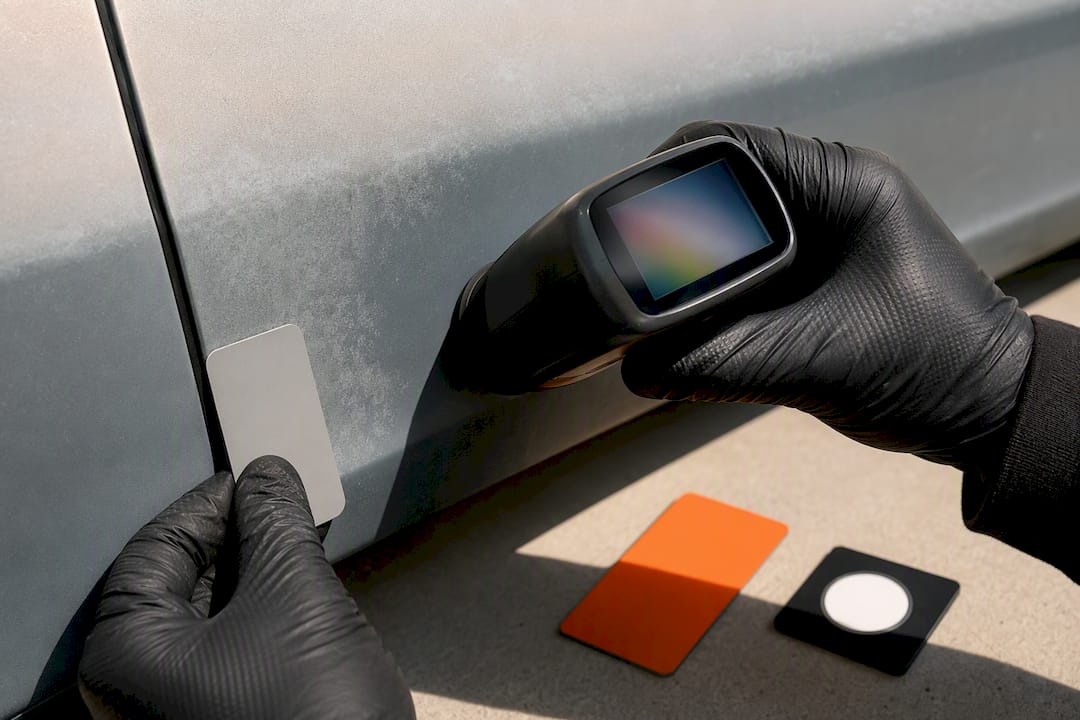
The fix is straightforward: for anything beyond a couple of years old, a digital scan or a shipped paint sample captures the paint as it actually exists today, weathering included, rather than as it existed on the factory floor. This matters even more for fleet vehicles, where different trucks in the same fleet may have been painted in different years and faded at different rates. A single paint code applied uniformly across an aging fleet can produce visibly inconsistent results from vehicle to vehicle, even though every truck technically has “the same” color on paper.
Does the Panel Underneath Affect the Final Color?
Yes, and this is one of the more overlooked variables in wrap color matching. Vinyl film has a degree of translucency, particularly in lighter colors and some metallics, which means whatever is underneath can subtly influence the final appearance. A white or light-colored wrap applied over a dark factory paint job can occasionally show slight undertone shifts compared to the same film applied over a lighter base.
Primer color plays a role too, though mostly in a secondary way: if bodywork or filler repair was done before wrapping, inconsistent primer shades under a light or thin film can create faint patchiness that wasn’t visible before the wrap went on. This is rarely a problem with properly prepped, uniformly primed panels, but it’s a real consideration on repaired or bodywork-heavy vehicles.
The practical takeaway is simple. Tell your installer about any bodywork, filler repair, or repaint history before the color-matching process starts, not after. A shop that knows what’s underneath the surface can choose a slightly heavier film weight or an extra base layer where needed, avoiding a surprise once the wrap is fully installed and the vehicle is sitting in daylight.
What Actually Matters in Wrap Color Matching (And What Doesn’t)
Most advice on this topic obsesses over paint codes, as if punching the right six-digit number into a database guarantees a match. It doesn’t. The research and the shop-floor reality both point somewhere else: process discipline beats code precision almost every time.
The conventional wisdom undersells how much viewing conditions matter. A color that gets approved under one light source and rejected under another isn’t a manufacturing defect, it’s physics. Metamerism is real, and no swatch book eliminates it. What actually reduces disappointment is testing outdoors, at different times of day, before any material gets cut.
If there’s one thing readers should prioritize above all else, it’s this: never approve a color off a screen. Insist on a physical proof printed on the actual film series you’re ordering. That single step catches more mismatches than any amount of paint-code research ever will, and it costs a shop almost nothing to provide. A shop that resists giving you one is telling you something about how they operate.
— NJ Vinyl Wrapz
Ready for a Wrap That Actually Matches? Here’s How to Start
NJ Vinyl Wrapz runs color-match projects the same disciplined way described throughout this guide: physical swatch comparisons against your vehicle, printed proofs on the actual film series before production, and archived color profiles so a future repair panel or fleet addition matches the original job exactly. Every install happens in a climate-controlled facility using licensed, insured crews working with 3M and Avery materials.
Before reaching out, gather what will speed up your quote and improve your match odds: photos of your vehicle taken in daylight (not under garage lighting), your factory paint code if the finish is recent, or a small physical paint sample if the finish has aged or been touched up. If you’re weighing scope, reviewing wrap and finish options first will help you land on the right project type before requesting swatches.
Ready to see how close a real match can get on your vehicle? Request a full vehicle wrap quote and ask specifically for a printed proof before any material goes into production.
Sources
For readers who want to go deeper on the technical side, a few resources back the guidance in this article. Gauge Magazine’s breakdown of wrap versus paint covers the material science behind why vinyl and paint behave differently under light. Wrapmate’s guide to wrap color walks through the swatch-testing process pros rely on. Krazy Graphics’ explanation of OEM matching limits sets realistic expectations around accuracy ranges. And Rvinyl’s swatch-ordering guide offers practical steps for testing film brands before committing. Readers researching finish durability alongside color may also find Diamondbrite’s matte paint protection guidance useful for understanding how finish choice affects long-term appearance.
- Vehicle Wrap vs Paint: A Straight Answer for Builders
- Why We Can’t Guarantee Exact OEM Color Matching (And Why It’s Normal)
- How to Find the Best Color Match Vinyl Wrap for Your Car
FAQ
Can you actually color match a wrap to your car’s paint?
Yes. Professional shops using physical swatches, digital scanning, and printed proofs typically land in the 90 to 98 percent visual match range, though a perfect 100 percent match under every lighting condition isn’t realistic with any current film technology.
Where can I get a color-matched car wrap done professionally?
Look for a licensed, insured shop that tests physical swatches against your vehicle, prints proofs on the actual film before production, and works with established brands like 3M or Avery Dennison. NJ Vinyl Wrapz follows exactly this workflow for full and partial color-match projects.
Does a vinyl wrap match the factory paint code exactly?
Not always. A paint code targets your vehicle’s original factory-fresh formula, but paint fades and shifts with age, so a code-based match on older paint can look brighter or cleaner than the surrounding panels. A digital scan or physical paint sample usually produces a closer real-world match on vehicles more than a couple of years old.
How do you match vinyl wrap colors correctly?
Start with your paint code or a digital scan, order swatches from multiple premium film lines, and test them outdoors at different times of day. Before committing to full production, request a printed proof on the actual film series to confirm how metallics or pearls will actually render on the material.