

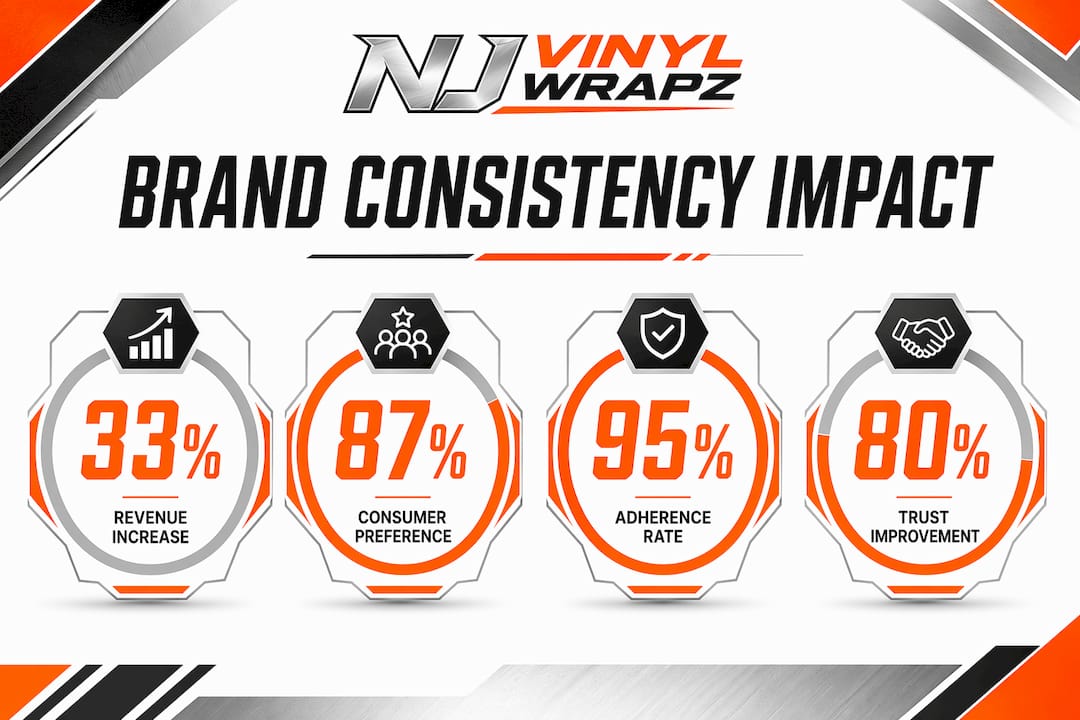
Brand consistency is defined as the practice of presenting your brand with the same visuals, voice, and messaging across every customer touchpoint, from your website to your fleet vehicles. This uniform presentation is the foundation of recognition, trust, and long-term customer loyalty. Research shows that consistent brand presentation is associated with a 23%–33% revenue increase, and businesses with strong consistency achieve 3.5x higher market visibility. The industry term for this practice is “brand governance,” and understanding why branding consistency matters is the first step toward turning your marketing spend into a compounding asset rather than a recurring expense.
Why branding consistency is the most underrated growth lever
The measurable benefits of uniform branding go far beyond aesthetics. They show up directly in revenue, retention, and how fast customers decide to buy.
- Revenue growth: 68% of organizations attribute 10%–20% of their revenue growth directly to brand consistency. Inconsistent branding, by contrast, can reduce revenue by up to 20%.
- Customer trust: 80% of consumers say inconsistent brand experiences reduce their trust in a company. That erosion of trust translates directly into lost sales.
- Churn reduction: Inconsistency leads to 22% higher customer churn. Retaining existing customers is far cheaper than acquiring new ones, so this number carries serious financial weight.
- Faster purchase decisions: 81% of consumers require brand trust before buying, and consistent messaging builds that trust three times faster than fragmented communication.
- Profit impact: A 5% increase in customer retention through trusted branding can raise profits by 25%–95%. That range reflects how dramatically loyalty compounds over time.
Brand consistency also shortens the sales cycle. When customers recognize your brand instantly and associate it with reliability, they spend less time evaluating and more time buying. Brand consistency reduces mental load for customers by creating cognitive coherence, which lowers acquisition costs and speeds up decisions. Think of it as removing friction from the buyer’s path. Every inconsistency adds a speed bump; every consistent touchpoint removes one.
The marketing ROI argument is equally strong. When your visuals, tone, and messaging align across campaigns, each new ad reinforces the last one. Without consistency, you spend budget re-educating customers about who you are instead of deepening the relationship you already built.
What misconceptions hold businesses back from brand consistency?
Most business owners assume that having a brand guide solves the problem. It does not.
- Having guidelines is not the same as enforcing them. Only 25%–30% of companies enforce brand guidelines consistently, despite 95% having formal brand books. The document exists; the discipline does not.
- Off-brand content is a symptom of process failure, not creative failure. Most brand consistency failures come from enforcement gaps, not from designers or marketers ignoring the rules. The workflow breaks down before the content ever reaches an audience.
- Consistency does not kill creativity. This is the most common objection from creative teams. The truth is the opposite. When core design elements are locked in, teams stop debating fonts and colors and start focusing on ideas. Consistency enables teams to avoid “reinvention fatigue” and improve time-to-market.
- Brand inconsistency has a direct dollar cost. Marketing compliance failures from brand inconsistency cost organizations an average of $1.4 million annually. That figure covers rework, legal exposure, and damaged customer relationships.
- Inconsistency is not just a visual problem. Many businesses focus only on logo and color usage. But 46% of marketers say they cannot produce fully on-brand content, which includes tone, messaging, and channel-specific voice. A mismatched email tone can undermine a perfectly designed ad.
Pro Tip: Audit your last 10 pieces of customer-facing content, including emails, social posts, and vehicle graphics, and check them against your brand guide. If more than two fail the test, you have an enforcement problem, not a creative one.
The operational cost of inconsistency is also spread invisibly across departments. Sales teams spend extra time explaining who you are. Marketing teams rebuild assets from scratch. Customer service handles confusion that consistent branding would have prevented. These costs rarely appear on a single line item, which is exactly why they go unaddressed.
How can businesses effectively achieve and maintain branding consistency?
Achieving brand consistency at scale requires systems, not just standards. Here is what works in practice.
- Centralized digital asset management (DAM): A DAM system stores approved logos, templates, color palettes, and copy in one place that every team can access. Organizations using DAM report 20%–40% less asset duplication and 2.7x faster content velocity. Faster content with fewer errors is the direct payoff.
- Automated approval workflows: Build a review step into your content process before anything goes public. Automated workflows flag off-brand elements before they reach customers, not after.
- Brand scoring before publication: Score content against brand standards as a checklist before it publishes. This turns brand compliance from a vague expectation into a measurable step.
- Cross-department alignment: Your sales deck, your fleet vehicles, your social media, and your email signatures all communicate your brand. Align tone, visuals, and messaging across every department, not just marketing.
- Version control for brand assets: Old logos and outdated templates cause more off-brand content than deliberate rule-breaking. Version control removes the guesswork by making the current approved assets the only accessible ones.
Implementation of centralized brand guidelines via DAM improves brand adherence to 95% in mature organizations. That is a near-complete elimination of the enforcement gap described above.
Pro Tip: Assign a brand steward in each department, not just in marketing. This person is responsible for flagging off-brand content before it leaves their team. One point of accountability per department closes more gaps than a company-wide memo ever will.
For businesses with physical assets like fleet vehicles, consistent wrap design is a direct extension of this system. A vehicle on the road is a moving brand touchpoint. If it does not match your digital presence, you are sending two different signals to the same customer.
How does brand consistency shape customer perception across touchpoints?
Customers do not separate your brand by channel. They experience it as one thing, and they judge it as one thing.

87% of consumers say brand consistency matters across all touchpoints, and 80% say inconsistency raises doubts about a company. That doubt is not passive. 61% of consumers who encounter inconsistency seek outside reassurance rather than proceeding with a purchase. They go look for reviews, ask colleagues, or simply walk away.
| Industry | Why consistency is critical | What inconsistency costs |
|---|---|---|
| Finance | Customers equate visual and messaging coherence with institutional reliability | Loss of account openings and referrals |
| Healthcare | Patients associate brand uniformity with professional competence | Reduced appointment bookings and patient trust |
| Technology | Buyers use brand coherence as a proxy for product quality | Longer sales cycles and higher churn |
| Retail and fleet services | Customers recognize brands faster when visuals repeat across channels | Missed impressions and lower recall |
The trust signal is especially powerful in high-stakes sectors like finance and healthcare, where customers are making decisions that carry real personal risk. A mismatched logo on a brochure versus a website may seem trivial. To a patient or an investor, it reads as a warning sign.
For businesses with fleet vehicles, this dynamic plays out on every road and parking lot. A professionally wrapped fleet that matches your website, signage, and uniforms tells customers you are organized, credible, and serious about your brand. An inconsistent fleet does the opposite. It signals that different parts of your business are not talking to each other, and customers notice. You can also see how aligned visuals and messaging translate into measurable revenue gains for businesses that commit to brand coherence across every customer-facing surface.
Key Takeaways
Brand consistency is a measurable business driver: companies that enforce it see higher revenue, lower churn, and faster purchase decisions across every channel and touchpoint.
| Point | Details |
|---|---|
| Revenue impact is direct | Consistent branding is linked to a 23%–33% revenue increase and 3.5x higher market visibility. |
| Enforcement gap is the real problem | 95% of companies have brand guidelines, but only 25%–30% enforce them consistently. |
| DAM systems close the gap | Centralized digital asset management improves brand adherence to 95% and cuts asset duplication by up to 40%. |
| Inconsistency has a dollar cost | Marketing compliance failures from brand drift cost organizations an average of $1.4 million annually. |
| Physical touchpoints count | Fleet vehicles, floor graphics, and window signage are brand touchpoints that must match digital and print assets. |
Brand consistency is a business engine, not a style guide
By Krunal
After working with dozens of businesses on their fleet branding, I have noticed a pattern. The companies that treat their brand guide as a living operational tool grow faster than the ones that file it away after launch. The difference is not the quality of the guide. It is whether anyone actually uses it.
The hidden ROI of consistency is not in the big campaigns. It is in the time your team does not waste rebuilding assets, the sales calls that close faster because the prospect already trusts your brand, and the customers who refer you because your name feels familiar and reliable. These savings are spread across departments, which is exactly why most finance teams never see them on a single report.
The warning I give every business owner is this: brand drift is silent. It does not happen in one bad decision. It happens across a hundred small ones, a slightly different font here, an outdated logo on a van there, a social post that sounds nothing like your website. By the time you notice it, customers already have. Treating consistency as a compound asset, one that builds recognition and trust over time, is the mindset shift that separates brands that grow from brands that plateau.
— Krunal
How Njvinylwrapz helps businesses stay on-brand on the road
Your fleet vehicles are one of the most visible brand touchpoints your business owns. Every mile they travel is a brand impression, and every inconsistency they carry is a missed opportunity.
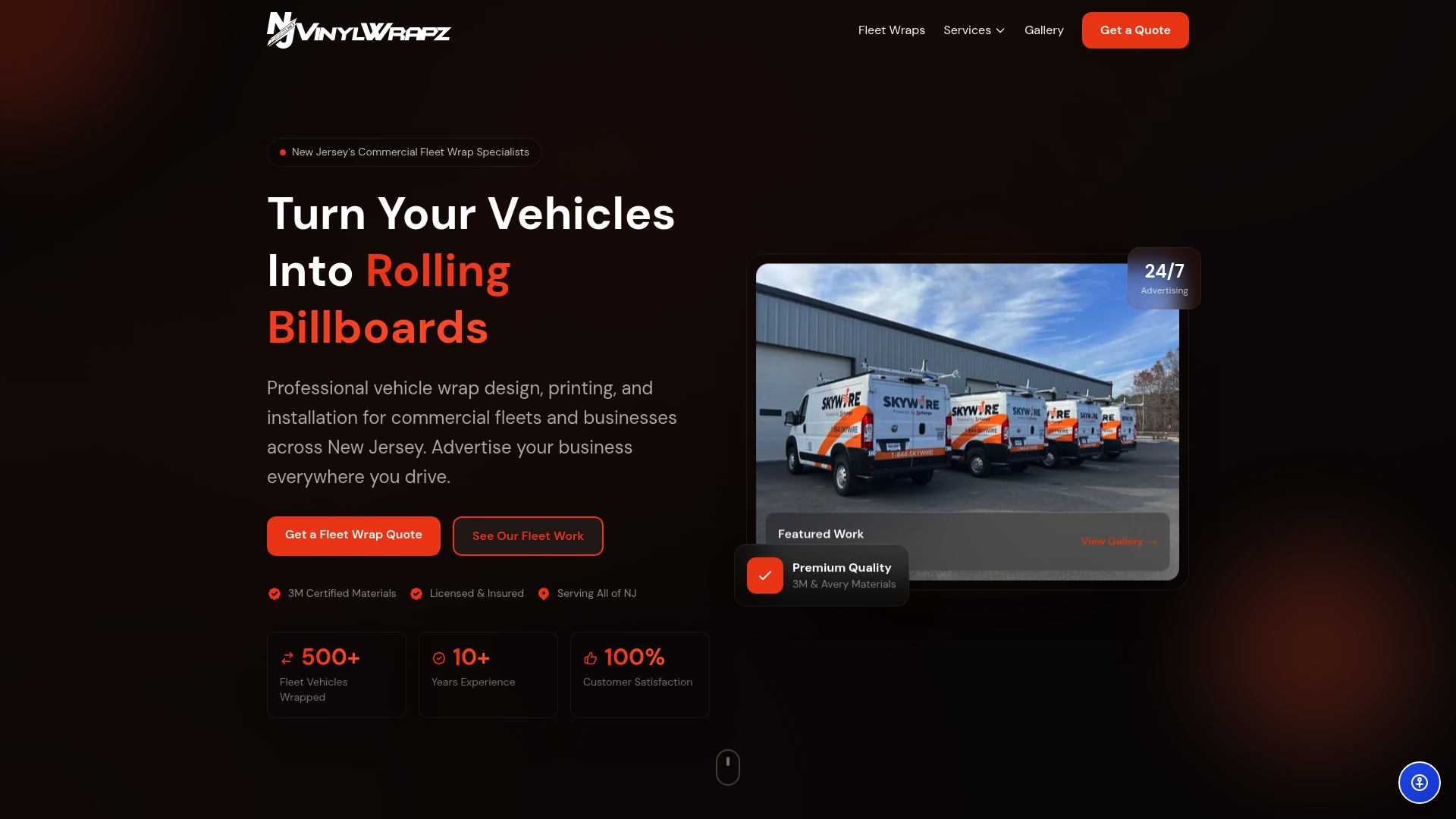
Njvinylwrapz specializes in full vehicle wraps that translate your brand standards directly onto your fleet, using premium 3M and Avery materials installed in climate-controlled facilities for lasting results. The team handles custom design, printing, and professional installation, so your vehicles match your digital and print presence exactly. Njvinylwrapz also offers window graphics and floor graphics to extend your brand across every physical space your business occupies. With over 10 years of experience serving commercial fleets across New Jersey, Njvinylwrapz delivers the brand integrity your fleet deserves.
FAQ
What is brand consistency and why does it matter?
Brand consistency is the practice of presenting the same visuals, voice, and messaging across every customer touchpoint. It matters because consistent branding is linked to a 23%–33% revenue increase and builds customer trust three times faster than fragmented communication.
How does inconsistent branding affect customer trust?
80% of consumers say inconsistent brand experiences reduce their trust in a company, and 61% seek outside reassurance rather than proceeding with a purchase when they encounter inconsistency.
What is the most common reason brand consistency fails?
The most common reason is enforcement failure, not lack of documentation. 95% of companies have formal brand guidelines, but only 25%–30% enforce them consistently.
How can a business maintain branding consistency across departments?
Centralized digital asset management systems, automated approval workflows, and a designated brand steward in each department are the most effective tools. Organizations using DAM report 2.7x faster content velocity and up to 40% less asset duplication.
Does brand consistency apply to physical assets like vehicles?
Yes. Fleet vehicles, floor graphics, and window signage are active brand touchpoints. Inconsistency between physical and digital assets sends conflicting signals to customers and reduces the trust that consistent branding builds.