

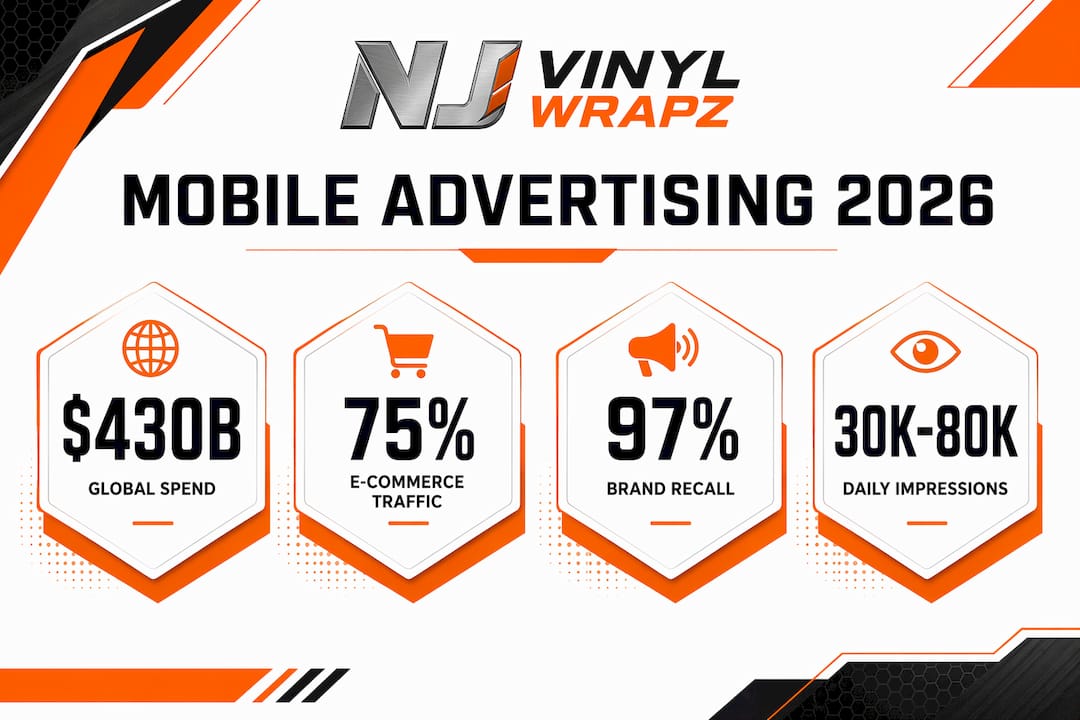
Mobile advertising is defined as paid promotional content delivered specifically to smartphone and tablet users, covering everything from in-app banners and SMS campaigns to physical vehicle wraps rolling through city streets. Global mobile ad spend exceeded $430 billion in 2026, accounting for roughly 74% of all digital advertising investment worldwide. That number tells you where consumer attention lives. Business owners and marketers who understand what mobile advertising is, and how its formats work together, hold a real edge over those still treating it as a secondary channel.
What is mobile advertising, and how does it work?
Mobile advertising is the practice of serving paid promotional messages to people on mobile devices, using placement signals like app context, location, and browsing behavior to reach the right person at the right moment. The industry term is “mobile advertising,” and it sits under the broader umbrella of digital marketing, though it now commands the majority of that budget.
Mobile devices generate 75% of e-commerce traffic and roughly three-quarters of all digital ad impressions worldwide. That concentration means a campaign that ignores mobile is, by definition, ignoring most of its potential audience.

The mechanics are straightforward. An advertiser buys placement through a platform, ad network, or direct publisher deal. The ad appears inside an app, on a mobile website, in a text message, or on a physical vehicle moving through a target market. The platform tracks engagement, and the advertiser adjusts bids, creatives, and targeting based on results.
Pro Tip: Treat mobile advertising as its own discipline, not a scaled-down version of desktop. Ad copy, creative dimensions, and call-to-action placement all behave differently on a 6-inch screen.
What are the main types and channels of mobile advertising today?
Mobile advertising includes diverse formats spanning both digital and physical channels. Each format serves a different stage of the customer journey, and the strongest campaigns mix several of them.
Digital in-app and mobile web formats
In-app advertising covers banner ads, interstitial full-screen ads, and rewarded video units where users watch an ad in exchange for in-game currency or premium content. Rewarded video consistently outperforms standard banners on engagement because users opt in. Mobile search ads appear when someone types a query into Google on their phone, capturing high purchase intent at the exact moment of search.
Mobile web ads function similarly to desktop display, but they load on a smaller screen with a shorter attention window. Shorter headlines and single-image creatives outperform complex layouts on mobile web placements.
SMS, push notifications, and owned channels
SMS and push notifications are the most direct channel in mobile advertising. SMS campaigns achieve conversion rates as high as 45%, a figure that dwarfs most display benchmarks. Push notifications drive comparable urgency for app-based businesses. Both channels require explicit opt-in consent, which makes list quality the primary performance variable.
Physical mobile advertising: vehicle wraps and mobile billboards
Physical mobile advertising places brand messages on vehicles that move through high-traffic areas. A mobile billboard is a large-format ad mounted on a truck or trailer, driven through a target geography on a set route. A vehicle wrap covers a car, van, or truck in printed vinyl graphics, turning the vehicle itself into a moving ad unit.
The distinction matters for planning. Mobile billboards are rented placements on third-party vehicles. Vehicle wraps are permanent or semi-permanent installations on your own fleet, giving you continuous impressions at no recurring media cost. For businesses with delivery vans, service trucks, or sales vehicles, fleet wraps convert an existing asset into a 24-hour advertising channel.
Pro Tip: When planning a physical mobile advertising campaign, map your vehicles’ daily routes against your target zip codes. A wrap on a vehicle that never enters your core market delivers far fewer impressions than one that drives through it daily.
Why invest in mobile advertising? Key advantages for businesses
The core advantage of mobile advertising is reach combined with relevance. No other channel puts your brand in front of a consumer at the precise moment they are searching, browsing, or commuting through your service area.
Here are the most concrete reasons to invest:
- Scale: 74% of digital ad spend globally flows to mobile, which reflects where audiences spend their time.
- Conversion performance: SMS campaigns convert at up to 45%, and SMS drives 15% of e-commerce revenue from just 3% of message volume.
- Local brand recall: Vehicle wraps produce a 97% brand recall rate, outperforming digital banner recall by a wide margin.
- Direct commerce: Mobile devices account for 75% of e-commerce traffic, meaning mobile ads sit one tap away from a purchase.
- First-party data: Owned channels like SMS and push lists give you direct audience access that does not depend on third-party platform algorithms.
The advantages of mobile advertising compound when you combine channels. A consumer who sees your wrapped van in the morning and then encounters your retargeting ad that afternoon has two brand touchpoints in one day. That frequency builds recognition faster than either channel alone.
For small and medium-sized businesses, the SME mobile marketing advantage is particularly strong in local markets. A single wrapped service vehicle driving daily routes in your city generates thousands of impressions from people who actually live and work in your service area.
How to optimize mobile advertising campaigns effectively in 2026
Optimizing mobile advertising in 2026 requires a different mindset than it did three years ago. Privacy changes across major operating systems have eliminated most device-level tracking. Marketers now optimize toward modeled conversion values and proxy events rather than deterministic user-level data.
Here is a practical framework for 2026 optimization:
-
Shift your measurement model. Replace last-click attribution with probabilistic measurement tools and platform-reported modeled conversions. Accept that some signal loss is permanent and build your KPIs around cohort-level lifetime value rather than individual cost-per-install.
-
Increase creative output. Creative volume and freshness are now the highest-leverage inputs in mobile ad auctions because platforms automate most targeting. Creative fatigue can set in within days on high-spend campaigns. Produce more variations, test faster, and retire underperformers quickly.
-
Diversify your channel mix. The top three mobile ad platforms capture 67% of global mobile ad spend. Concentrating your entire budget on one platform creates fragility. Allocate across search, in-app, SMS, and physical mobile formats to reduce dependency.
-
Build owned mobile audiences. Grow compliant SMS and push notification lists. These channels are not subject to platform algorithm changes, and their conversion rates justify the investment in list building.
-
Add physical mobile advertising to your mix. Vehicle wraps require no ongoing media spend after installation. They generate continuous impressions in your local market and boost website visits by 47% post-exposure, making them a strong complement to digital campaigns.
Pro Tip: Use short-form video creatives across in-app placements. Video under 15 seconds with captions performs well on muted autoplay, which covers the majority of mobile video views.
What role does physical mobile advertising, such as vehicle wraps, play?
Physical mobile advertising is the channel most marketers underestimate. A wrapped vehicle is not a passive asset. It is an active ad unit that generates impressions every time it parks, drives, or sits in traffic.
Vehicle wraps generate between 30,000 and 80,000 daily impressions per vehicle in urban environments. That volume rivals many paid digital placements, at a fraction of the ongoing cost. Vehicle wraps also deliver 53% more traffic and an average ROI of 800% over three years compared to static billboards. The ROI figure reflects the one-time installation cost spread across years of continuous exposure.
The 97% brand recall rate for vehicle wraps is the most striking data point in physical mobile advertising. Digital display ads typically achieve single-digit recall. The difference comes from format size, movement, and the fact that a wrapped vehicle appears in the real physical environment of the viewer, not inside a screen they are already tuned out from.
For businesses with fleet vehicles, the integration with digital campaigns is direct. A vehicle wrap builds local awareness. That awareness shortens the sales cycle when the same prospect later encounters a search or social ad. Physical and digital mobile advertising reinforce each other.
For deeper context on how vehicle branding fits into a broader marketing plan, the 2026 vehicle branding trends analysis covers the formats and materials driving the strongest results this year.
Pro Tip: Include a QR code or short URL on your vehicle wrap. It creates a direct, trackable connection between your physical mobile ad and your digital presence, letting you measure wrap-driven web traffic.
Key Takeaways
Mobile advertising delivers the highest reach and conversion potential of any marketing channel in 2026, combining digital precision with physical brand presence for maximum impact.
| Point | Details |
|---|---|
| Mobile dominates ad spend | Global mobile ad spend exceeded $430 billion in 2026, representing 74% of all digital advertising. |
| SMS converts at scale | SMS campaigns achieve conversion rates up to 45%, making owned mobile lists a high-ROI asset. |
| Vehicle wraps outperform digital recall | Physical vehicle wraps achieve a 97% brand recall rate, far exceeding digital display benchmarks. |
| Creative volume drives performance | Platform targeting is automated; creative freshness is now the primary lever marketers control. |
| Channel diversification reduces risk | The top three platforms hold 67% of mobile ad spend. Spreading budget across formats protects against algorithm changes. |
My take on where mobile advertising is actually heading
The conversation around mobile advertising has shifted in a way that most marketing guides have not caught up with yet. Everyone talks about targeting and data, but the real competitive advantage in 2026 is creative production speed. Platforms have commoditized audience targeting. What separates a winning campaign from a wasted budget is whether your creative team can produce, test, and replace ad variations faster than your competitors.
The second thing I keep coming back to is how badly physical mobile advertising gets overlooked in the digital-first conversation. I have seen businesses spend thousands per month on in-app placements while their delivery vans drive around with no branding at all. That is a missed opportunity that costs nothing to fix relative to the impressions it generates. A wrapped fleet vehicle working your local market every day is not a nice-to-have. It is one of the most cost-efficient ad placements available to a local business.
The marketers who will win over the next few years are the ones who treat mobile advertising as a full-spectrum discipline. That means owning your SMS list, producing creative at volume, measuring with modeled data rather than waiting for perfect attribution, and putting your brand on every physical asset that moves through your market. The vehicle-based mobile marketing guide we put together covers the physical side of this in detail if you want to go deeper.
— Krunal
How Njvinylwrapz can put your brand on the road
Njvinylwrapz transforms commercial vehicles into full-time mobile advertising assets for businesses across New Jersey and beyond. With over 10 years of experience, licensed and insured operations, and materials from 3M and Avery, every installation is built to last and built to be seen.
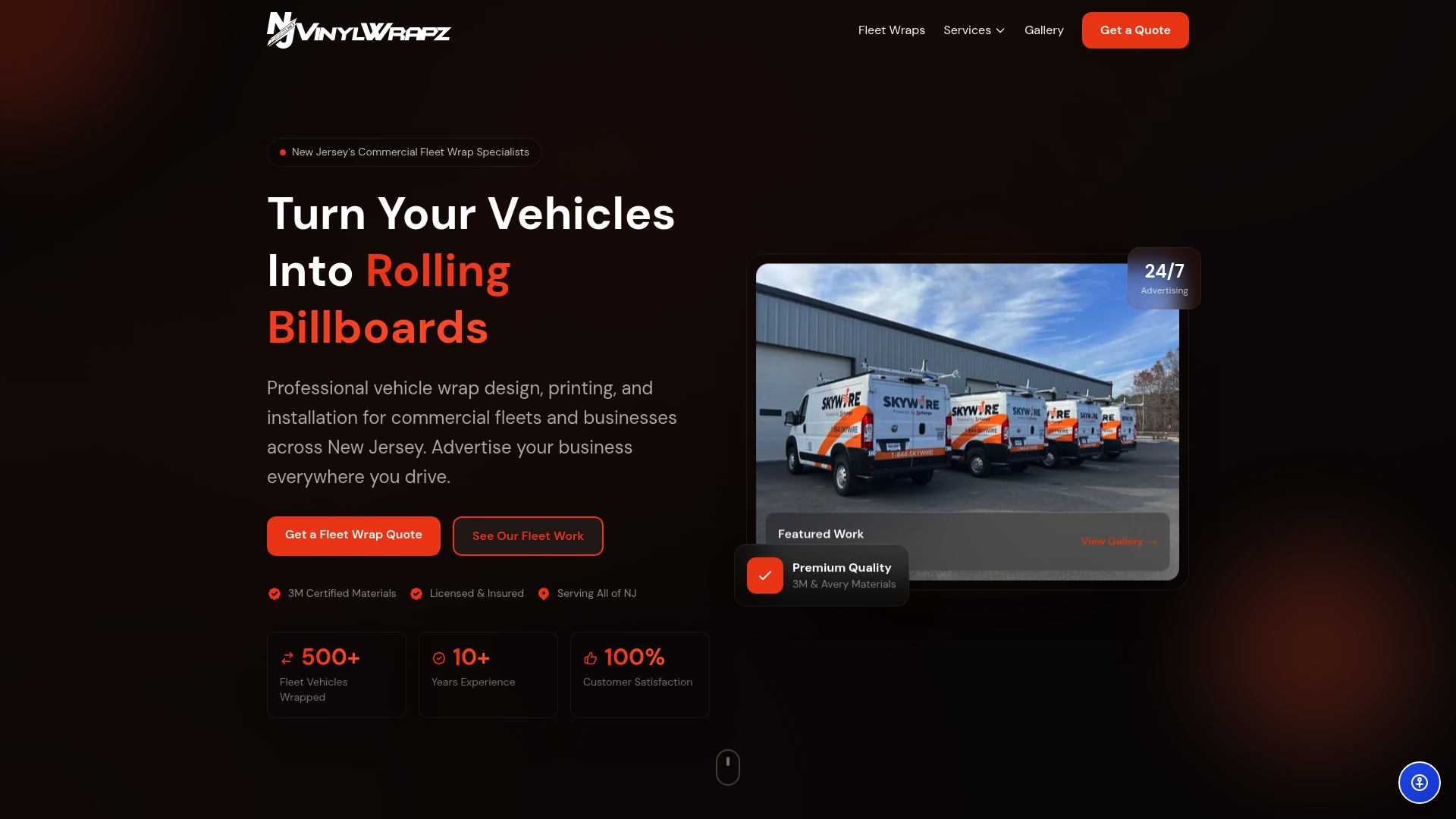
Whether you run a single service van or a multi-vehicle fleet, Njvinylwrapz designs, prints, and installs wraps that generate thousands of daily impressions in your local market. The full vehicle wrap service covers every inch of your vehicle in high-resolution graphics, giving you a moving billboard that works every hour your vehicle is on the road. For businesses ready to make their fleet work harder, explore all wrap options and find the format that fits your brand and budget.
FAQ
What is the mobile advertising definition?
Mobile advertising is paid promotional content delivered to users on smartphones and tablets, including formats like in-app ads, SMS campaigns, mobile search ads, and physical vehicle wraps.
How does mobile advertising work for small businesses?
Small businesses use mobile advertising by buying placements in apps or search results, running SMS campaigns to opted-in lists, or wrapping their vehicles to generate local impressions at a fixed one-time cost.
What is a mobile billboard?
A mobile billboard is a large-format advertisement mounted on a truck or trailer and driven through a target area on a planned route, distinct from a vehicle wrap, which covers a business’s own fleet vehicle in branded graphics.
Why use mobile advertising over other channels?
Mobile advertising reaches consumers where they spend the most time. Mobile devices account for 75% of e-commerce traffic and 74% of global digital ad spend, making mobile the highest-reach channel available.
How do vehicle wraps compare to digital mobile ads?
Vehicle wraps achieve a 97% brand recall rate and generate up to 80,000 daily impressions per vehicle, while delivering an average ROI of 800% over three years, making them a strong complement to digital mobile campaigns.