

Fleet consistency is defined as the uniform alignment of branding, vehicle specifications, and operational processes across every vehicle in a fleet. The industry term for this practice is fleet standardization, and it covers three distinct pillars: visual branding, mechanical fitouts, and maintenance protocols. When all three align, a fleet stops being a collection of individual vehicles and becomes a single, reliable system. Fleet managers who understand what is fleet consistency gain a measurable advantage in brand recognition, cost control, and operational uptime.
What is fleet consistency and why does it matter?
Fleet consistency is the practice of applying the same standards to every vehicle, from the graphics on the door panel to the torque wrench in the cargo bay. The National Association of Fleet Administrators (NAFA) identifies standardization as a core driver of fleet efficiency, citing its role in reducing maintenance costs and improving driver safety. Without consistency, fleets accumulate what the industry calls “configuration drift,” where vehicles diverge over time and create hidden costs.
The business case is direct. Inconsistent fleet configurations increase training costs, reduce efficiency, and create safety risks. Retrofitting consistency after the fact costs significantly more than building it in from the start. Fleet managers who treat consistency as a foundational policy, not an afterthought, avoid that penalty entirely.
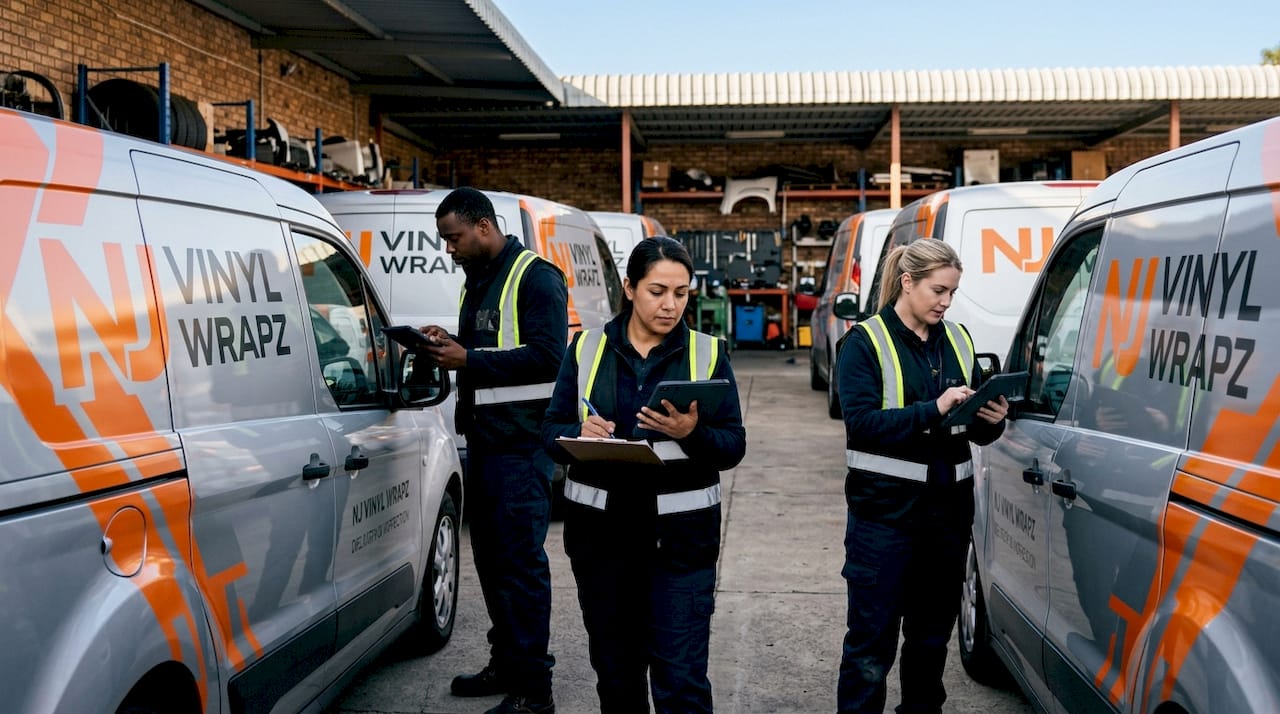
Fleet consistency also signals organizational discipline to the outside world. A uniform, professional fleet tells customers that the business behind it operates with the same care it applies to its vehicles. That perception directly affects customer trust and repeat business.
How does consistent fleet branding build trust and recognition?
Uniform vehicle graphics are one of the most cost-effective marketing tools available to fleet managers. Vehicle wraps last 5–7 years, delivering continuous brand exposure without recurring advertising costs. That lifespan makes a well-executed fleet wrap program one of the highest-return visual marketing investments a business can make.
The psychological mechanism behind this is the mere-exposure effect. People who see the same visual identity repeatedly develop familiarity and trust with that brand, even without a direct interaction. 97% of people recall ads on cars, which means a consistent fleet wrap is not just decoration. It is an active recall tool working every time a vehicle is on the road.
Branding elements that require standardization across a fleet include:
- Color codes: Use exact Pantone or CMYK values, not approximations. Color deviation beyond Delta E 2.0 is visible to the human eye and undermines brand uniformity.
- Logo placement: Define exact position, size, and clearance zones for every vehicle type in the fleet.
- Typography and taglines: Use the same font files and approved copy on every vehicle.
- Layout templates: Create vehicle-specific templates for vans, trucks, and sedans so graphics scale correctly.
Consistent branding also affects employee pride. Drivers who operate a clean, professionally wrapped vehicle report higher job satisfaction and take better care of the vehicle. That behavior reduces wear and can improve resale value when the fleet cycles out.
Pro Tip: Create a one-page visual playbook for each vehicle type in your fleet. Include exact color codes, logo placement specs, and approved wrap materials. Give this document to every vendor before any wrap job begins.
How does vehicle standardization improve operational efficiency?
Fleet standardization means specifying a common core platform for vehicles, including engine type, cargo configuration, and installed equipment. The operational benefit is immediate: drivers who move between vehicles in a standardized fleet do not need to relearn controls or locate tools. That muscle memory reduces errors and speeds up daily operations.
Standardized fleets also make maintenance faster and cheaper. Standardized fleets enable faster diagnostics and easier preventive maintenance scheduling because technicians work on identical configurations every time. A technician who knows one vehicle in the fleet effectively knows all of them, which cuts diagnostic time and reduces the chance of errors.
One underappreciated risk in fleet standardization is the order-to-delivery timeline. Upfit changes can add 30+ days of lead time when vehicle specifications change late in the procurement process. That delay cascades into operational gaps, especially for growing fleets that need vehicles on the road quickly.
Flexible standardization offers a practical middle ground. This approach uses a common core platform while allowing minor regional variations, such as climate-specific equipment or local regulatory requirements. The key is that variations are documented and controlled, not improvised. Uncontrolled variation is what creates the patchwork inefficiencies that make fleets expensive to manage.
Common pitfalls fleet managers encounter during standardization include:
- Skipping upfit engineering review during vehicle procurement
- Allowing individual drivers to modify vehicle configurations without approval
- Failing to document the standard so new procurement staff repeat old mistakes
- Treating standardization as a one-time project rather than an ongoing policy
Pro Tip: Involve upfit engineers at the start of the vehicle procurement process, not after the order is placed. Early involvement prevents the specification changes that cause costly delivery delays.
How do you standardize fleet operations and maintenance?
Operational consistency goes beyond the vehicles themselves. It covers the processes, schedules, and communication methods that keep a fleet running reliably. Fragmented processes cause data unreliability and reactive maintenance, which means problems get fixed after they cause downtime rather than before. That reactive pattern is expensive and avoidable.
A structured approach to operational standardization follows a clear sequence:
- Audit existing processes. Document every inspection checklist, maintenance schedule, and reporting method currently in use across the fleet. Identify where teams use different formats or intervals for the same task.
- Define shared KPIs. Establish common metrics such as vehicle uptime percentage, mean time between failures, and cost per mile. Shared KPIs make performance comparable across locations and drivers.
- Write standard operating procedures (SOPs). Create written SOPs for pre-trip inspections, fueling, incident reporting, and scheduled maintenance. SOPs remove ambiguity and make training faster.
- Centralize data and communication. Use a single fleet management platform to log maintenance records, track vehicle locations, and share inspection results. Centralized data eliminates the silos that cause reactive maintenance.
- Schedule proactive maintenance. Build maintenance intervals into the calendar based on mileage or time, not on breakdown events. A fleet vehicle maintenance program built on proactive scheduling reduces unplanned downtime significantly.
- Review and update regularly. Set a quarterly review cycle to update SOPs, adjust KPIs, and address any configuration drift that has crept back in.
Consistent fleet operations build readiness that leads to predictable, disruption-free performance. Readiness, not speed, is what keeps fleets on schedule and customers satisfied.
Practical strategies for building fleet consistency at scale
Building fleet consistency across a large or growing fleet requires a phased approach. Trying to standardize everything at once creates resistance and errors. A phased rollout lets managers test standards on a pilot group, refine them, and then roll out with confidence.
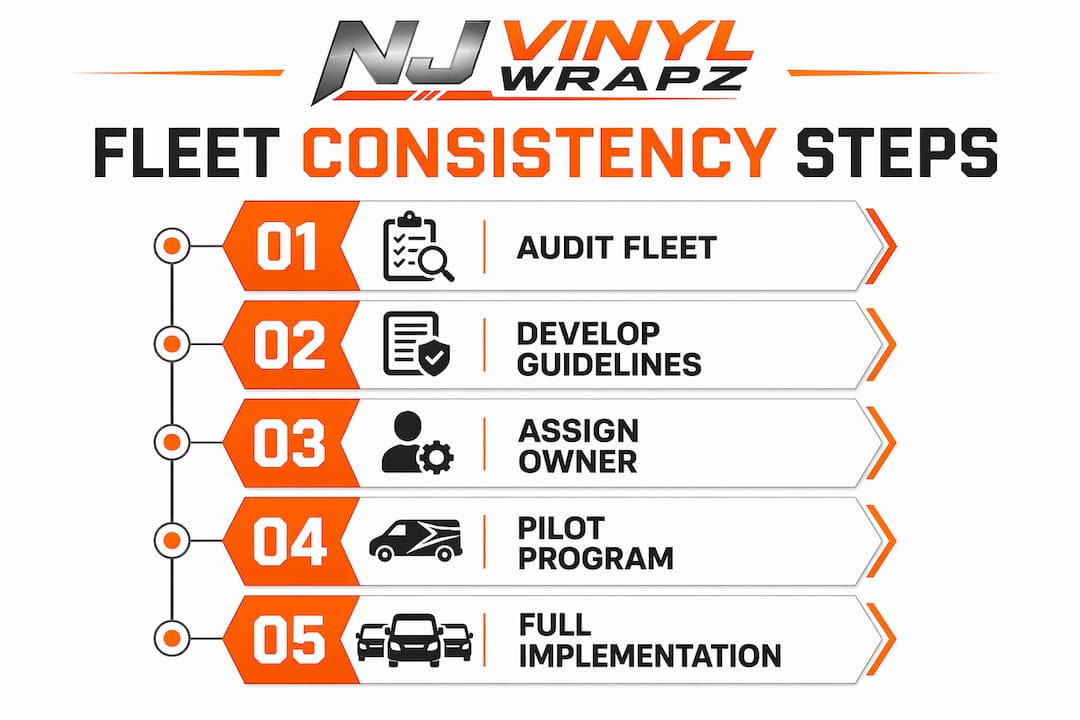
Start with a full audit of current fleet configurations and branding. Photograph every vehicle, document every equipment variant, and map every maintenance process. This baseline reveals the true scope of inconsistency and sets a measurable starting point.
Next, create a fleet brand guideline document. This is separate from a general marketing style guide. It addresses vehicle-specific details: wrap materials, approved vendors, installation standards, and inspection criteria. Njvinylwrapz recommends specifying materials by manufacturer grade, such as 3M or Avery cast vinyl, to prevent substitutions that compromise durability or color accuracy. Learn more about how fleet vehicle branding works as a long-term marketing asset.
Governance is what separates a one-time project from a lasting standard. Assign a fleet consistency owner, someone responsible for approving changes, auditing compliance, and updating the guidelines annually. Without ownership, standards erode within 12–18 months as procurement decisions and vendor relationships shift.
Pro Tip: Run a pilot wrap on three to five vehicles before committing to a full fleet rebrand. Use the pilot to verify color accuracy against your Delta E standard, test material durability, and confirm installation quality before scaling.
Key Takeaways
Fleet consistency requires aligning branding, vehicle specifications, and operational processes to build a reliable, professional fleet system.
| Point | Details |
|---|---|
| Define your standard early | Document color codes, vehicle specs, and SOPs before procurement begins to prevent costly retrofits. |
| Branding drives recall | Vehicle wraps lasting 5–7 years deliver continuous exposure, and 97% of viewers recall vehicle advertising. |
| Standardization cuts costs | Uniform vehicle configurations reduce technician learning curves and enable faster, cheaper maintenance. |
| Proactive maintenance wins | Shared KPIs and centralized data shift maintenance from reactive to scheduled, reducing downtime. |
| Governance sustains consistency | Assign a fleet consistency owner to audit compliance and update standards at least once per year. |
Why readiness beats speed every time
Fleet managers often chase speed. Faster delivery, faster repairs, faster onboarding. Speed feels like the goal. After working in and around fleet branding for years, I’ve come to believe that readiness is the actual goal, and consistency is how you build it.
I’ve seen fleets where every vehicle looked different, ran on different specs, and followed different inspection checklists. Those fleets were always reacting. A breakdown here, a branding complaint there, a driver confused by unfamiliar controls. The cost wasn’t just financial. It was the constant low-grade chaos that made managing the fleet exhausting.
The fleets that run well are boring in the best possible way. Every vehicle looks the same. Every technician knows exactly what they’re working on. Every driver knows where everything is. That predictability is not a limitation. It’s the foundation that lets you scale without losing control.
One misconception I hear often is that strict standardization kills flexibility. It doesn’t, if you build the standard correctly. Flexible standardization with a documented core platform and controlled regional variations gives you both. What kills flexibility is the absence of a standard, because then every exception becomes a permanent deviation.
Consistent branding also does something that operations managers sometimes overlook: it makes drivers proud of their vehicles. A driver operating a clean, professionally wrapped truck carries themselves differently. That pride shows up in how they treat the vehicle and how they interact with customers. That’s a real operational benefit, not a soft one.
— Krunal
How Njvinylwrapz supports fleet branding consistency
Fleet managers who have the operational side locked down often find that branding is the last piece to standardize. Njvinylwrapz works with commercial fleets across New Jersey to deliver full vehicle wraps that match exact brand specifications, from Pantone-matched colors to approved logo placements on every vehicle type.
Njvinylwrapz uses 3M and Avery cast vinyl materials installed in climate-controlled facilities, which means color accuracy and adhesion quality stay consistent across every vehicle in the fleet. The team handles wrap options ranging from full wraps to partial wraps and vehicle lettering, so fleets can standardize at any scale. With over 10 years of experience and licensed, insured operations, Njvinylwrapz is built to handle fleet branding projects that require precision and repeatability. Contact Njvinylwrapz to start a fleet branding consultation.
FAQ
What is the fleet consistency definition?
Fleet consistency is the uniform alignment of branding, vehicle specifications, and operational processes across an entire fleet. The goal is to make every vehicle and every process predictable, reducing costs and improving brand recognition.
Why is fleet consistency important for fleet managers?
Consistent fleets reduce training costs, lower maintenance expenses, and build customer trust through a professional, uniform appearance. Inconsistent configurations increase safety risks and make scaling a fleet significantly more expensive.
How do you measure fleet consistency?
Fleet managers measure consistency through shared KPIs such as vehicle uptime, cost per mile, and maintenance interval compliance. Color accuracy in branding is measured using the Delta E standard, where a deviation above 2.0 is visible to the human eye.
How long do fleet vehicle wraps last?
High-quality vehicle wraps last 5–7 years when installed with premium cast vinyl materials such as 3M or Avery. That lifespan makes fleet wraps a cost-effective, long-term branding investment compared to recurring advertising spend.
What is flexible standardization in fleet management?
Flexible standardization uses a common core vehicle platform while allowing documented, controlled variations for regional or regulatory needs. It prevents the patchwork configurations that arise when variations are improvised rather than planned.