
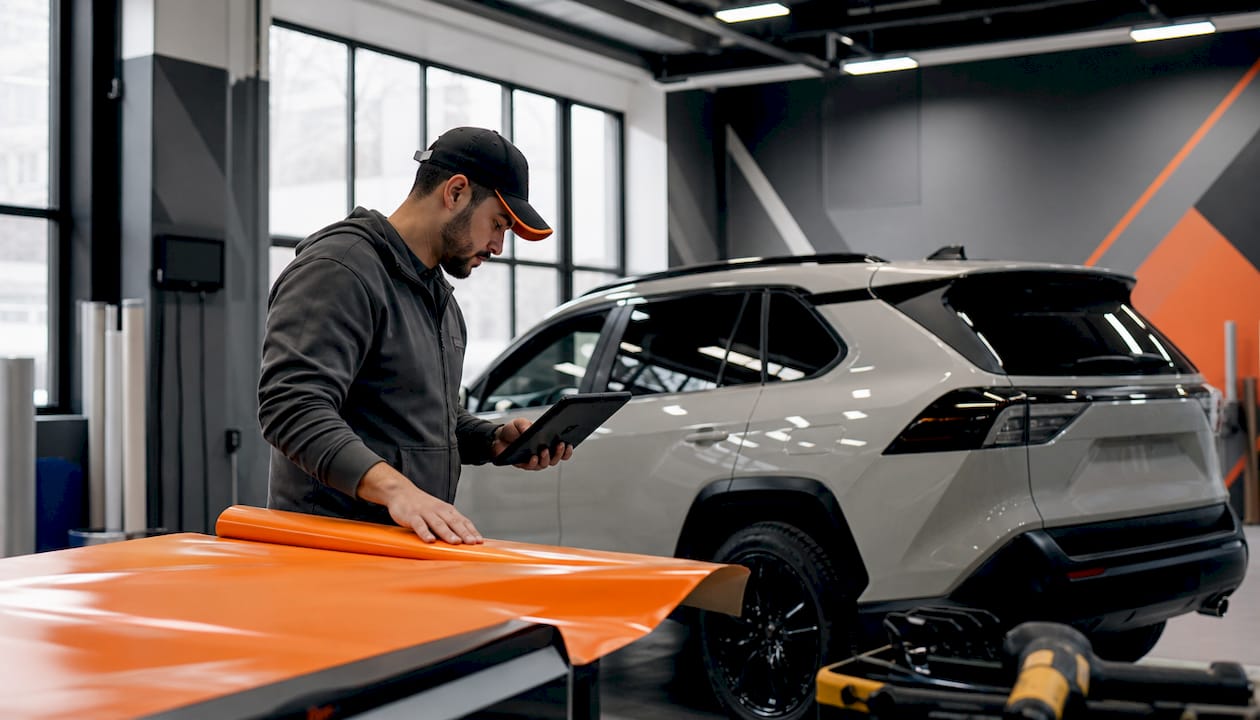
Climate-controlled installation is defined as the process of applying vehicle wraps, paint protection film (PPF), or vinyl graphics inside an enclosed environment where temperature and humidity are actively regulated to ensure proper adhesive bonding and film performance. Without this control, pressure-sensitive adhesives cannot achieve full chemical contact with the vehicle surface, leading to defects that appear days or weeks after the job looks complete. Njvinylwrapz operates dedicated climate-controlled facilities to eliminate these failure points from the start. Understanding what this process involves, and why it matters, helps you make smarter decisions about protecting your vehicle or fleet investment.
What is climate-controlled installation and how does it work?
Climate-controlled installation follows a defined sequence of steps, each dependent on the one before it. Skipping or rushing any stage compromises the adhesive bond, even if the finished wrap looks perfect on day one.
-
Thermal equalization of the vehicle. Before any film touches the surface, the vehicle must sit indoors for 2–3 hours. Solar load causes panels to run significantly warmer than ambient air. Installing on sun-hot panels causes adhesives to cure prematurely, locking in defects. Cold metal substrates present the opposite problem: they retain low temperature for 30–45 minutes or more even after entering a warm workshop, so rushing this step guarantees adhesion failure.
-
Environmental calibration. The workspace must hold a temperature of 68–77°F (20–25°C) and a relative humidity of 40–60%. These are not comfort settings. They are the operating window for pressure-sensitive adhesive chemistry. Outside this range, the adhesive either flows too fast or not at all.
-
Surface preparation. Technicians clean and degrease every panel. Contamination under the film creates bubbles that no amount of post-application squeegeeing can fix. Gloves are worn throughout, and anti-static spray prevents dust attraction during handling.
-
Film application. With the surface and environment stable, the installer applies the vinyl or PPF using squeegees and heat guns to conform the film to curves and recesses. The controlled temperature keeps the adhesive in its working window, giving the technician time to reposition and smooth the material without rushing.
-
Post-installation curing. The vehicle stays indoors for 24–72 hours after application to allow the adhesive to reach full bond strength. Adhesive cure rates roughly double for every 10°C increase in temperature, so a stable warm environment accelerates this phase without overheating the film.
Pro Tip: Ask your installer for the specific temperature log from your installation day. A professional shop records ambient conditions throughout the job. If they cannot produce this, the environment was not truly controlled.
Why does climate control determine adhesive performance?
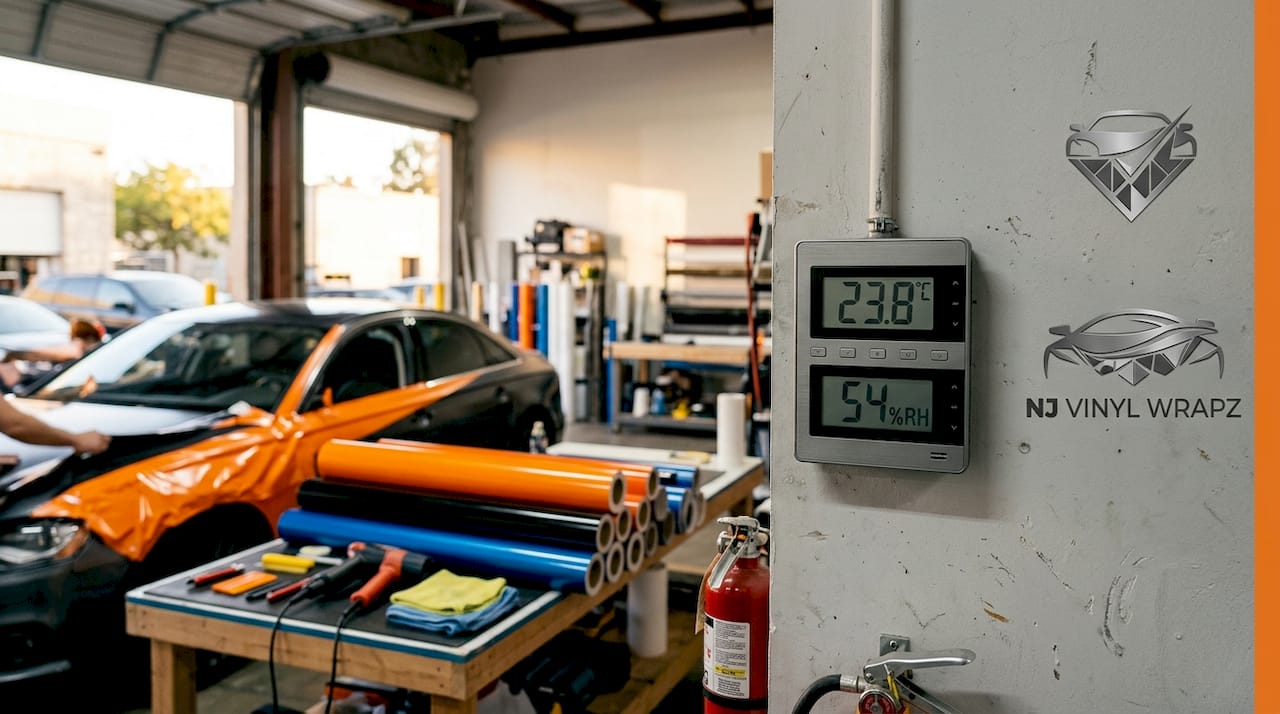
The chemistry of pressure-sensitive adhesives explains why environment matters so much. Vinyl and PPF are pressure-sensitive polymers, meaning they bond through contact and flow rather than through a chemical reaction triggered by mixing. Proper “wet out” occurs only within a specific temperature window. Outside that window, the adhesive either stiffens and fails to make full contact or flows too aggressively and loses repositionability.
Temperature extremes create predictable failure modes:
- Below 60°F (16°C substrate temperature): The adhesive chills and stiffens. Installing below 16°C leads to microscopic adhesion voids and bubbles that appear weeks later despite an initially clean look. Cold film also loses flexibility, making it prone to cracking during application on curved panels.
- Above 85°F (30°C): Adhesive properties deteriorate rapidly above 30–35°C, shortening the working window and causing premature bonding. Hot workshops force rushed installations, which is where most visible defects originate.
- Humidity below 40%: Static buildup below 40% humidity attracts dust particles under the wrap, producing a bumpy finish that cannot be corrected without removing and replacing the film.
- Humidity above 60%: Excess moisture interferes with adhesive cure and can cause the film to trap water vapor, leading to cloudy patches or delayed edge lifting.
“Vinyl and PPF are pressure-sensitive polymers requiring precise temperature and humidity for optimal adhesive wet out. Incorrect conditions cause microscopic adhesion voids that are invisible on day one but cause failure within weeks if climate control is ignored during installation.”
Edge lifting is the most common complaint after a poorly controlled installation. It starts at corners and trim edges where adhesive contact is thinnest, then spreads inward as the film is exposed to temperature swings and car washes. Preventing it starts before the first piece of film is unrolled, not after.
How to set up a proper climate-controlled workspace
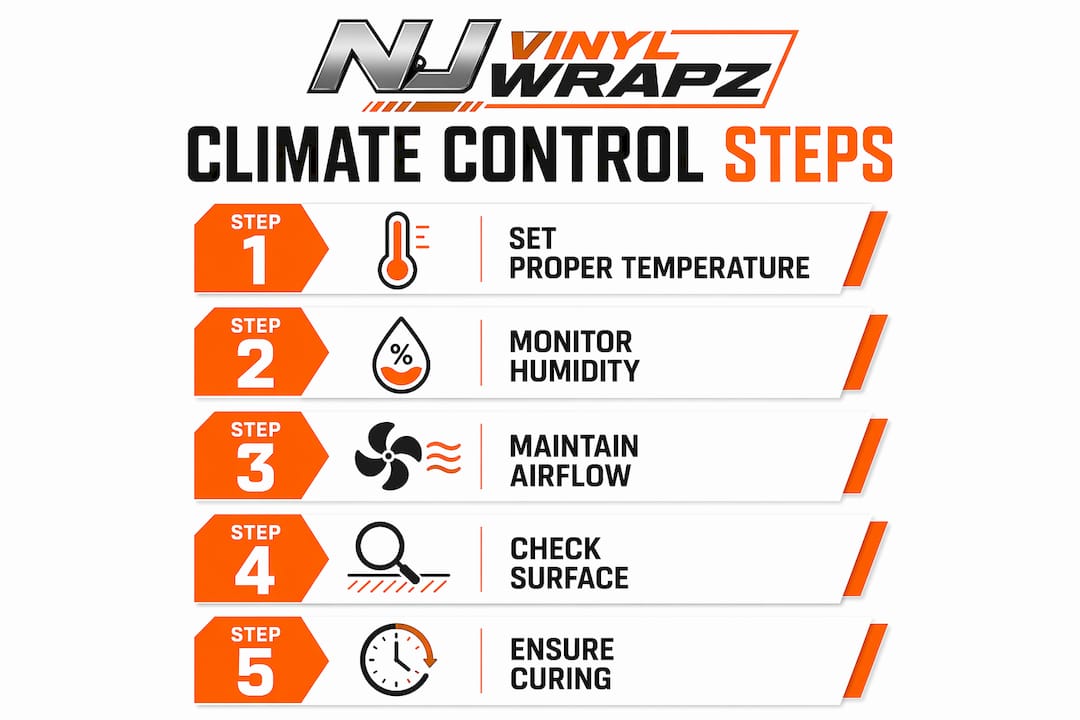
A genuinely controlled installation environment requires more than a closed garage. The right equipment and monitoring practices separate a professional facility from a space that merely looks professional.
Core equipment requirements:
- HVAC system with precise thermostat control to hold the 68–77°F range without cycling swings that briefly push temperatures out of spec
- Industrial dehumidifier or humidifier to maintain relative humidity at 40–60% year-round, since New Jersey winters and summers both push humidity to extremes
- HEPA-grade dust filtration on air intake and circulation systems to prevent airborne particles from settling on freshly cleaned panels
- Calibrated thermometers and hygrometers placed at vehicle height, not ceiling level, since temperature stratifies in large spaces
- Anti-static spray and lint-free gloves for all film handling to prevent contamination from hands and static charge
Pro Tip: Install your monitoring sensors at the same height as the vehicle hood, not near the ceiling. Heat rises, and a ceiling sensor can read 72°F while the panel surface sits at 65°F. That 7-degree gap is enough to cause adhesion problems.
Managing solar load is a separate challenge even inside a controlled space. Windows and skylights allow radiant heat to warm panel surfaces above ambient air temperature. Blocking direct sunlight with window film or shading on the facility itself prevents this hidden variable from undermining an otherwise well-controlled environment. Workspace organization also matters: clutter traps dust, and foot traffic near the vehicle during application stirs particles into the air. A clean, organized bay is a functional requirement, not just a preference.
You can learn more about preparing your vehicle before it enters the installation bay to reduce the time needed for thermal equalization and surface prep.
What are the benefits of climate-controlled installation for your vehicle?
The benefits of climate-controlled installation extend well beyond the day the wrap goes on. They compound over the life of the film.
- Longer adhesive life. A full chemical bond formed under ideal conditions resists heat cycling, UV exposure, and mechanical stress far longer than a partial bond formed in uncontrolled conditions. Releasing a vehicle too soon from indoor hold causes edge lifting when exposed to temperature swings, confirming that the curing phase is as important as the application itself.
- Cleaner finish with fewer defects. Dust-free, humidity-controlled air means the surface stays clean from prep through cure. Fewer contaminants mean fewer bubbles, fewer bumps, and a finish that looks as good at 18 months as it did on pickup day.
- Reduced rework costs. A wrap that fails at the edges within 90 days requires full or partial replacement. That cost falls on the shop or the customer depending on warranty terms. Climate-controlled installation eliminates the most common causes of early failure, protecting both parties.
- Consistent results across a fleet. For businesses wrapping multiple vehicles, consistency matters. A controlled environment produces the same result on vehicle 12 as it does on vehicle 1, which is critical for brand uniformity across a commercial fleet.
- Better protection for the underlying paint. PPF installed under proper conditions bonds fully to the clear coat, providing the impact and UV protection it was designed to deliver. A partial bond leaves gaps where moisture and debris can work underneath the film.
Understanding the benefits of wrap protection for fleet vehicles puts these installation standards in context. The wrap is only as good as the conditions under which it was applied.
Key Takeaways
Climate-controlled installation is the single most important factor determining whether a vehicle wrap or PPF delivers its full rated lifespan.
| Point | Details |
|---|---|
| Temperature range matters | Maintain 68–77°F during application to keep adhesive in its working window. |
| Humidity must stay balanced | Hold relative humidity at 40–60% to prevent static, dust, and cure interference. |
| Thermal equalization is required | Allow 2–3 hours of indoor acclimation before applying any film to the vehicle. |
| Curing time is non-negotiable | Keep the vehicle indoors for 24–72 hours post-installation to achieve full bond strength. |
| Controlled environments prevent rework | Proper climate control eliminates the root causes of edge lifting, bubbling, and premature peeling. |
Why I think most people underestimate the curing phase
Perspective by Krunal
After years of working with vehicle wraps and paint protection films, the question I hear most often is some version of “Can I pick it up today?” The application is done, the vehicle looks great, and the customer is ready to drive. I understand the impulse completely.
The part that rarely gets explained is that the adhesive has not finished working when the installer puts down the squeegee. The curing phase, those 24–72 hours indoors, is where the bond actually forms at a molecular level. Releasing a vehicle into cold air or direct sun before that window closes is the single most common cause of the edge lifting complaints I see come back to shops. The wrap did not fail. The process was cut short.
The other mistake I see regularly is assuming that any indoor space qualifies as “climate-controlled.” A garage with a space heater running in one corner is not a controlled environment. Temperature stratifies, humidity fluctuates, and dust settles on panels the moment the heater cycles off. Real climate management means consistent, monitored conditions from the moment the vehicle enters the bay to the moment it leaves after curing.
My honest advice to anyone considering a wrap or PPF: ask the shop to walk you through their facility before you book. If they cannot show you a thermostat, a hygrometer, and a filtration system, the environment is not controlled. The material cost and the labor cost are the same whether the installation succeeds or fails. The environment is the variable that decides which outcome you get.
— Krunal
Njvinylwrapz climate-controlled installation for lasting results
Njvinylwrapz installs every vehicle wrap and paint protection film in a fully climate-controlled facility, holding temperature and humidity within the ranges that pressure-sensitive adhesives require for a complete bond. Every vehicle goes through thermal equalization before film touches the surface, and every job includes the full post-installation curing period before the vehicle leaves the bay.

Whether you are protecting a personal vehicle or branding a commercial fleet, the installation environment determines how long your investment lasts. Njvinylwrapz’s full vehicle wrap services and paint protection film installations are backed by over 10 years of experience, licensed and insured operations, and materials from trusted brands including 3M and Avery. Contact Njvinylwrapz to schedule your installation and see the difference a controlled environment makes.
FAQ
What is the ideal temperature for vehicle wrap installation?
The ideal installation temperature is 68–77°F (20–25°C) for both the ambient air and the vehicle panel surface. Outside this range, pressure-sensitive adhesives either stiffen and fail to bond fully or cure too fast for proper application.
How long does a vehicle need to cure after wrap installation?
A vehicle should remain in a stable, climate-controlled environment for 24–72 hours after installation. Releasing it too soon exposes the adhesive to temperature swings before the bond is complete, which causes edge lifting.
Why does humidity matter during wrap installation?
Humidity below 40% causes static buildup that attracts dust under the film, producing a bumpy finish. Humidity above 60% interferes with adhesive cure and can trap moisture under the wrap.
Can a vehicle be wrapped in a regular garage?
A standard garage without active temperature and humidity control does not meet the conditions required for proper adhesive bonding. Dust, temperature swings, and uncontrolled humidity all create defects that appear weeks after installation.
What happens if a wrap is installed in cold conditions?
Installing vinyl or PPF on a substrate below 60°F (16°C) causes the adhesive to stiffen and fail to make full contact with the panel. The result is microscopic voids that develop into visible bubbles and edge lifting within weeks.