
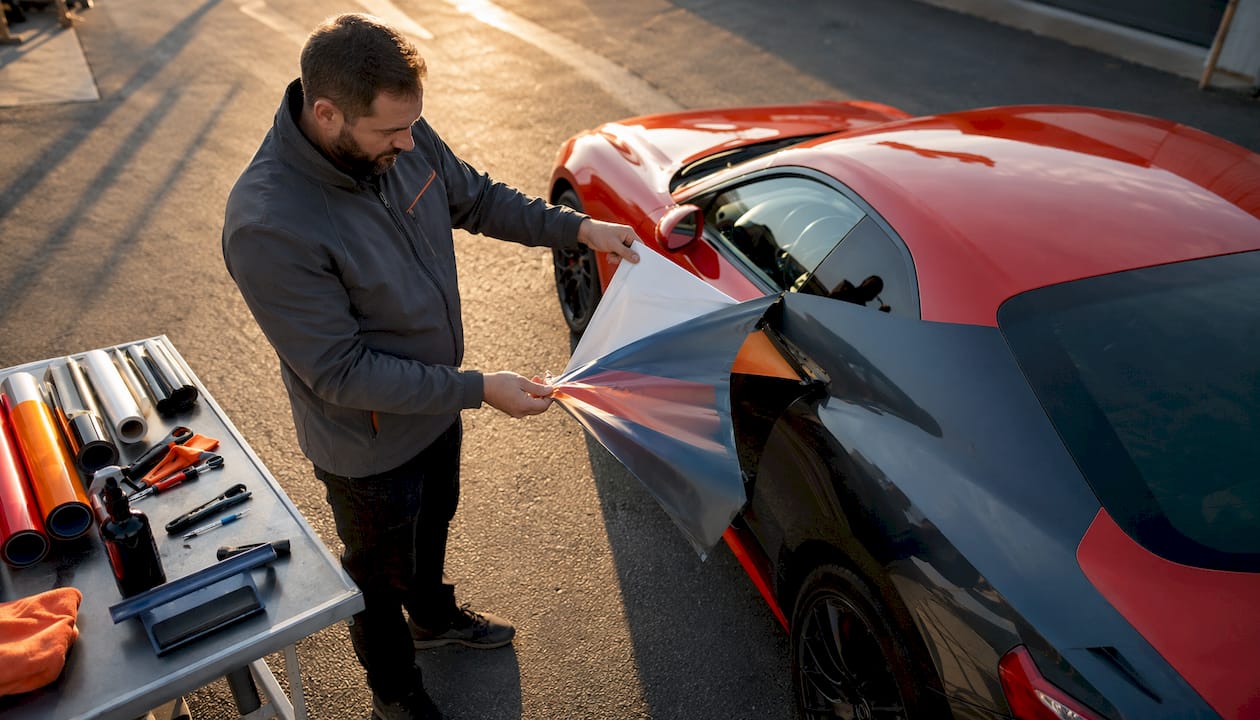
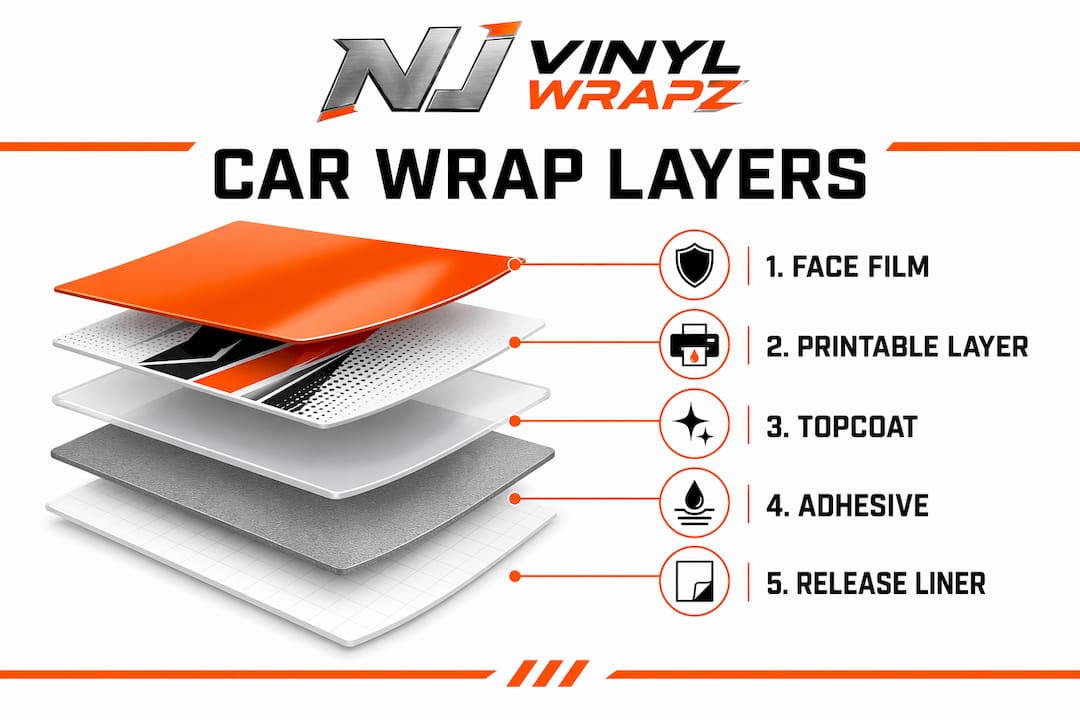
A car wrap is a multi-layer film built around a face film (usually polyvinyl chloride, or PVC; sometimes thermoplastic polyurethane, or TPU), combined with plasticizers, stabilizers, pigments, a protective topcoat, a pressure-sensitive acrylic adhesive, and a release liner. That stack is what film composition experts and manufacturers like 3M and Avery Dennison have standardized across the industry. Premium cast films from those brands are generally around 2.0–2.5 mils thick and carry manufacturer warranties covering several years of outdoor use.
The layers at a glance:
- Face film (PVC or TPU): The visible surface that carries color, texture, and structure
- Printable/ink layer: Where graphics and color are applied before lamination
- Topcoat/overlaminate: Seals the ink, controls gloss or matte finish, and blocks UV
- Pressure-sensitive adhesive: Bonds the film to the vehicle’s painted surface
- Release liner: Protects the adhesive during shipping, printing, and handling; peeled away at install
Table of Contents
- What is car wrap made of, layer by layer?
- How is car wrap film actually made?
- Cast vs. calendered vinyl: which one fits your project?
- Vinyl wrap vs. paint protection film: what’s the real difference?
- Material specs and finishes: what the numbers actually mean
- How long do wraps last, and how do you maintain them?
- Environmental and safety considerations for PVC wraps
- Professional recommendations: matching film to application
- Key Takeaways
- The material choice most installers wish clients understood sooner
- Njvinylwrapz: professional installs backed by premium materials
- Useful sources
- FAQ
What is car wrap made of, layer by layer?
Every wrap film you see on a vehicle is a precisely engineered sandwich. Each layer has a specific job, and the chemistry of each one directly affects how the wrap looks, how long it lasts, and how easy it is to remove.
Face film: PVC vs. TPU
The face film is the structural core. Most wraps use a PVC face film because PVC is cost-effective, accepts pigment well, and can be engineered to stretch around curves. Plasticizers are blended into the PVC to keep it flexible; stabilizers (typically heat and UV stabilizers) prevent the film from degrading prematurely. The exact plasticizer chemistry matters more than most buyers realize. Premium films use high-stability plasticizers that resist migration, while budget films use simpler formulations that can leach out over time, leaving the film brittle.
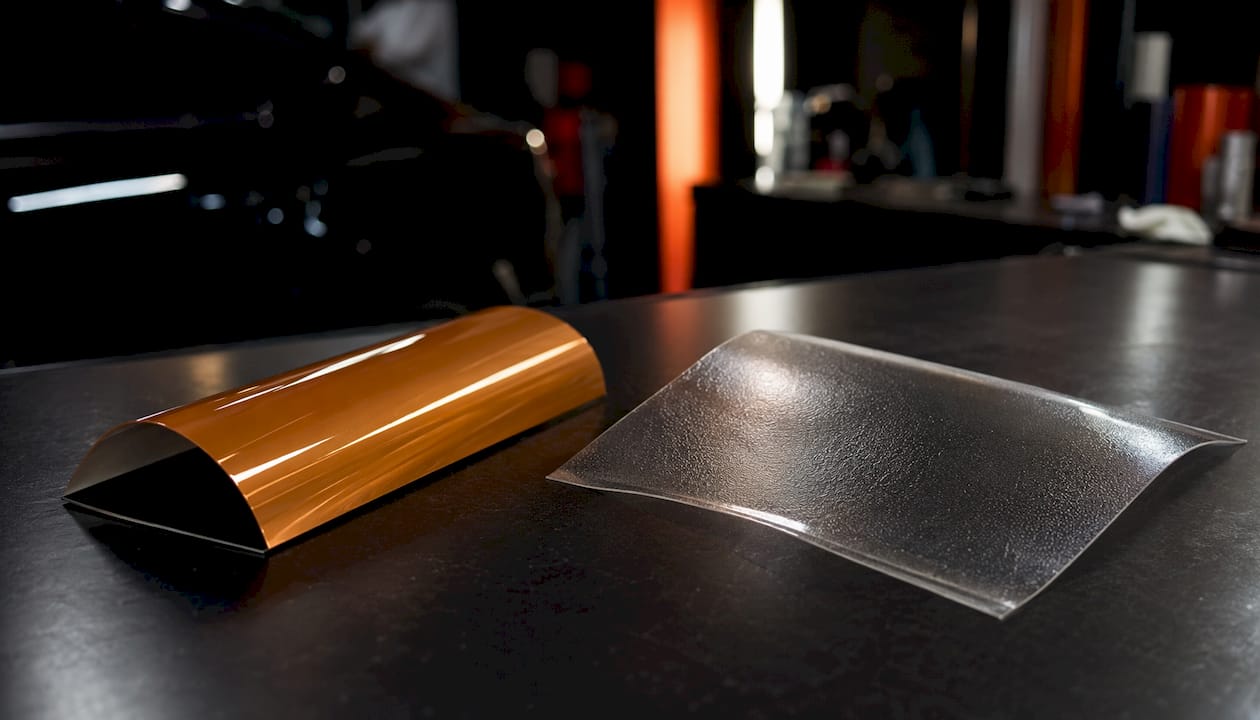
TPU face films are a different animal. They’re tougher, more elastic, and naturally self-healing at a microscopic level, which is why TPU is the material of choice for paint protection film (PPF) rather than decorative wraps.
| Layer | Primary Material | Function |
|---|---|---|
| Face film | PVC (most wraps) or TPU (PPF) | Color, structure, conformability |
| Ink/printable layer | Solvent or latex inks | Graphics, branding, color change |
| Topcoat/overlaminate | Polyurethane or acrylic chemistry | UV protection, gloss/matte control |
| Adhesive | Pressure-sensitive acrylic | Bonds film to paint; enables removal |
| Release liner | Silicone-coated paper or polyester | Protects adhesive; aids printing registration |
Printable layer and topcoat
For printed wraps, inks are applied directly to the face film or to a printable overlaminate. Solvent-based and latex inks are both common; solvent inks penetrate the film surface for durability, while latex inks cure with heat and are considered lower in volatile organic compounds. After printing, a clear overlaminate is applied. That laminate is what gives a wrap its gloss, satin, or matte finish, and it’s the primary UV barrier protecting the ink underneath.
Adhesive and release liner
The adhesive layer is a pressure-sensitive acrylic formulation. “Pressure-sensitive” means it bonds on contact without heat or solvent activation. Tack profiles vary: repositionable adhesives allow adjustment during install, while permanent adhesives grip immediately and are harder to reposition. Many premium films use an air-egress adhesive pattern (tiny channels embossed into the adhesive surface) that lets air escape during application and prevents bubbles. The release liner, usually silicone-coated polyester, keeps the adhesive clean and stable until the installer peels it away.
How is car wrap film actually made?
The manufacturing process is where cast and calendered films diverge, and that divergence explains nearly every performance difference you’ll encounter in the field.
-
Solution casting (cast film): Liquid PVC resin is dissolved in a solvent to create a viscous solution. That solution is poured onto a moving casting sheet and spread to a precise, uniform thickness. The solvent evaporates in a controlled oven, leaving a cured film with low internal stress and exceptional dimensional stability. The result is thin (typically 2.0–2.5 mils), highly conformable, and capable of stretching around compound curves without springing back.
-
Calendering (calendered film): PVC compound is heated and forced through a series of heavy rollers that squeeze it to the target thickness. The mechanical pressure introduces internal stress into the film. Calendered film is thicker (typically 2.5–4.0 mils for lettering grades) and carries a “memory” of that stress, meaning it wants to return to its original flat shape when heat is applied.
-
Primer and adhesive coating: After the face film is produced, a primer layer is applied to improve adhesive bonding. The pressure-sensitive acrylic adhesive is then coated onto the primed surface and the release liner is laminated on top.
-
Topcoat or overlaminate application: A clear protective coat is applied either inline (during manufacturing) or as a separate lamination step. This is where finish options (gloss, matte, metallic) are determined.
-
Slitting and roll conversion: The finished master roll is slit to standard widths (typically 54 or 60 inches for vehicle wrap films) and wound onto cores for distribution. Print shops and installers receive these rolls and apply graphics or cut them to shape before installation.
The practical consequence: cast film conforms to door handles, mirror caps, and bumper curves with heat and moderate pressure. Calendered film resists that conforming and will try to lift at edges if forced onto compound curves.
Cast vs. calendered vinyl: which one fits your project?
| Feature | Cast vinyl | Calendered vinyl |
|---|---|---|
| Manufacturing method | Solution casting | Roller extrusion |
| Typical thickness | 2.0–2.5 mils | 2.5–4.0 mils |
| Conformability | High (compound curves, recesses) | Low to moderate (flat/simple curves) |
| Dimensional stability | Excellent (low internal stress) | Lower (internal stress causes shrink) |
| Expected outdoor life | multiple years for premium films | shorter duration typical for calendered films |
| Relative cost | Higher | Lower |
| Best applications | Full-body color change, complex panels | Flat signage, short-term graphics, lettering |
Choose cast vinyl when: you’re wrapping a full vehicle, dealing with modern sculpted body panels, or need the wrap to last more than three years outdoors. Manufacturers and professional installers consistently recommend cast vinyl for full-body wraps precisely because of its higher elongation and low shrink tendency.
Calendered is acceptable when: you’re applying flat decals, door lettering, or short-term promotional graphics on flat surfaces. The lower cost makes sense for high-turnover fleet graphics that get replaced seasonally.
The failure modes to know: Calendered film on compound curves will edge-lift as its internal stress reasserts itself, especially in heat. Mixing cast face film with a calendered laminate (or vice versa) is generally discouraged because the two films expand and contract at different rates, voiding most manufacturer warranties. Always use matched film and laminate sets.
Vinyl wrap vs. paint protection film: what’s the real difference?
People conflate these two products constantly, and the confusion leads to real money wasted. Vinyl wrap is primarily cosmetic. PPF is primarily protective. The material difference is the reason.
- Vinyl wrap: PVC-based face film engineered for color, texture, and graphics. It provides a modest UV and chemical barrier for the paint underneath, but it has no self-healing capability and won’t absorb rock chips or road debris without showing damage.
- PPF: TPU-based film engineered for impact absorption. Premium PPF products self-heal fine swirl marks and light scratches when exposed to heat. The trade-off is cost: PPF runs significantly more per square foot than vinyl, and finish options are more limited.
For fleet managers and business owners, the practical answer is a hybrid install. Wrap the full vehicle in cast vinyl for branding and color change, then add PPF on the high-impact zones: the hood leading edge, front bumper, fenders, and door edges. You get the visual impact of a full wrap with meaningful protection where the vehicle actually takes hits. For more on PPF vs. vinyl differences, Njvinylwrapz covers the specifics in detail.
Material specs and finishes: what the numbers actually mean
When you’re reviewing quotes or evaluating materials, these are the specs that matter.
| Spec | Cast film (typical) | Calendered film (typical) |
|---|---|---|
| Thickness | 2.0–2.5 mils | 2.5–4.0 mils |
| Elongation at break | several times | approximately double |
| Adhesive type | Repositionable or permanent acrylic | Permanent acrylic |
| Air-egress liner | Common on premium films | Less common |
| Outdoor warranty | several years | 1–3 years |
Finish options are almost entirely controlled by the topcoat or overlaminate:
- Gloss: Standard high-shine finish; the most common and easiest to clean
- Satin/matte: Flat or semi-flat topcoat that diffuses light; hides minor surface imperfections
- Metallic: Metallic flake or brushed-aluminum effect embedded in the face film or topcoat
- Chrome/mirror: Extremely thin metallic layer; the most demanding to install and most sensitive to damage
- Textured: Carbon fiber, leather grain, or brushed finishes created by embossing the face film surface
When reviewing a technical data sheet (TDS) from 3M or Avery Dennison, look for UV resistance test results (typically measured in kilolangley hours), plasticizer stability data, and whether the warranty requires a specific matched laminate. Those three data points tell you more about real-world durability than any marketing claim. Njvinylwrapz’s breakdown of why 3M and Avery materials earn their premium is worth reading before you spec a project.
How long do wraps last, and how do you maintain them?
Premium cast films from major manufacturers typically last several years outdoors when properly installed and maintained, while calendered films have a shorter typical lifespan under the same conditions. Those numbers assume correct film selection, professional installation, and consistent upkeep. UV exposure, chemical contact, and heat are the three biggest life-shorteners.
Plasticizer migration is the failure mode most owners never see coming. Over time, plasticizers leach out of the PVC face film, especially in hot, sunny climates. The film becomes progressively stiffer and more brittle, eventually cracking at flex points. Premium films slow this process with more stable plasticizer chemistry, but no PVC film eliminates it entirely.
Maintenance basics:
- Hand wash with pH-neutral soap and a soft microfiber cloth; avoid automated brushed car washes
- Rinse with low-pressure water; high-pressure jets near edges can lift the film
- Remove fuel spills, bird droppings, and tree sap immediately; prolonged contact etches the topcoat
- Apply a wrap-safe sealant (not a wax with petroleum distillates) every three to six months
- Store vehicles indoors or under cover when possible to limit UV accumulation
Pro Tip: For the first 30 days after installation, keep high-pressure water away from all edges and avoid automated car washes entirely. The adhesive needs time to fully cure and bond to the paint surface. Washing too aggressively during that window is one of the most common causes of early edge lift.
For fleet vehicles specifically, Njvinylwrapz covers wrap protection strategies that extend service life across high-mileage commercial applications.
Environmental and safety considerations for PVC wraps
PVC is not a clean material from an environmental standpoint, and buyers who care about that should know the trade-offs before committing.
- Chlorine content: PVC contains chlorine by definition. Incineration releases hydrogen chloride and, under some conditions, dioxins. Landfill disposal is the more common end-of-life path, but PVC does not biodegrade.
- Recycling limitations: Most curbside recycling programs do not accept vinyl wrap film. Specialty vinyl recyclers exist in some markets, but access is inconsistent across the U.S.
- Plasticizer migration: Beyond the durability concern, migrating plasticizers (particularly older phthalate-based formulations) raise environmental and health questions. Premium films have largely shifted to non-phthalate plasticizers, but budget films may still use older chemistry.
- PVC-free alternatives: TPU films (used in PPF) are more recyclable and produce fewer toxic byproducts at end of life. Some specialty wrap films use polyurethane or other polymer bases, though finish options and cost profiles differ from standard PVC wraps.
- Installer safety: Solvent-based printing requires adequate ventilation. Installers working with solvent inks in enclosed spaces should use appropriate respiratory protection and ensure air exchange meets OSHA guidelines.
For most buyers, the practical answer is to choose premium films with non-phthalate plasticizers, ask your installer about end-of-life disposal options, and consider TPU-based films for applications where protection is the primary goal.
Professional recommendations: matching film to application
The single most preventable failure in vehicle wrapping is using the wrong film for the panel. Here’s the short version of what professionals recommend.
For full-body wraps on modern vehicles: Use cast vinyl, full stop. The compound curves on contemporary body panels will defeat calendered film within months. Ask your installer for the manufacturer’s TDS and confirm the film and laminate are a matched set.
For flat graphics, lettering, or short-term promotions: Calendered film is cost-effective and performs well. Just don’t apply it to bumpers, mirror caps, or door handles.
Hybrid install checklist for fleet vehicles:
- Hood leading edge and full hood: PPF
- Front bumper: PPF
- Front fenders: PPF or cast vinyl depending on budget
- Doors, roof, rear panels: cast vinyl wrap for branding
- Mirrors: cast vinyl (high conformability needed)
Pro Tip: When vetting an installer, ask three things: Is the facility climate-controlled? Can you show me the TDS for the film you’re recommending? Do you have documented examples of removal from a vehicle after five-plus years? An installer who can answer all three confidently is working at a professional level. One who can’t answer the second question is guessing on materials. Njvinylwrapz’s guide on preparing your vehicle for a professional wrap covers the pre-install steps that make a real difference in outcome.
Key Takeaways
Car wrap film is a multi-layer PVC or TPU system where cast vinyl outperforms calendered on complex curves, PPF adds impact protection vinyl cannot provide, and consistent maintenance is what separates a five-year wrap from a two-year one.
| Point | Details |
|---|---|
| Core material | Most wraps use a PVC face film with plasticizers, stabilizers, pigments, adhesive, and a release liner. |
| Cast vs. calendered | Cast film (2.0–2.5 mils) conforms to compound curves; calendered (2.5–4.0 mils) suits flat graphics only. |
| Vinyl vs. PPF | Vinyl is cosmetic; TPU-based PPF absorbs impacts and self-heals, making hybrid installs the smart choice for fleets. |
| Lifespan expectations | Premium cast films last several years outdoors; calendered films have a shorter typical lifespan. |
| Njvinylwrapz | Njvinylwrapz installs matched cast vinyl and PPF in a climate-controlled facility using 3M and Avery Dennison materials. |
The material choice most installers wish clients understood sooner
The conversation that comes up most often in professional shops isn’t about color or finish. It’s about why a wrap that looked great at six months is lifting at the edges by month eighteen. Almost every time, the answer traces back to one of three things: calendered film on a panel it was never designed for, a mismatched laminate that expands at a different rate than the face film, or surface prep that was rushed.
What’s underappreciated is how much the adhesive formulation matters independently of the face film. A cast film with a repositionable adhesive gives an installer the margin to correct alignment on a complex panel. A permanent adhesive on the same film punishes any hesitation. Clients who push for the fastest possible install time are often the ones who end up with bubbles or misaligned graphics, because speed and adhesive chemistry are in direct tension on compound surfaces.
The other thing worth saying plainly: vinyl wrap has no self-healing properties. None. A fine swirl from a brushed car wash will stay there. Chrome and mirror finishes are especially unforgiving because every surface imperfection reads clearly. If a client wants a chrome finish on a daily driver that goes through an automated wash, the honest answer is that it won’t look good for long. The material is real; the maintenance expectation has to match it.
Njvinylwrapz: professional installs backed by premium materials
When the material choice and the installation quality both have to be right, working with a shop that sources from 3M and Avery Dennison and installs in a climate-controlled environment removes most of the variables that cause early failures.
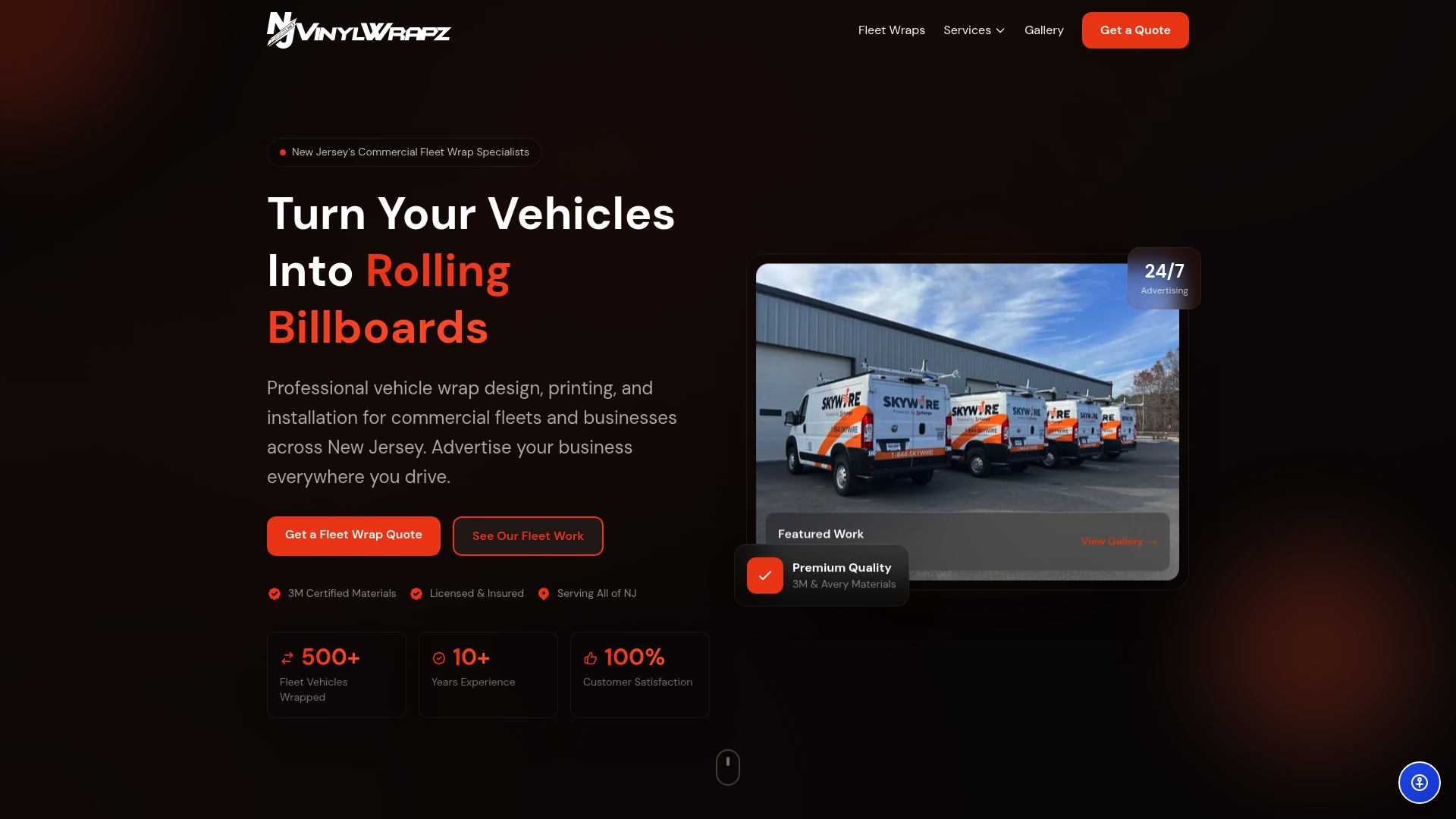
Njvinylwrapz has over 10 years of experience wrapping commercial fleets and personal vehicles across New Jersey, with services covering full vehicle wraps, partial graphics, vehicle lettering, PPF, and hybrid installs. Every project starts with a material review: the right film family for the panel geometry, a matched laminate set, and a TDS from the manufacturer on file. For fleet managers who need consistent branding across multiple vehicles, or individual owners who want a color change that holds up, the next step is straightforward. Request a quote or consultation at Njvinylwrapz and get a material recommendation before you commit to anything.
Useful sources
- Vehicle vinyl wrap (Wikipedia): A solid overview of wrap history, materials, and applications; useful starting point for context.
- 3M Graphics Technical Data Sheets: Manufacturer TDS for 3M wrap films, including thickness, elongation, UV resistance, and warranty terms. Search “3M 1080 series TDS” for the most widely used wrap film line.
- Avery Dennison Vehicle Wraps: Avery’s technical resources cover film specifications, matched laminate requirements, and installer certification programs.
- Cast vs. Calendered Vinyl (Hoosier Decal): Clear technical explainer on manufacturing differences and performance implications; good pre-purchase reading.
- PPF vs. Vinyl Wrap (Euroluxe Detailing): Practical breakdown of TPU vs. PVC for buyers deciding between protection and aesthetics.
- Tint & Wraps Customs: A professional vehicle protection shop covering tinting, PPF, and wrap services; useful reference for hybrid protection strategies.
FAQ
What are the downsides of wrapping a car?
Vinyl wrap offers no self-healing protection, so rock chips and scratches remain visible. Improper installation or the wrong film type can also cause edge lifting and premature failure, particularly on compound curves.
Can you wash a wrapped car?
Yes, but hand washing with pH-neutral soap and a soft microfiber cloth is strongly recommended. Avoid brushed automated car washes and high-pressure jets near edges, especially in the first 30 days after installation.
How long will a wrap last on a car?
Premium cast films typically last several years outdoors with proper maintenance. Calendered films generally have a shorter typical lifespan before showing significant wear or edge lift.
Is it cheaper to wrap a car or paint it?
A professional full-body wrap is generally less expensive than a high-quality paint job, and it’s fully removable without damaging the original paint. The cost advantage narrows if you choose premium PPF or specialty finishes like chrome.