
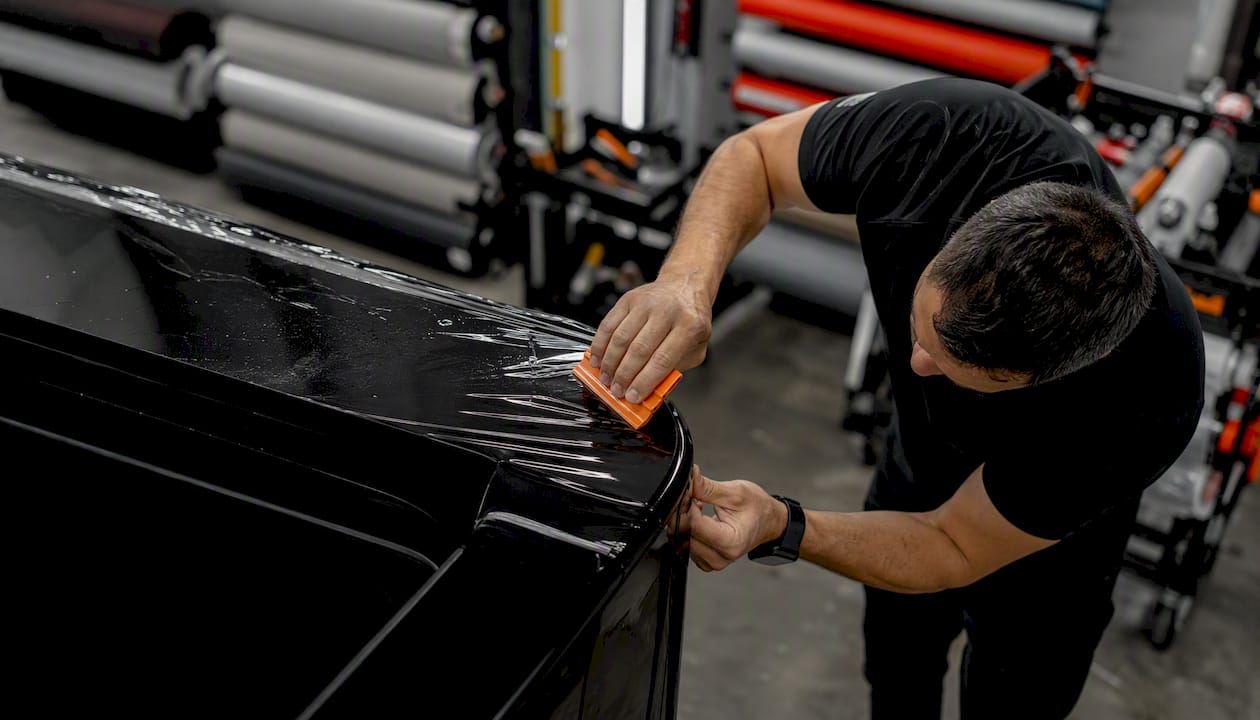
For a full color-change wrap, pick a premium cast film in the 2.5 to 3.5 mil range. For partial wraps, decals, and flat panel graphics, a calendered or thicker cast film around 3 to 4.5 mil holds up fine. If rock chips and road debris are the real threat, paint protection film at 6 to 10 mil is the right tool, not a thicker wrap. The trade-off underneath all three choices is the same: more caliper buys you scratch and impact resistance, but it costs you conformability on curves.
A few quick rules before you dig into specs:
- Complex curves and body lines favor cast vinyl almost every time, regardless of exact mil count.
- Impact and chip protection calls for PPF, not a thicker color-change wrap. They solve different problems.
- Always check whether a spec lists face caliper or total caliper before comparing two products. They are not the same number, and mixing them up is how people get burned.
The rest of this guide breaks down what those mil numbers actually measure, how manufacturing method changes what a mil delivers, and how to read a spec sheet like someone who’s installed a few hundred wraps.
Key Takeaways
Vinyl wrap thickness matters less than manufacturing method, but face caliper, dimensional stability, and material class together determine how a film performs on curves, in sunlight, and over years.
| Point | Details |
|---|---|
| Match thickness to job | Color-change wraps run 2.5–3.5 mil cast; PPF runs 6–10 mil for impact protection. |
| Construction beats raw mil | Cast film’s low-stress manufacturing outperforms thicker calendered film on curves. |
| Check face caliper, not total | Spec sheets that blend face, adhesive, and laminate numbers overstate true film thickness. |
| Shrinkage tracks material type | Calendered vinyl carries manufacturing stress that causes edge lifting over time. |
| NJ Vinyl Wrapz recommends by use case | The shop pairs cast film with full color changes and steers chip-prone vehicles toward PPF. |
Table of Contents
- What Vinyl Wrap Thickness Actually Measures
- Cast vs. Calendered vs. Hybrid: Why Manufacturing Matters More Than the Number
- Recommended Vinyl Wrap Thickness Options by Job Type
- How Thickness Affects Conformability and Durability
- How Film Thickness Changes the Installation Process
- How to Read a Vinyl Wrap Spec Sheet
- Quick Checklist for Choosing Your Wrap Thickness
- What NJ Vinyl Wrapz Sees on the Shop Floor
- Cast Film for Color, Thicker Film for Impact
- Get the Right Film Thickness the First Time
- Sources
- FAQ
What Vinyl Wrap Thickness Actually Measures
A “mil” is one thousandth of an inch. A micrometer, written µm, is one millionth of a meter. Since most manufacturers now publish both, a rough anchor helps: 1 mil equals about 25.4 µm, so a 4 mil film runs close to 102 µm. Nothing exotic. It’s just a small unit for a thin material.
Here’s where people get tripped up: a wrap has multiple layers, and specs don’t always say which one they’re measuring. Face caliper is the colored film itself, the part you see and touch, and it’s the number installers actually compare when judging conformability and finish. Adhesive caliper is the sticky layer underneath, usually a fraction of the face thickness. Total caliper adds everything together, including any laminate or clear topcoat.
Before comparing two products, check for:
- Whether the number is labeled “face,” “film,” or “total”
- Whether adhesive thickness is broken out separately
- Whether a laminate or overlaminate is included in the stated figure
A sheet that quietly reports total caliper next to one that reports face caliper will look thicker than it really is, and that gap changes how a film behaves on a bumper versus a door skin.
Cast vs. Calendered vs. Hybrid: Why Manufacturing Matters More Than the Number
Two films can share the same mil rating and behave completely differently on a car. That’s because thickness only tells you how much material there is, not how it was made or how it wants to move once it’s warm and under tension.
Cast vinyl is poured as liquid PVC and cured into a thin, relaxed sheet, typically around 2 to 3 mil at the face. Because it’s never mechanically stretched during production, it holds almost no internal stress. That’s why it stretches, shrinks back less over time, and settles into deep recesses, mirrors, and bumper contours without fighting you. Cast film’s relaxed manufacturing process is the actual reason it outperforms thicker alternatives on tight curves, not some magic property of being “premium.”
Calendered vinyl is made differently: hot PVC gets forced through rollers under pressure, which stretches and thins the material mechanically. That process bakes in tension the film “remembers” for years. Calendered films run thicker, usually 3 to 4 mil or more, and cost less, but that stored memory means they want to shrink back toward their original shape, especially on curved panels.
Hybrids split the difference, engineered to behave more like cast film while costing less to produce. PPF is a different animal entirely: a urethane based film built for impact absorption, not color, running 6 to 10 mil because its job is mechanical protection, not conformability.
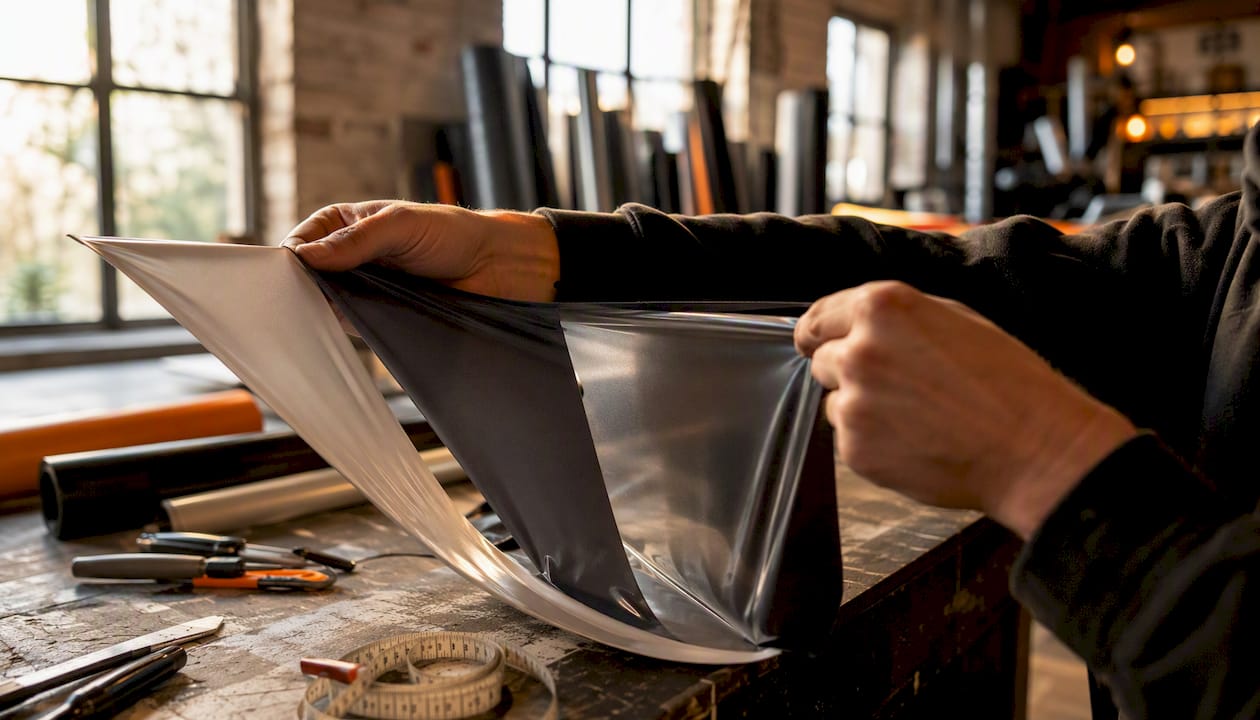
Pro Tip: If a job has flat panels and a tight budget, calendered vinyl at 3 to 4 mil is a reasonable call. The moment you’re wrapping mirrors, door handles, or complex curves, pay for cast film even though it’s thinner. You’ll spend less time fighting the material with a heat gun.
Recommended Vinyl Wrap Thickness Options by Job Type
The right thickness depends entirely on what the vehicle needs to survive, not just what looks good on day one. Manufacturer data and installer-facing guides converge on a fairly consistent set of ranges once you sort by use case.
| Use Case | Face Thickness (Mil / µm) | Material Type | Conformability | Expected Life |
|---|---|---|---|---|
| Full color-change wrap | 2.5–3.5 mil | Premium cast | Excellent on curves | 5–7+ years |
| Partial wraps and decals | 3–4.5 mil | Calendered or standard cast | Good on flat/moderate curves | 3–5 years |
| Fleet graphics | 3–4 mil | Calendered or hybrid | Good, built for flat panels | 1–3 years |
| Paint protection film | 6–10 mil | Urethane (PPF) | Moderate, needs heat to conform | 5–10 years with care |
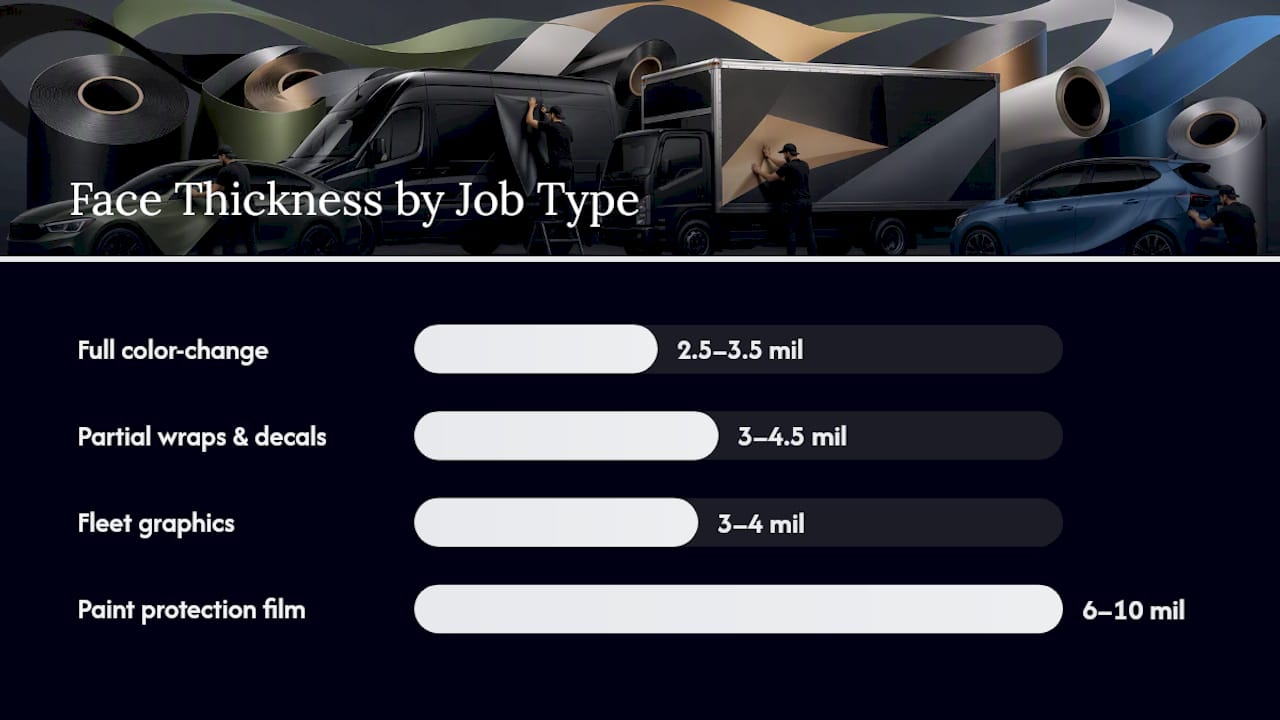
An industry explainer on film thickness backs up these bands, and separate material comparison data shows premium cast running as thin as 2.0 to 2.5 mil while still outlasting thicker calendered options.
Total caliper complicates this table a bit. A laminate or overlaminate adds protection against UV and scratches, but it also adds mechanical stiffness. If a spec sheet’s “total” number includes a heavy laminate, don’t assume the face film underneath is thick, too; it might still be a thin, flexible cast film with a tough topcoat riding on top.
Longevity tracks material choice as much as raw mil count:
- Premium cast: 5 to 7 years or more with proper care
- Standard cast or hybrid: 3 to 5 years
- Calendered: 1 to 3 years, shorter on curved panels
- PPF: 5 to 10 years depending on maintenance, as covered in our guide to reaching 5 to 7 years of wrap life
How Thickness Affects Conformability and Durability
Thinner cast films consistently outperform thicker calendered films on anything with real geometry, mirrors, wheel wells, roof pillars, because they carry no manufacturing stress to fight against. That’s counterintuitive to a lot of first-time buyers who assume thicker automatically means tougher, but conformability and impact resistance are two separate properties, and thickness only helps with one of them.
Durability against UV and scratches works differently. A laminate or thicker topcoat genuinely does add abrasion resistance, and Avery Dennison’s own product data sheet for its SW900 line puts face caliper at roughly 3.2 to 4.7 mil while flagging that films at 4 mil and above can show reduced conformability. That’s a manufacturer stating plainly that its own thicker SKUs trade flexibility for surface toughness, right on the spec sheet.
Shrinkage is the long game. Calendered films carry stored tension from the rolling process, and that tension slowly releases over months and years, most visibly at edges and inside curves. The practical result shows up as lifting corners, bubbling near recessed panels, and a wrap that looks tired well before its color has faded.
- Cast film: low shrinkage, stable appearance for years
- Calendered film: higher shrinkage, especially on curved sections
- Thicker laminates: better scratch resistance, added stiffness during install
Finish choice, gloss, satin, matte, usually comes from the laminate layer rather than the base film, so a matte finish doesn’t automatically mean a thinner or thicker product underneath.
How Film Thickness Changes the Installation Process
Thickness changes what happens the moment a heat gun comes out. Thin cast films respond fast and need less heat to stretch into a recess, so overheating is the real risk, not underheating. Thicker films and PPF need more sustained heat and a proper post-heat cycle to let the adhesive fully bond after the material relaxes into shape.
Tension matters just as much as heat. Thin films need a gentler touch with the squeegee since they’ll distort if you pull too hard, while thicker films tolerate a slightly heavier hand and forgive minor technique mistakes.
Trimming is where thickness quietly bites installers who aren’t paying attention. Heavier laminates and topcoats dull blades faster, and a dull blade dragging through a thick film tears edges instead of cutting them clean. Avery’s own installation bulletin calls out fresh blades specifically for thicker laminate work.
Pro Tip: Most Avery films skip adhesive promoter entirely when applied per the manufacturer’s bulletin. Reach for primer only on unusual substrates like textured plastic trim, not as a default habit.
How to Read a Vinyl Wrap Spec Sheet
Before trusting any thickness claim, check five lines on the spec sheet: face caliper, adhesive caliper, dimensional stability, elongation at yield, and the warranty or durability table. Skip any of those and you’re comparing marketing copy, not material.
Avery’s SW900 line is a good real-world example of why the specific SKU matters more than the product family name. Standard colors sit around 4.2 mil face caliper, the Diamond finishes run thicker at 5.4 to 5.7 mil, and the Rugged line lands near 4.5 mil. Three products under one family name, three different conformability profiles. 3M publishes comparable data for its own wrap film lines, and it’s worth pulling that sheet side by side before assuming two “premium” films behave the same way.
Dimensional stability and elongation at yield matter as much as face caliper because they predict how a film behaves once it’s stretched and heated, not just how thick it sits on the shelf.
Ask your supplier or installer for the actual product data sheet, not a summary. If you’re unsure what “adhesive caliper” refers to on that sheet, our breakdown of what car wrap is made of walks through each layer in plain terms.
Quick Checklist for Choosing Your Wrap Thickness
Before you call an installer, work through these five questions:
- How long do you need this to last: a season, a lease term, or the life of the vehicle?
- How complex is the vehicle’s body: mostly flat panels, or full of curves and recesses?
- Are you after color and branding, or physical impact protection?
- What’s the budget ceiling for material and labor?
- Have you confirmed face caliper and dimensional stability, not just a headline “thickness” number?
As a shortcut: full color-change, go premium cast at 2.5 to 3.5 mil. Fleet graphics on boxy vans, calendered or hybrid at 3 to 4 mil is fine. Front-end rock chip protection, skip vinyl altogether and go PPF at 6 to 10 mil.
What NJ Vinyl Wrapz Sees on the Shop Floor
After years of installs across fleets and personal vehicles, one pattern holds: premium cast wins nearly every full color-change job, and not by a small margin. Less shrinkage means fewer callbacks eighteen months later for lifting edges, and it finishes cleaner around mirrors and door handles the first time.
The most common client mistake is confusing laminate thickness with face caliper, then getting surprised when a “thick-sounding” product still shrinks at the edges. A close second: choosing calendered vinyl for a vehicle with heavy body sculpting because it was cheaper per square foot, then paying for a redo. Fleet clients who skip edge sealing also see lifting sooner, regardless of what film they chose.
In practice, we point commercial fleets toward standard or hybrid cast in the 3 to 4 mil range for the balance of cost and lifespan, and we steer clients toward PPF or ceramic coating instead of a thicker wrap when the actual goal is rock chip and abrasion protection.
Cast Film for Color, Thicker Film for Impact
If the goal is color, branding, or a clean finish on a vehicle with real body lines, premium cast in that 2.5 to 3.5 mil range is the right call almost every time. Design fidelity and a smooth finish come from the film relaxing into the shape, not fighting it.
If the actual worry is rock chips, road debris, or resale value on the front end, that’s a different job entirely, and it calls for PPF, not a heavier wrap. NJ Vinyl Wrapz can walk through material selection for either scenario; the full vehicle wraps page is the fastest way to get a project-specific recommendation.
Get the Right Film Thickness the First Time
Guessing at mil ranges from a spec sheet is one thing. Having someone who installs these films every week tell you exactly which one fits your vehicle and your budget is another. NJ Vinyl Wrapz has spent more than 10 years fitting premium cast, calendered, and PPF films onto everything from single work trucks to full commercial fleets, working exclusively with 3M and Avery Dennison materials in a climate-controlled facility where temperature and humidity aren’t fighting the install.

That matters because thickness decisions made on paper only hold up if the install matches them, correct heat, correct tension, correct edge sealing. Licensed and insured on every job, NJ Vinyl Wrapz handles full color-change wraps, fleet branding at scale, and paint protection film installs for owners who care more about chip resistance than color. If you’re not sure whether your project calls for 3 mil cast or 8 mil PPF, request a quote through the full vehicle wraps page and get a straight answer based on your vehicle’s shape and how long you need the result to last.
Sources
Before buying, pull the actual product data sheet rather than relying on a seller’s summary.
- PDS - SW 900 Series Supreme Wrapping Film
- Vinyl Film Thickness Explained: Choosing the Right Mil for Durability and Conformability
- Cast vs Calendered Vinyl Wrap Material Comparison | WrapSize
- Understanding the Role of Vinyl Thickness in Car Wraps | Elite Wrappers Blog
3M publishes equivalent spec sheets for its own wrap lines; ask your installer or supplier for the exact SKU document rather than a general brochure.
FAQ
How thick should vinyl wrap be?
Most full color-change jobs use premium cast film between 2.5 and 3.5 mil, while installer guidance puts the broader practical range for vehicle wraps at roughly 3 to 4.5 mil depending on material type.
How thick is a 3M vinyl wrap?
3M publishes face caliper specs on its individual product data sheets, and figures vary by line, similar to how Avery’s SW900 family ranges from about 4.2 to 5.7 mil depending on the specific finish. Always check the exact SKU sheet rather than assuming one number applies across the brand.
Is 12 gauge or 16 gauge vinyl thicker?
Lower gauge numbers indicate thicker material, so lower gauge vinyl is thicker than higher gauge. This gauge system is more common in banner and sign vinyl than in automotive wrap film, which is almost always specified in mils instead.
How much can a 20 sq ft wrap cover?
Twenty square feet covers a small section like a hood, a set of doors, or a modest partial wrap area, not a full vehicle. A typical sedan needs a few hundred square feet of material for a full wrap, so 20 square feet is closer to a decal or spot graphic job.