

Vehicle wraps typically run a CPM between $0.10 and $0.80, and even conservative estimates rarely push past $1. That beats billboards, radio, and local TV by a wide margin, largely because a wrapped vehicle keeps generating impressions every mile it drives for years, not weeks. The number you actually get depends on your route density and how long the wrap lasts, so run the formula in the next section against your own mileage before you compare it to any other channel.
TL;DR:
- Vehicle wraps generally have a CPM between $0.10 and $0.80, heavily influenced by route density, vehicle size, and material durability.
- Accurate impression estimates are crucial, with the miles-per-impression method providing conservative figures and the daily impressions method offering straightforward calculations.
- Longer-lasting wraps on high-mileage fleets can drop the effective CPM over time, making them ideal for brands with consistent local routes and high daily impressions.
- Installation quality significantly impacts the wrap’s lifespan and true CPM, with proper prep and climate-controlled application preventing early failure.
- Comparing vehicle wrap CPM to other media helps gauge value, but wraps are best suited for long-term branding rather than short-term promotions.
Table of Contents
- How to Calculate Your Vehicle Wrap CPM
- How Vehicle Wrap CPM Stacks Up Against Other Media
- What Actually Moves Your CPM Up or Down
- Turning CPM Into ROI: Break-Even and Payback
- What a Wrap Actually Costs, and How to Amortize It
- Why Installation Quality Is the Hidden CPM Variable
- When Wraps Earn Their Keep, and When They Don’t
- Get a CPM-Backed Wrap Quote From NJ Vinyl Wrapz
- Sources
- FAQ
How to Calculate Your Vehicle Wrap CPM
The formula is the same one media buyers have used for decades: CPM = total cost ÷ (total impressions ÷ 1,000). The only hard part with vehicle wraps is getting a defensible impressions number, since nobody hands you a media report the way a billboard company does.
There are two practical ways to estimate impressions:
- Daily impressions method. Multiply a conservative daily impression estimate by the number of days the wrap will be on the road, then by the years you expect it to last.
- Miles-per-impression method. Estimate impressions per mile driven (a common rough range is 1 to 3 impressions per mile in mixed traffic), then multiply by your annual mileage.
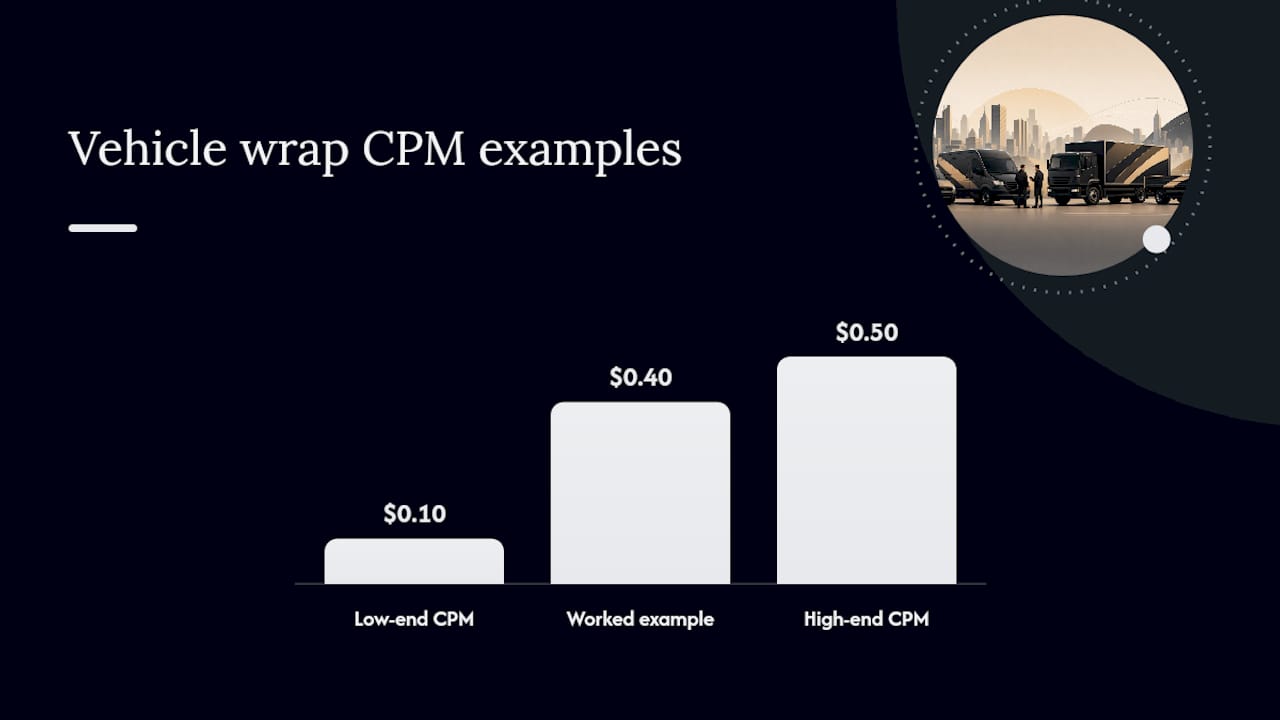
Here’s a worked example using the daily method. Say you spend $4,000 on a full van wrap and drive it 250 days a year for 4 years. Using a conservative 10,000 daily impressions (a reasonable lower bound for a suburban service route), your total impressions come to 10,000,000 over the wrap’s life. That’s $4,000 ÷ (10,000,000 ÷ 1,000), which equals $0.40 CPM. This lines up with worked examples showing fleet-wrap CPMs commonly land in the $0.10 to $0.50 range depending on how conservative your inputs are.
Pro Tip: Always round your daily impression estimate down, not up. A wrap you underestimate looks better every year it keeps performing; a wrap you overestimate makes your CPM math worthless the moment someone asks how you got the number.
Treat your daily impressions figure as the variable to be most skeptical about. Cost and mileage are facts you can verify. Impressions are an estimate, and an inflated one undermines every downstream ROI calculation you build on top of it.
How Vehicle Wrap CPM Stacks Up Against Other Media
Out-of-home advertising as a category already beats most traditional media on cost efficiency, and vehicle wraps sit at the low end of that category. Industry data distributed by the Out of Home Advertising Association of America has long supported sub-$1 CPMs for vehicle-based formats, and trade coverage has cited a vehicle-wrap CPM of roughly $0.77 in direct comparisons against broadcast buys.
Rough benchmark ranges you’ll see across the industry:
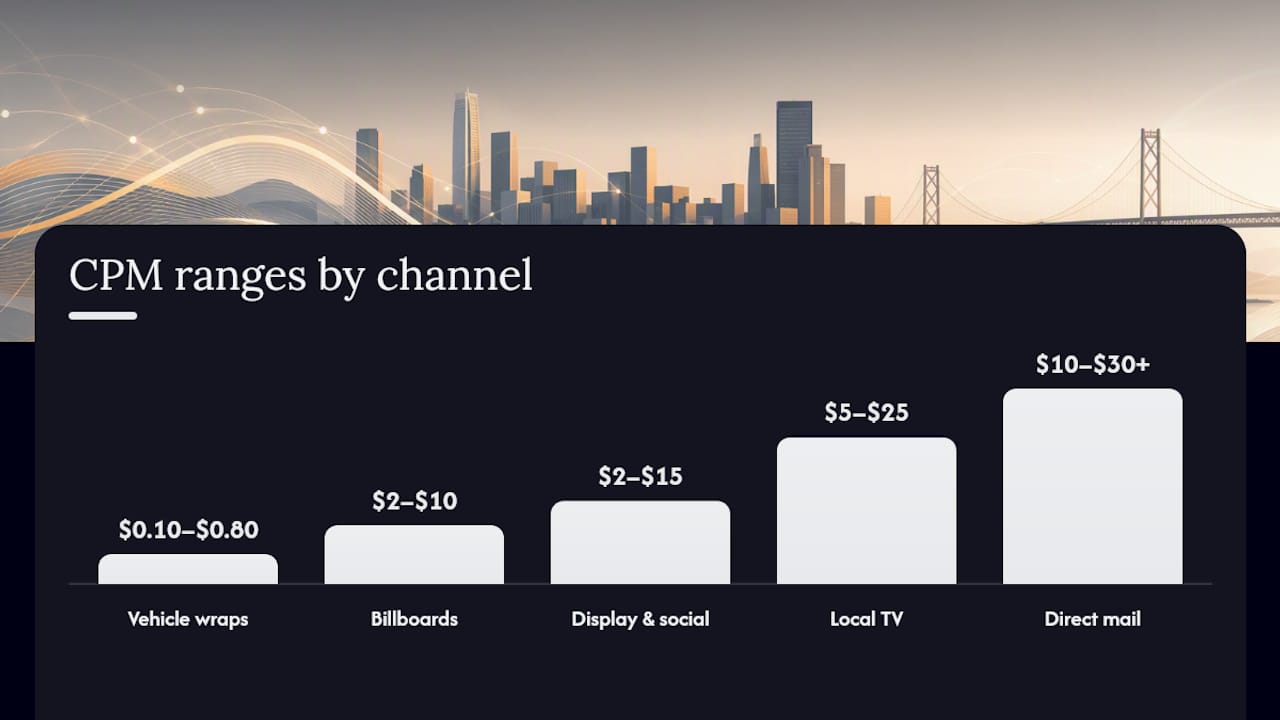
- Billboards: typically $2 to $10 CPM, depending on market and location
- Local TV: often $5 to $25 CPM depending on daypart and market size
- Radio: commonly $5 to $15 CPM
- Direct mail: frequently $10 to $30+ CPM once printing and postage are counted
- Display and social ads: wide range, often $2 to $15 CPM depending on targeting
- Vehicle wraps: roughly $0.10 to $0.80 CPM over the wrap’s working life
The catch is that these numbers aren’t perfectly comparable. A billboard sells a fixed audience in a fixed location at a fixed price point per campaign. A vehicle wrap is a mobile, owned asset that keeps producing impressions for years after the initial spend, so its CPM naturally drops the longer it stays on the road and the more the vehicle is driven. Comparing vehicle-wrap CPM to a one-month billboard buy is useful for a gut check on relative value, but it’s not an apples-to-apples media buy. Use CPM comparisons to gauge magnitude, not to make a spreadsheet claim that a wrap “beats” a billboard by a specific multiple.
What Actually Moves Your CPM Up or Down
Four variables do almost all the work in determining whether your wrap lands at $0.15 or $0.90 CPM.
- Vehicle size and class. A box truck offers more surface area and higher visibility per impression than a sedan, but it also costs more to wrap, so the CPM impact depends on whether the added visibility outpaces the added cost.
- Route density and hours on the road. A delivery van running dense urban routes all day generates far more impressions than the same van parked in a warehouse lot half the week. Trade reporting has noted urban routes can produce daily impression counts as high as 30,000 to 70,000 in dense corridors, though that figure applies specifically to heavy urban routing, while suburban service route impressions are generally lower.
- Design and readability. A wrap with cluttered text, poor contrast, or no clear call to action gets seen but not read, and an impression that doesn’t register your phone number or offer is a wasted one for ROI purposes even if it still counts for CPM.
- Material and installation quality. A wrap that fails early because of poor lamination or a rushed install shortens your amortization window and quietly raises your effective CPM, even though the sticker price on the job never changed.
Pro Tip: If you’re choosing between spending more on a bigger vehicle or more on a better installer, spend it on the installer first. A premium wrap that fails at 18 months costs you more per impression than a modest wrap that holds for 5 years.
Turning CPM Into ROI: Break-Even and Payback
CPM tells you how cheap your impressions are, but it doesn’t tell you whether the wrap is making money. For that, break-even analysis is the more useful business metric, because it ties your wrap spend directly to customers instead of impressions.
The formula: Break-even customers = wrap cost ÷ profit per new customer.
- Take your total wrap investment (say $4,000 for a van wrap).
- Divide by your average profit per new customer. If a typical job nets you $200 in profit, you need 20 new customers over the life of the wrap to break even.
- Spread that across your wrap’s expected lifespan. Twenty customers over 4 years is 5 customers a year, or roughly one every 10 weeks, which is a modest bar for a vehicle that’s already on the road doing its job anyway.
The harder part isn’t the math, it’s attribution. You need a way to know a lead actually came from the wrap rather than your website or word of mouth. Fleet managers running multiple wrapped vehicles can extend this further using GPS and telematics data to correlate high-traffic routes with lead spikes, which sharpens both your impressions estimate and your attribution story.
Run the payback math under a pessimistic conversion assumption, not an optimistic one. If your realistic conversion rate is half what you hoped, does the wrap still pay for itself inside 2 years? If yes, you have a genuinely defensible investment case, not a hopeful one.
What a Wrap Actually Costs, and How to Amortize It
Cost ranges vary by vehicle size and how much of the surface you cover. Sample regional pricing shows small cars typically running lower than vans, with box trucks and larger commercial vehicles costing more due to sheer surface area and material volume, though exact figures shift by region and shop.
- Full wraps cover the entire vehicle and deliver the strongest brand impact and the lowest CPM per square foot of coverage, since you’re maximizing visible surface area for a single install cost.
For amortization, use a conservative lifespan of 3 to 5 years for standard installs and up to 5 to 7 years for premium materials with careful installation and maintenance. Divide total cost by expected years to get an annual cost figure, then divide that by your annual impressions to recheck your CPM every year the wrap stays functional. A longer-lasting wrap doesn’t just look better, it mathematically lowers your CPM every additional year it survives on the road.
Why Installation Quality Is the Hidden CPM Variable
Every CPM calculation assumes the wrap survives long enough to hit its projected impression count. That assumption lives or dies on installation quality, not just material grade.
Acclimating vinyl before application, running a multi-step surface cleaning process, installing in a climate-controlled space, and holding steady temperatures for the first 24 hours after application all reduce the early failures (bubbling, lifting edges, premature fading) that cut a wrap’s working life short.
NJ Vinyl Wrapz has built its full vehicle wrap process around that protocol, using 3M and Avery materials installed in a climate-controlled facility rather than an open bay exposed to dust and temperature swings. That matters for CPM specifically because a wrap that fails at 18 months instead of lasting 5 years doesn’t just look bad, it silently doubles or triples your real cost per impression.
It’s also why conservative daily-impression inputs matter more than impressive-sounding ones. A fleet manager who models 10,000 daily impressions and gets 12,000 looks credible to their CFO. One who models 50,000 and gets 15,000 has a budgeting problem on their hands next quarter.
— NJ Vinyl Wrapz
When Wraps Earn Their Keep, and When They Don’t
Wraps make the most sense for local service fleets, businesses building long-term brand recognition, and anyone racking up high daily mileage, since the CPM keeps dropping the longer the vehicle stays on the road. They’re the wrong tool for a flash sale or a promotion that needs traffic this week. If you need an immediate, trackable spike in foot traffic or phone calls, pair the wrap with a short digital or direct mail push instead of expecting the vehicle alone to carry a deadline.
Get a CPM-Backed Wrap Quote From NJ Vinyl Wrapz
You’ve got the formula and the benchmarks. What most marketers lack is a quote that actually holds up against that math, one built on real installation costs and materials instead of a rough guess. Some providers have extensive experience installing wraps for area fleets using licensed, insured crews and premium materials, applied in climate-controlled facilities so the lifespan assumptions in CPM calculations actually hold up on the road.
Whether you’re pricing out a single service van or a full commercial fleet, you can run the numbers from this article against a real project. Browse fleet wrap options if you’re managing multiple vehicles, or check wrap packages for a single vehicle to see what full, partial, and lettering jobs typically include. Request a quote and NJ Vinyl Wrapz will help you translate your expected mileage and route into a realistic impressions estimate before you commit a dollar.
Sources
- Vehicle wraps offer better value than TV, radio ads | Automotive Fleet
- How to calculate the ROI of a fleet wrap (With real numbers) — Summit Graphics
FAQ
What is the average cost of a car wrap?
A full car wrap typically runs into the low thousands depending on vehicle size and design complexity, while partial wraps and lettering cost less. NJ Vinyl Wrapz lists partial wraps at $1,500 to $3,000 and lettering starting from $300, with full wrap pricing available on request.
How long will a quality vehicle wrap last?
A well-installed wrap using premium cast vinyl typically lasts 3 to 5 years under standard conditions, with premium materials and careful installation stretching that to 5 to 7 years. Installation quality, including proper surface prep and climate-controlled application, has a bigger effect on lifespan than most owners expect.
How much can a wrapped vehicle earn back through advertising exposure?
There’s no fixed return figure, since it depends entirely on route mileage, conversion rates, and profit per customer. The more useful approach is running your own break-even calculation: divide your wrap cost by your average profit per new customer to see how many conversions you need to cover the investment.
Is it cheaper to wrap a car than to paint it?
A full color-change wrap is generally comparable in cost to a quality paint job, but it’s reversible and typically faster to complete, which makes it attractive for businesses or lease vehicles that may need to revert to original paint later. NJ Vinyl Wrapz offers color change wraps as an alternative to permanent repainting, with pricing available on request.
Why is vehicle wrap CPM so much lower than other media?
A vehicle wrap keeps generating impressions every time the vehicle is driven for as long as the wrap lasts, often years, while most paid media buys expire after a single campaign window. That extended lifespan is why wraps frequently land near $0.77 CPM or lower, compared with the multi-dollar CPMs typical of TV, radio, or billboards.