

Every self-propelled commercial motor vehicle must display the carrier’s legal name (or a single trade name) exactly as registered on Form MCS-150, plus the USDOT number preceded by the letters “USDOT,” on both sides of the vehicle. The lettering has to contrast sharply with the background and be readable from 50 feet in daylight. Two inches is the legal minimum for character height, with many fleets using larger sizes for better legibility.
TL;DR:
- Ensuring the legal name on vehicle markings matches the registered name in the MCS-150 is critical, as even a missing word or abbreviation can trigger violations.
- The USDOT number must be preceded by “USDOT” and be legible from 50 feet during daylight, with a recommended character height of 3 to 4 inches for reliable visibility.
- Markings placed on lower cab doors or side panels are preferable, but placement must not obstruct readability from the required distance, especially on sleeper cabs or curved units.
- Trailer markings are required for vehicles over 10,001 pounds GVWR operating interstate, unless already covered by the tractor’s markings or alternative documentation.
- Regular yard inspections and pre-check routines, including photo documentation and the 50-foot visibility test at different times of day, help prevent roadside violations and ensure compliance.
Table of Contents
- What Counts As Correct US DOT Number Placement On A Yard Check
- What The Regulation Actually Requires
- Where To Place Markings On Trucks And Trailers
- How To Pass The 50-Foot Legibility Test Every Time
- Vinyl, Paint, Or Magnets: Choosing A Marking Method That Lasts
- Special Cases: Leased Units, Intermodal, Driveaway, And PRISM
- Common Mistakes And A Repeatable Yard Audit
- Verifying And Updating Your MCS-150 Registration
- What A Professional Installer Should Deliver For Compliance
- Why The 50-Foot Test Matters More Than Fleets Think
- Get Your Fleet’s Markings Inspection-Ready
- Sources
- FAQ
What Counts As Correct US DOT Number Placement On A Yard Check
A five-minute walk-around catches most violations before a roadside inspector does. Run this before any truck leaves the lot:
- Pull up the MCS-150 record and confirm the lettering on the door matches the registered legal name or trade name, character for character.
- Check that “USDOT” precedes the number, with no missing letters or extra punctuation.
- Stand 50 feet from each side of the cab in daylight and confirm you can read the marking without squinting.
- Photograph both sides for a dated compliance record.
- Confirm there’s only one visible USDOT number on the unit. Leftover markings from a previous owner or lessee need to come off, not just get covered.
- Note any leased or rented unit separately. It may carry a different name than your other trucks depending on the lease terms.
If a truck fails any one of these checks, hold it. A five-minute fix at the yard beats a citation at a weigh station.
What The Regulation Actually Requires
49 CFR 390.21 is the rule that governs everything in this article, and it’s worth reading in plain terms rather than relying on secondhand summaries. The regulation requires every self-propelled commercial motor vehicle operated by a motor carrier to show the carrier’s legal name or single trade name, along with the USDOT number, on both sides of the vehicle. It also requires the marking to contrast sharply with the vehicle’s color and remain legible during daylight hours from 50 feet away.
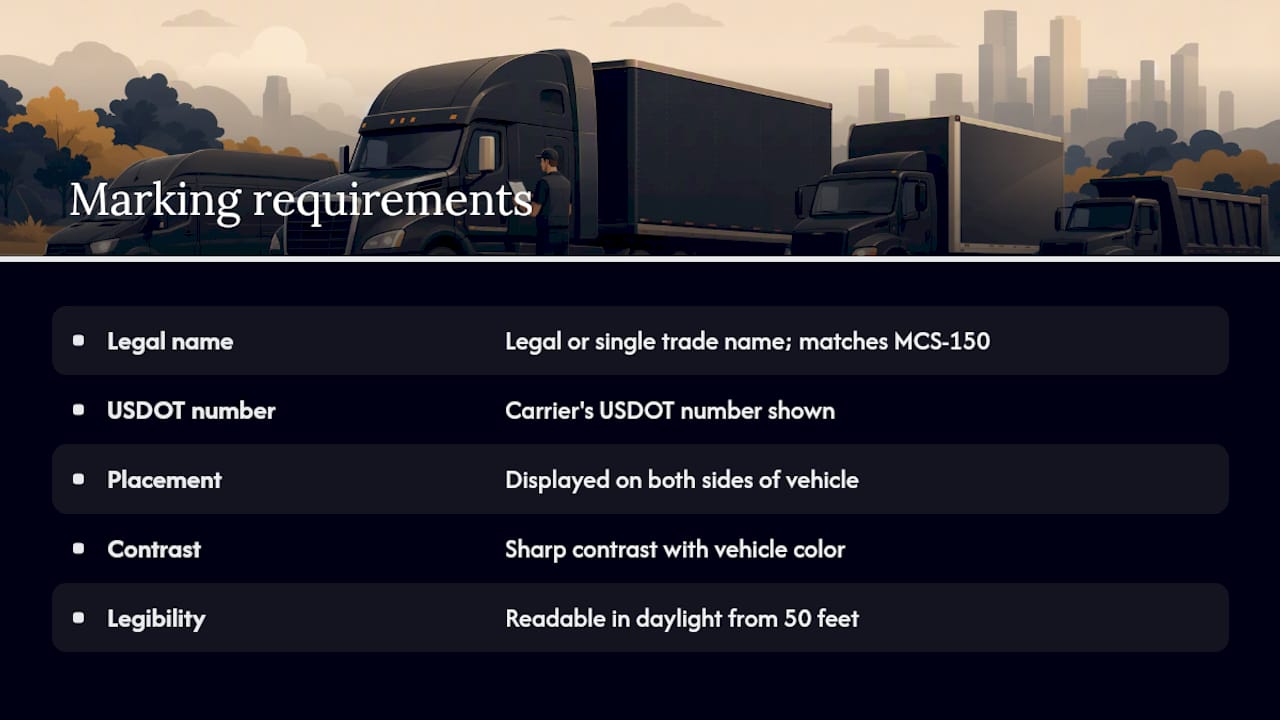
That legibility distance isn’t a suggestion. Fifty feet, daylight hours, no squinting required is the enforcement standard officers actually apply during roadside checks, according to FMCSA safety-planner guidance.
The exact-name requirement matters more than most fleets realize. FMCSA guidance makes clear that the name on the truck has to match the name on file in the MCS-150 registration, not a shortened version, not an old DBA, not a marketing name that sounds close enough. A single missing word or a swapped abbreviation is enough to trigger a finding during a roadside stop, because the inspector is cross-referencing what they see on the door against what SAFER shows on record. Maintenance matters too. A decal that has faded, peeled, or cracked to the point it no longer contrasts sharply or reads clearly from 50 feet is treated the same as having no marking at all.
Where To Place Markings On Trucks And Trailers
Placement zones are more flexible than most operators assume, as long as the marking stays legible and undamaged. The lower cab doors are the default spot, and for good reason: they’re flat, visible from both sides, and rarely obstructed by mirrors or fuel tanks. Cab side panels work too, especially on trucks with limited door space or custom fairings.
Sleeper berth placement is legal but comes with a caveat. If the sleeper section sits far enough back that an inspector can’t get a clean 50-foot read on both sides at once, especially on a curved or angled unit, you’re creating a legibility risk even though the letters themselves meet size requirements.
Trailers get their own rule, and it trips up a lot of fleets. A trailer with a gross vehicle weight rating over 10,001 pounds operating in interstate commerce needs the operating carrier’s markings if the power unit’s identification does not already cover it in a way that satisfies the inspector. In practice, most fleets mark trailers separately from tractors, especially when trailers get swapped between different tractors or leased out.
Common placement pitfalls worth checking during any audit:
- Aerodynamic fairings or bug shields that partially cover door lettering.
- Door seams or hinges that split the marking across two panels.
- Toolboxes, ladder racks, or side-mounted equipment installed after the decals went on.
- Trailer swaps where the marking followed the wrong unit, leaving a tractor or trailer temporarily unmarked.
How To Pass The 50-Foot Legibility Test Every Time
The 2-inch minimum character height in 49 CFR 390.21 is the legal floor, not the target. Industry advisories commonly recommend 3 to 4 inches, and that extra size buys real margin when weather, glare, or an inspector’s angle isn’t ideal.
Color contrast trips up more fleets than size does. Gray lettering on a silver trailer, dark blue on black, or white on light tan all look fine up close and disappear at distance. Stick to combinations with clear separation: white or yellow on dark paint, black or navy on white or light-colored panels.
Font choice matters more than people expect. Solid block or sans-serif fonts hold their shape at distance far better than script, condensed, or heavily stylized letterforms, a point FMCSA’s marking rule guidance backs up directly. Keep spacing even and avoid cramming the legal name and USDOT number into a space that forces tiny kerning.
Pro Tip: Run the 50-foot test at three different times of day, morning glare, midday sun, and late afternoon shadow, before you approve a proof. A decal that reads clean at noon can wash out completely at 4 p.m. against certain paint colors.
Vinyl, Paint, Or Magnets: Choosing A Marking Method That Lasts
Permanent vinyl decals or painted lettering are the preferred methods for a reason: they hold contrast and edge sharpness far longer than removable alternatives under normal road conditions. Magnetic signs are legal in specific scenarios, mainly short-term leases and driveaway moves, but they demand more upkeep because they shift, fade, and pick up dirt film faster than adhered vinyl.
Material choice affects how long a marking stays compliant, not just how it looks on install day. UV-stable films with proper lamination resist the chalking and color fade that turn a sharp white decal into a dull gray one after a couple of seasons in direct sun, a durability point echoed in FMCSA’s guidance on the marking rule. A decal installation done right with edge sealing keeps moisture from working under the vinyl and lifting corners.
Build a simple maintenance routine around three checks:
- Inspect markings monthly for peeling edges, cracking, or fading, more often for trucks running heavy highway miles.
- Clean with mild soap and water. Avoid high-pressure washers aimed directly at decal edges.
- Replace at the first sign of contrast loss. Don’t wait until it’s fully unreadable. A marginal decal fails the 50-foot test before it looks obviously wrong.
Special Cases: Leased Units, Intermodal, Driveaway, And PRISM
Not every scenario fits the standard “your truck, your name” model. Here’s how the exceptions actually work:
- Leased or rented short-term units. The carrier operating the vehicle at the time, not necessarily the owner, is generally responsible for displaying its own name and USDOT number, unless the lease agreement and regulation permit removable markings for the lease term.
- Intermodal equipment. Chassis and container operations may satisfy marking requirements through database entries or interchange agreement documentation rather than physical decals, according to 49 CFR § 390.21, as long as the alternative method is used correctly.
- Driveaway operations. Removable devices, magnetic signs or placards, are lawful specifically because these units are moving between locations under temporary operating authority, not running a fixed route under one carrier’s ongoing branding.
- PRISM states. Some states participating in the Performance and Registration Information Systems Management program apply additional registration cross-checks, so confirm your state’s specific PRISM procedures if you operate there regularly.
Common Mistakes And A Repeatable Yard Audit
The same handful of errors show up again and again: a name on the door that doesn’t match MCS-150, old carrier markings left half-removed under a new decal, lettering sized to the 2-inch minimum with zero margin, low-contrast color pairings, and decals partially blocked by racks or fairings installed after the fact.
A repeatable audit catches these before a roadside stop does:
- Pull the current MCS-150 registration for the legal name and USDOT number on file.
- Walk each unit and compare the door lettering against that record, word for word.
- Run the 50-foot daylight legibility test from both sides.
- Photograph every unit and log the date.
- Assign any failure a corrective action and an owner, with a deadline before the truck goes back on the road.
Pro Tip: Keep the photo log even after a unit passes. If an inspector documents a marking violation, dated photos showing when the decal was still compliant can support your case that the damage or fading happened after your last check.
Verifying And Updating Your MCS-150 Registration
Before ordering a single decal, confirm what’s actually on file. The SAFER company snapshot shows your registered legal name and USDOT number exactly as FMCSA has it, and that’s the record an inspector checks against, not your invoice letterhead or your website.
- Search your company on SAFER and screenshot the snapshot for your records.
- If the name is outdated or wrong, file a correction through Form MCS-150 as soon as possible, since furnishing misleading registration information carries its own penalties.
- Re-mark every affected vehicle immediately after any registration update. A name change on paper means nothing to an inspector reading the door.
- Keep dated photos, installation receipts, and the SAFER screenshot together as a compliance file you can produce on demand.
What A Professional Installer Should Deliver For Compliance
A qualified installer’s job starts before any vinyl gets cut. Verifying the exact legal name against your current MCS-150 record, then confirming letter size and color contrast in a proof, catches mismatches while they’re still a five-minute fix instead of a re-order.
From there, the installation itself matters as much as the design. Climate-controlled application, proper edge sealing, and lamination protect against the peeling and fading that eventually put a truck back out of compliance. Vehicle lettering done to that standard should come with documentation, not just a finished truck.
Expect these deliverables from any installer worth hiring:
- A material spec sheet showing the vinyl and laminate used, so you can match it on future replacements.
- Photo documentation of both sides post-install, dated for your compliance file.
- A maintenance recommendation covering inspection frequency and expected decal lifespan under normal highway use.
- A clear point of contact for touch-ups if a panel gets damaged before the decal’s expected service life is up.
Why The 50-Foot Test Matters More Than Fleets Think
Most compliance guidance treats US DOT number placement as a box-checking exercise: get the letters on the door, move on. That undersells what the regulation is actually built around, which is a distance-based legibility standard, not just a presence requirement. A truck can technically have both required markings and still fail an inspection if the color contrast washes out in afternoon glare or the lettering shrank when someone resized artwork to fit a fairing.
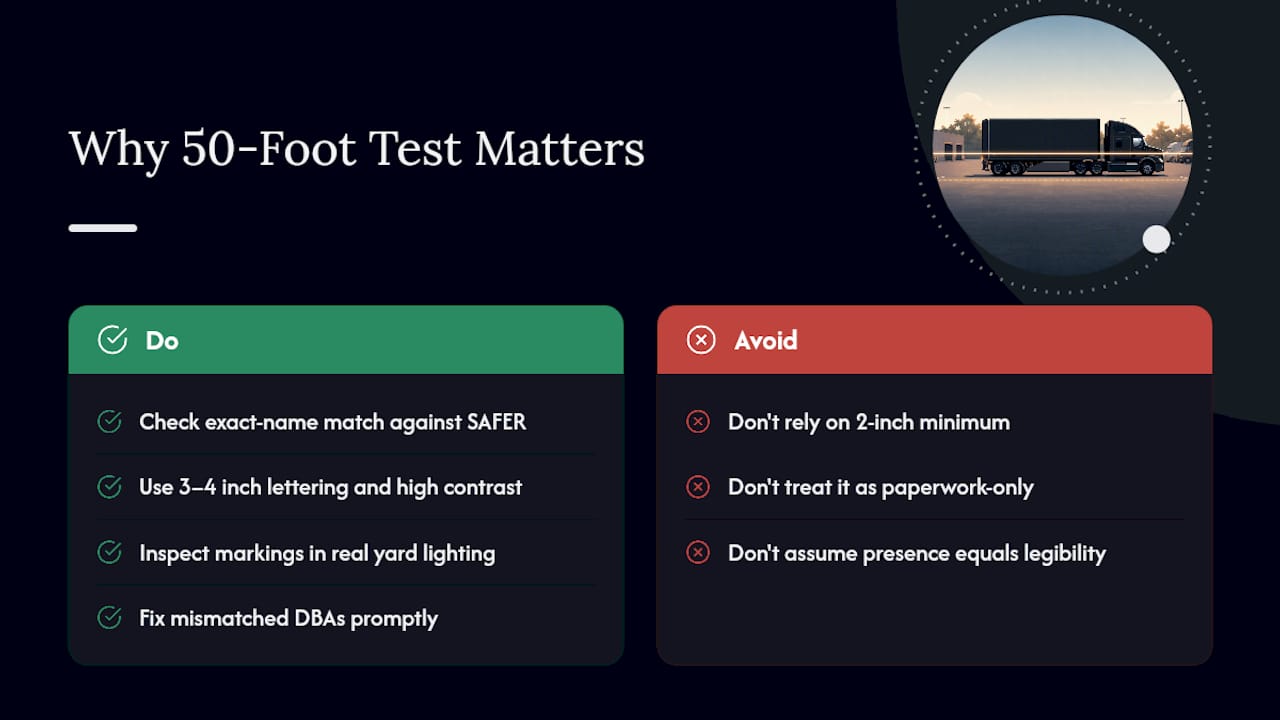
The exact-name-match issue is the one we’d flag first if a fleet manager only had time to fix one thing. It’s the easiest violation to create by accident, a DBA that evolved slightly, a merger that left an old name on half the trucks, and the easiest to fix once someone actually pulls the SAFER record and compares it letter by letter. Most fleets treat this as a paperwork problem. It’s a physical one, sitting on every door in the yard.
The conventional advice stops at “meet the 2-inch minimum.” That’s technically legal and practically risky. Given how much variation exists in paint colors, lighting, and inspector angle, the fleets that stay out of trouble are the ones that treat 3 to 4 inches and high contrast as the real standard, not the exception.
— NJ Vinyl Wrapz
Get Your Fleet’s Markings Inspection-Ready
Reading the regulation is one thing. Getting every truck in your yard to actually match it, letter for letter, side for side, is where most fleets lose time they don’t have. A company with over 10 years of experience installs FMCSA-compliant vehicle lettering and full fleet re-marking using high-quality materials in a climate-controlled facility designed for precision work.

Whether you need a single truck relettered after a name change or a full fleet audit and re-mark before a DOT inspection, the services run the same way: verify your MCS-150 record first, confirm size and contrast in a proof before anything gets cut, then install with edge sealing and full photo documentation you can keep in your compliance file. When you request a quote, ask specifically about material spec, warranty coverage, and installation timeline so you know exactly what you’re getting before work starts. Start with vehicle lettering for targeted fixes, or look into full vehicle wraps if you’re re-marking and rebranding at the same time.
Sources
- eCFR :: 49 CFR Part 390 Subpart B – General Requirements and Information
- FMCSA — Do I need a USDOT number?
- Govinfo
FAQ
Where Should USDOT Numbers Be Placed On A Truck?
The USDOT number, preceded by the letters “USDOT,” must appear on both sides of the self-propelled power unit, most commonly on the lower cab doors or cab side panels, legible from 50 feet in daylight.
Do Trailers Need To Display A USDOT Number?
Trailers with a gross vehicle weight rating over 10,001 pounds operating in interstate commerce need the operating carrier’s markings unless the arrangement already satisfies the requirement through the power unit’s identification.
How Hard Is It To Get A USDOT Number?
Getting a USDOT number requires filing Form MCS-150 with FMCSA; the harder part for most fleets is keeping the name on that registration matched exactly to what’s painted or decaled on every truck.
How Tall Do USDOT Numbers Need To Be?
The legal minimum character height is 2 inches, though industry practice commonly favors 3 to 4 inches for better legibility margin under real-world lighting and weather conditions.
How Do I Check If My Company’s USDOT Information Is Correct?
Search your company on the SAFER company snapshot to see the legal name and USDOT number currently on file, then compare it against your vehicle lettering.