
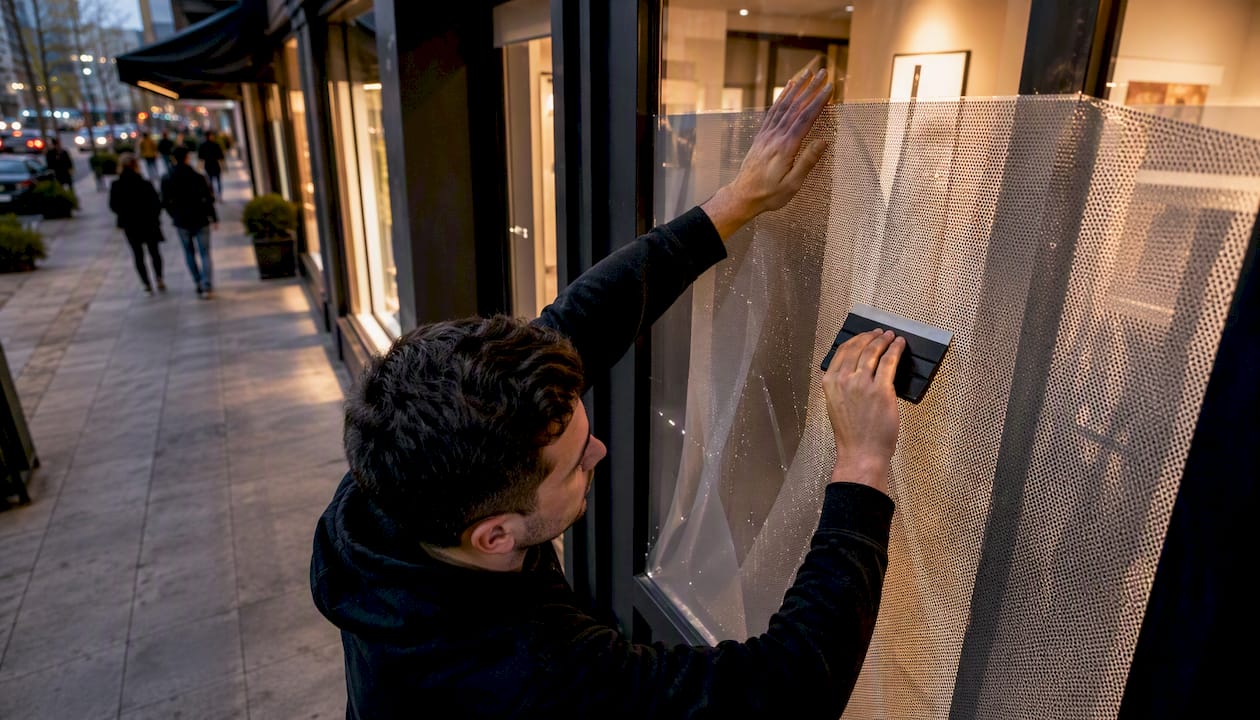
Storefront window graphics are printed or cut vinyl film applied directly to glass to promote your brand, advertise a sale, or create privacy. The fastest next step: photograph your windows, measure each pane, and send those details to a qualified installer for a scaled proof and quote.
Before you go further, here’s how the main types match common retail goals:
- Branding (permanent): Cut vinyl lettering or full-coverage printed vinyl for your logo, store name, and hours
- Short-term promotions: Perforated one-way film or low-tack removable prints that swap out seasonally
- Privacy or safety: Frosted/etched-look film or manifestation bands for changing rooms, office windows, and full-height glass doors
To get an accurate quote fast, send your vendor: window photos (inside and outside), pane measurements in inches, your desired coverage percentage, and your brand’s logo files.
Key Takeaways
Matching film type to your specific goal, confirming local sign code, and working with a vendor who uses named manufacturer films are the three decisions that determine whether your storefront graphics succeed long-term.
| Point | Details |
|---|---|
| Match film to objective | Use cast perforated film (3M 8170-P50) for permanent branding; removable film (Avery MPI2077) for seasonal promos. |
| Know your lifespan ranges | Interior-applied vinyl lasts 5–7 years; exterior-applied lasts 2–4 years; frosted film can reach 10+ years. |
| Check coverage limits first | Many cities cap window graphics at 25% of total window area; CPTED sightline rules can trigger removal orders. |
| Budget realistically | Installed perforated film typically costs a moderate rate per square foot; full-storefront wraps often require a higher budget depending on size and complexity. |
| NJ Vinyl Wrapz | Provides design, print, and professional installation using 3M and Avery Dennison materials with a written warranty. |
Table of Contents
- What types of storefront window graphics should you use?
- Which materials and films hold up best for retail windows?
- What artwork specs and measurements do you need before ordering?
- What does professional installation involve, and how long do graphics last?
- What does storefront window graphics cost, and how long does a project take?
- What local regulations apply to storefront window graphics?
- How do you choose a vendor you can actually trust?
- What most retailers get wrong about window graphics
- Ready to get your storefront graphics designed, printed, and installed?
- Sources
- FAQ
What types of storefront window graphics should you use?
Not every window in your store serves the same purpose, and the graphic type should follow that logic.
Perforated one-way vision film (often called window perf) is the workhorse for display windows. It prints a full-color image visible from the street while preserving outward sightlines from inside. The perforation ratio matters: a 65/35 pattern (65% ink surface, 35% open holes) delivers a bolder image but reduces interior light more than a 50/50 pattern, which balances advertising impact with visibility. Designers sometimes run perf only across the lower half of a window to keep daylight coming in at the top while placing graphics at pedestrian eye level.
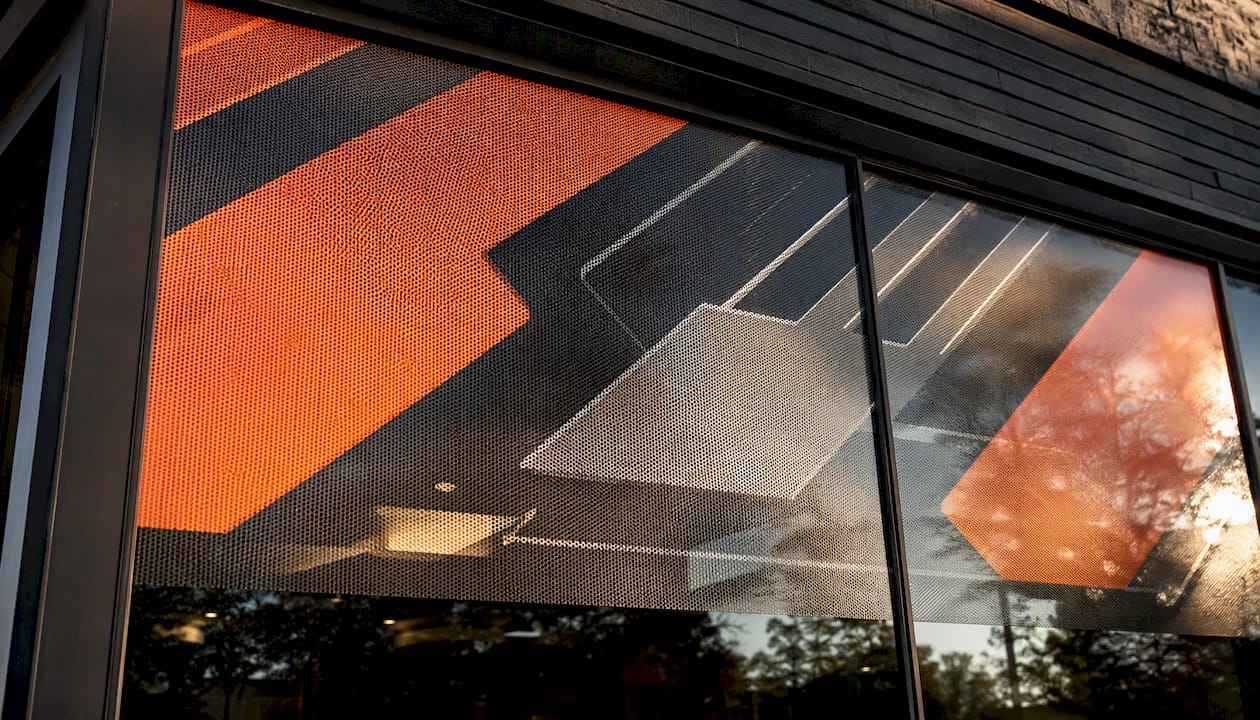
Full-coverage printed vinyl works for windows where you don’t need to see out at all, like a back-office door or a wall of windows used purely for branding. It gives you the richest color and the most design flexibility.
Cut vinyl lettering and spot graphics are the right call when you want clean, professional store hours, a logo, or a phone number without covering the whole pane. They’re durable, cost-effective, and easy to update one element at a time. The branding benefits of window decals are well documented for small retailers who want a polished look on a modest budget.
Frosted or etched-look film mimics sandblasted glass at a fraction of the cost. Use it on changing-room windows, conference room glass, or any pane where you want diffused light and privacy without blocking it entirely.
Static cling and low-tack films are removable without adhesive residue, making them ideal for short seasonal campaigns. They’re not rated for long outdoor exposure, but for interior-facing glass or a 4–8 week promotion window, they do the job cleanly.
Manifestation bands are safety markings required on full-height glazing to prevent collisions. Rather than plain frosted strips, many retailers integrate their logo or a repeating brand pattern into these bands, turning a code requirement into a branding moment.
Some businesses get the best coverage by combining approaches: window perf on display windows paired with tint on non-display windows keeps the advertising impact where foot traffic sees it while controlling heat and glare elsewhere.
Pro Tip: If you’re deciding between spot graphics and full-coverage film, start with spot graphics on your entry door and one anchor display window. You’ll learn what draws attention before committing to a full-storefront wrap.
Which materials and films hold up best for retail windows?
Film choice is where most retail owners make expensive mistakes. The wrong material either fails prematurely or becomes a nightmare to remove.
Cast vs. calendared vinyl is the first distinction. Cast vinyl is thinner, more conformable, and rated for longer outdoor exposure. Calendared vinyl is thicker and less expensive but can shrink over time on complex surfaces. For flat glass, calendared performs fine on short-to-medium-term installs; for anything expected to last more than three years outdoors, cast is the better call.
Perforated vinyl adds a micro-hole pattern to allow two-way visibility. Film grade and perforation pattern both affect how long it lasts and how well it performs. 3M’s 8170-P50 is a cast perforated film built for durability, commonly specified for vehicle glass and long-life storefront installs. For short-term retail promotions where you’ll swap graphics seasonally, Avery Dennison MPI2077 with its ultra-removable adhesive is a practical choice that peels cleanly without damaging the glass or leaving residue.
Avery Dennison MPI 2728 is a calendared perforated film suited to intermediate-term retail applications. It offers a good balance of print quality and cost for campaigns running several months rather than years.
3M Controltac adhesive technology uses microscopic glass beads that allow repositioning during installation before the adhesive fully bonds. On large panes where alignment is critical, this matters.
Low-tack and removable films are designed for interior glass or short campaigns. Static cling requires no adhesive at all, which makes it the easiest to swap but also the least durable outdoors.
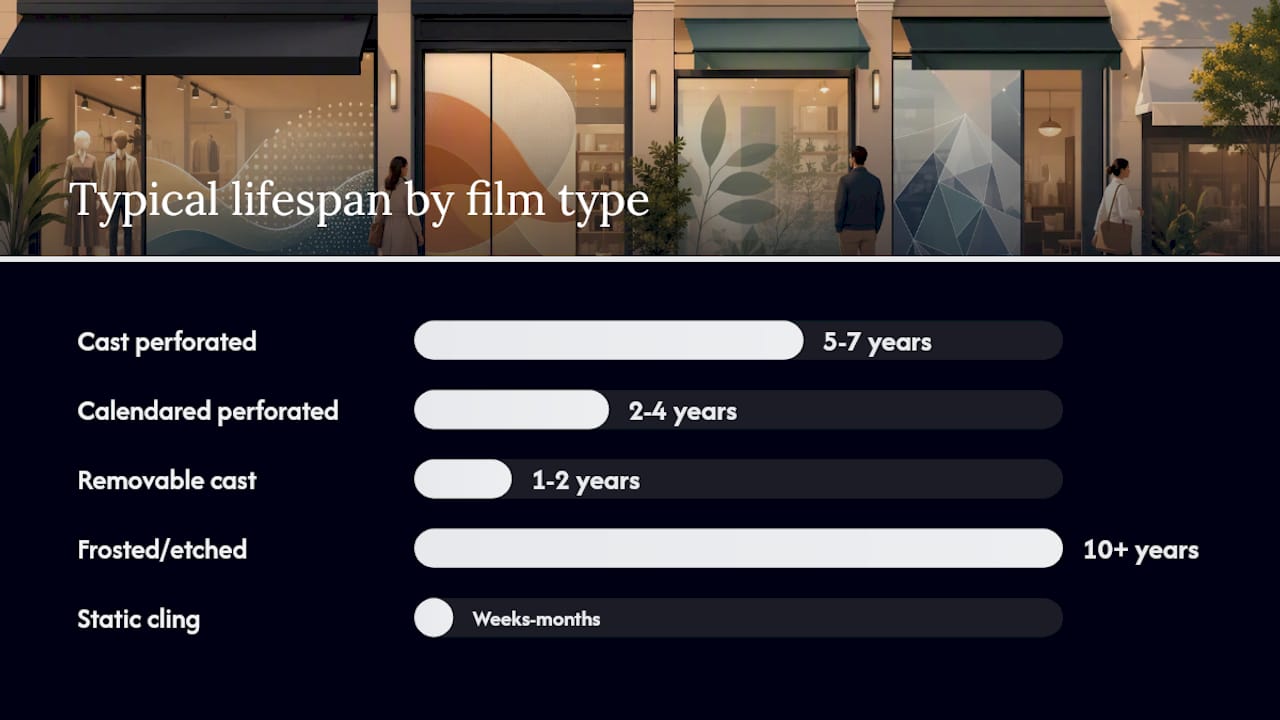
Application surface also affects longevity. Second-surface application (film applied to the interior face of the glass) is standard for most commercial window graphics because the glass itself shields the print from UV and weather. First-surface (exterior) application is used when interior access is impossible or a specific visual effect requires it, but exterior-applied printed vinyl typically lasts 2–4 years in sun-exposed conditions. Interior-applied printed vinyl can reach 5–7 years, and etched/frosted films often last 10 years or more. Lamination adds roughly 1–2 years to any printed film.
| Film Type | Typical Lifespan | Removability | Exterior/Interior | Relative Cost |
|---|---|---|---|---|
| Cast perforated (e.g., 3M 8170-P50) | 5–7 years | Moderate | Both | Higher |
| Calendared perforated (e.g., Avery MPI 2728) | 2–4 years | Moderate | Interior preferred | Mid |
| Removable cast (e.g., Avery MPI2077) | 1–2 years | Easy, clean | Interior | Mid |
| Frosted/etched film | 10+ years | Moderate | Interior | Mid |
| Static cling | Weeks to months | Very easy | Interior only | Low |
It is recommended to request material datasheets and warranty documentation from your vendor before approving a project. Reputable installers typically provide these documents readily.
What artwork specs and measurements do you need before ordering?
Getting your files and measurements right before the first conversation with a vendor cuts proof rounds in half.
File specifications checklist:
- Format: PDF, TIFF, or native Adobe Illustrator (.AI) files preferred; avoid low-resolution JPEGs
- Color profile: CMYK, not RGB; screen colors and print colors render differently, and RGB files often shift noticeably when converted
- Resolution: 300 dpi at 100% of the final printed size; for very large windows, 150 dpi at full scale is sometimes acceptable, but confirm with your printer
- Text and logos: Supply as vector paths, not rasterized; this keeps edges sharp at any scale
- Bleed: Add at least 0.25 inches of bleed beyond the trim line on all sides
- Safe area: Keep critical text and logos at least 0.5 inches inside the trim line to avoid cutoff
Measurement quick guide:
Measure each glass pane individually, not the full window frame. Note the width and height of the visible glass in inches. If your window has mullions (the vertical or horizontal dividers between panes), measure each section separately and note the mullion width so the designer can account for them. Also record any frame setback (the distance the glass sits behind the frame face) and note whether the glass is single or double-pane, since double-pane units sometimes have installation restrictions.
Full-height glazing that requires manifestation markings needs those markings at specified heights, typically between 850mm and 1000mm and again between 1400mm and 1600mm from the floor, though exact requirements vary by jurisdiction. Integrating your brand pattern into these zones is worth planning at the design stage rather than retrofitting later.
Send your vendor a photo of each window from the outside, one from the inside, and a rough sketch or annotated photo showing which panes you want covered and at what percentage. That package alone will get you a faster, more accurate quote than a phone call ever will.
What does professional installation involve, and how long do graphics last?
Professional installation is not just about avoiding bubbles. It’s about surface chemistry, temperature, and the sequence of steps that determine whether a graphic lasts two years or seven.
Installation steps, in order:
- Site survey: Measure panes, confirm glass type, check for coatings or tints that affect adhesion, and identify any access challenges (high windows, recessed frames).
- Surface cleaning: Glass is cleaned with isopropyl alcohol to remove oils, dust, and residue. Any contamination left behind creates adhesion failures that show up weeks later.
- Temperature check: Most vinyl adhesives require application between 50°F and 90°F. Cold glass causes adhesive to stiffen; hot glass can cause premature bonding before the film is positioned correctly. 3M Controltac’s repositionable adhesive gives installers a wider working window.
- Application: Film is applied wet or dry depending on the product spec. A squeegee drives out air and water from the center outward.
- Edge sealing: Edges are pressed firmly and, on exterior applications, sometimes sealed with an overlaminate or edge coat to prevent lifting.
- Post-install inspection: The installer checks for bubbles, lifted edges, and alignment before signing off.
Pro vs. DIY: A DIY install on a small interior decal is manageable. A full display window with perforated film, precise alignment, and a brand logo is not. Misalignment on a large pane is visible from 50 feet away, and a botched install on a film with permanent adhesive can damage the glass surface on removal. Most manufacturer warranties are also voided by non-professional installation.
Maintenance do’s and don’ts:
- Clean with a soft cloth and mild soap; avoid ammonia-based cleaners (Windex and similar products degrade adhesive over time)
- Do not use abrasive scrubbers near graphic edges
- Inspect edges every six months for lifting, especially on exterior applications
- For perforated film, avoid high-pressure washing directly at the surface
What does storefront window graphics cost, and how long does a project take?
Price varies more than most retailers expect, and the biggest driver is usually not the film itself.
Pricing drivers:
- Coverage area: More square footage means more material and more labor. A single entry door graphic and a full-storefront wrap are entirely different budget conversations.
- Film grade: Cast perforated films cost more than calendared or removable films. The regional pricing benchmarks published by installers give a useful range: static cling runs roughly $8–$15 per sq ft installed; frosted privacy film roughly $12–$20 per sq ft; perforated one-way film roughly $18–$30 per sq ft installed; full-storefront wraps often run $1,500–$3,000 or more depending on window count.
- Lamination: An overlaminate adds cost but extends lifespan and protects against scratching.
- Print complexity: A simple two-color logo costs less to print than a full-bleed photographic image.
- Installation labor: Ground-floor windows with easy access cost less to install than second-story glass requiring lifts or scaffolding.
- Local permits: Some municipalities require a sign permit for window graphics above a certain coverage percentage. Permit fees vary by city.
Typical project timeline:
Design and proof: 2–5 business days for a first proof, depending on how complete your files are. Print production: 3–7 business days after proof approval. Installation: usually 1 day for a single storefront, longer for multi-location projects. Total from first contact to installed graphics: roughly 2–3 weeks for a standard project. Rush production is available from most professional shops but adds cost.
Quote-request template: When you contact a vendor, include window photos (inside and outside), pane dimensions in inches, your desired coverage type and percentage, your logo files, your target install date, and any local permit requirements you are already aware of. That package gets you an accurate bid rather than a ballpark.
What local regulations apply to storefront window graphics?
Window graphics are regulated as signs in most U.S. jurisdictions, and the rules are more specific than most retailers realize.
Quick compliance checklist:
- Coverage percentage limits: Many cities cap how much of a window can be covered by graphics. The City of Sunrise, FL limits window identification signs and message signs each to 25% of total window area, with separate square-footage caps for hours-of-operation and open/closed signs.
- CPTED sightline rules: Crime Prevention Through Environmental Design guidelines require clear sightlines at entrances and exits. Sunrise enforces these explicitly, and many other cities apply similar standards. Graphics that obstruct visibility at a door can trigger a removal order.
- Letter height limits: Some codes set maximum letter heights for window-applied text, separate from overall coverage limits.
- Illuminated sign rules: Backlit or LED-illuminated window graphics often fall under a separate permit category with stricter limits.
- Interior display classification: Some jurisdictions, including San Luis Obispo, CA, treat graphics placed more than approximately 36 inches behind the glass as interior displays rather than regulated exterior signs. That classification can allow larger interior displays without consuming your exterior sign area allocation.
Rules vary significantly by city and even by zoning district within a city. A graphic that’s fully compliant in one municipality may require a permit or partial removal two miles away.
Pro Tip: Before ordering, ask your installer to pull the relevant section of your city’s sign code and confirm your design stays within coverage limits. A good vendor will do this as part of the site survey, not as an afterthought.
How do you choose a vendor you can actually trust?
The difference between a graphic that looks sharp for five years and one that’s peeling by summer usually comes down to who installed it and what film they used.
Questions to ask every vendor:
- Which specific film brands and product lines do you use? (A vague answer like “commercial-grade vinyl” is a red flag.)
- Do you carry 3M or Avery Dennison manufacturer partnerships?
- Can you provide the material datasheet and warranty for the film you’re recommending?
- Are you licensed and insured? Can you provide a certificate of insurance?
- Do you print in a climate-controlled facility?
- Can you show before-and-after photos of similar retail window projects?
- What’s your removal policy, and does removal damage the glass?
- Will you conduct an on-site survey before quoting?
Trust signals worth looking for:
- Manufacturer partnerships with 3M or Avery Dennison (these require training and quality standards)
- A portfolio of completed retail window projects, not just vehicle wraps
- Written warranty on both materials and installation labor
- Proof of insurance on file
- Willingness to provide a scaled proof before production begins
Red flags:
- Can’t name the specific film product they plan to use
- No portfolio or only stock images
- Quotes remotely without a site visit or at minimum a photo review
- No written warranty
- Pressure to approve without a proof
For large-format vinyl work, the same material and installation standards that apply to trailer and hauler wraps carry over directly to storefront glass. Seeing how a vendor handles complex large-format projects tells you a lot about their precision on retail windows.
Smaller retailers often get the best return by combining permanent brand elements (cut vinyl for the store name, hours, and logo) with rotating printed or cling promos for seasonal campaigns. Using removable or low-tack films for those seasonal changes keeps long-term costs down and avoids the adhesive buildup that makes future installs harder.
What most retailers get wrong about window graphics
The most common mistake isn’t choosing the wrong film. It’s treating every window the same way.
A display window facing a high-foot-traffic sidewalk and a side window facing a parking lot serve completely different functions. Perforated one-way film on the display window delivers advertising value and some heat reduction in certain patterns, while a commercial tint on the side window handles UV control and privacy without the cost of a full printed graphic. Mixing approaches by window type is almost always the smarter budget decision than applying one solution across the whole storefront.
The second mistake is ordering graphics before confirming local sign code. The cost of removal and reprinting a compliant version is almost always higher than a 30-minute code check before production.
Finally, most retailers underestimate how much the first proof matters. Request a photo mockup at scale with your actual brand colors, your hours, and any required legal text included. Catching a color shift or a layout problem at the proof stage costs nothing. Catching it after installation costs everything.
Ready to get your storefront graphics designed, printed, and installed?
NJ Vinyl Wrapz delivers the full project from design through installation, using 3M and Avery Dennison materials with a written warranty on both film and labor. Where most print shops hand you a file and wish you luck, NJ Vinyl Wrapz conducts an on-site survey, handles local permit verification, and installs in climate-controlled conditions that protect adhesive performance.
The services that apply directly to retail storefront projects include custom graphic design, material selection (cast and calendared perforated films, removable films, frosted and etched-look options), large-format printing, professional installation, and removal and refresh programs for seasonal updates. NJ Vinyl Wrapz is licensed, insured, and carries manufacturer partnerships with 3M and Avery Dennison.
Request a free storefront assessment and scaled proof by visiting the window graphics services page. Bring your window photos and measurements, and NJ Vinyl Wrapz will turn them into a proof you can approve before a single roll of film is cut.
Sources
The following references were used to verify technical claims, pricing benchmarks, and regulatory examples in this article. Request material datasheets and your local sign code section from any vendor before approving a project.
- Commercial Window Signage Regulations | City of Sunrise, FL
- Window Graphics: Considerations in Choosing the Right Film | GraphicsPRO
- Window Graphics Guide: Types, Materials, Application Methods and Regulations | Commercial Print Services UK
- Retail Window Graphics: Seasonal Displays & Branding | Gilroy Blackout
FAQ
How long do storefront window graphics last?
Interior-applied printed vinyl typically lasts 5–7 years; exterior-applied printed vinyl lasts 2–4 years in sun-exposed conditions. Frosted and etched-look films can exceed 10 years, and lamination adds roughly 1–2 years to any printed film.
Can window graphics be removed without damaging the glass?
Yes, when the correct film is specified. Removable films like Avery Dennison MPI2077 use ultra-removable adhesive designed to peel cleanly. Permanent adhesive films require professional heat-assisted removal to avoid glass damage.
Do storefront window graphics require a permit?
Many U.S. cities regulate window graphics as signs and require permits above certain coverage thresholds. The City of Sunrise, FL, for example, limits window message signs to 25% of total window area. Check your local sign code before ordering.
What perforation ratio should I choose for my display window?
A 65/35 ratio (65% ink surface) delivers a bolder exterior image but reduces interior light more than a 50/50 ratio. Use 65/35 for maximum visual impact on high-traffic windows; use 50/50 when interior brightness matters.
How do I get an accurate quote for storefront window graphics?
Send your vendor window photos from inside and outside, each pane’s dimensions in inches, your desired coverage type, your logo files, and your target install date. NJ Vinyl Wrapz offers a free storefront assessment and scaled proof through its window graphics services page.