
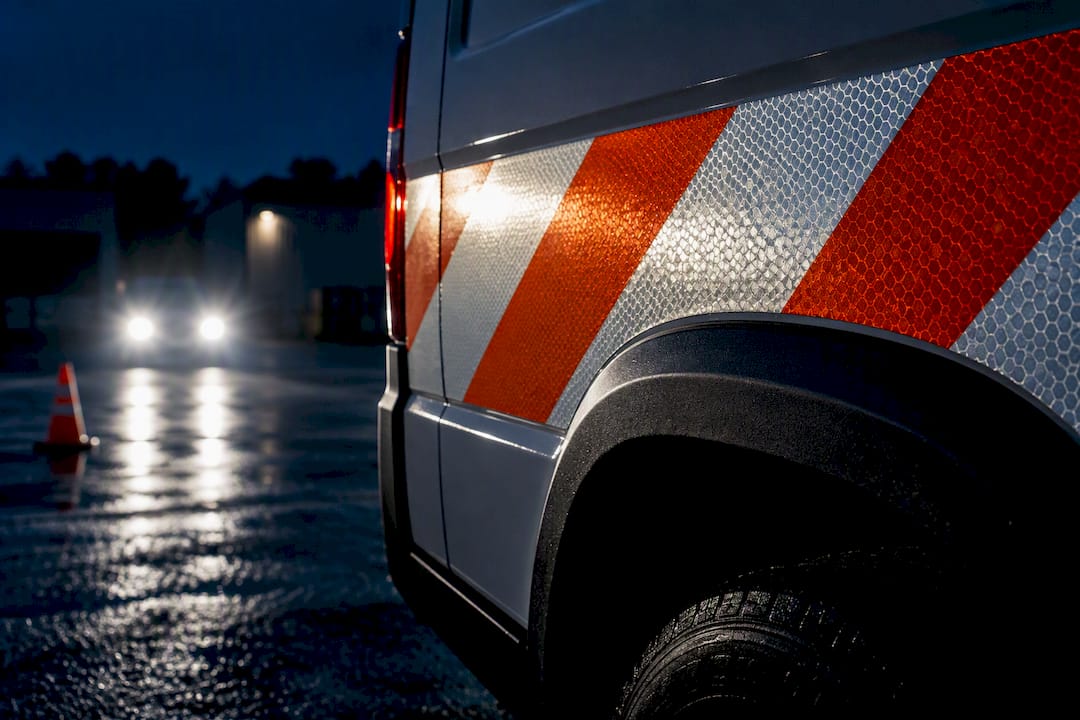
Reflective vinyl earns its cost on any fleet with regular nighttime, highway, or roadside exposure, and the biggest reason is detection distance, not looks. 3M’s own testing shows reflective film lets other drivers spot a vehicle from at least twice as far away compared to standard paint or vinyl. Add in the fact that your graphics work as branding around the clock instead of shutting off at dusk, and the modest per-vehicle material premium looks small next to one avoided collision or insurance claim.
TL;DR:
- Microprismatic film is roughly five to ten times brighter than glass-bead sheeting, making it essential for highway-speed detection on unlit roads.
- Prioritize reflective placement on rear doors, lower side panels, bumpers, and chevrons to maximize safety, especially for vehicles operating at night or in low visibility conditions.
- Conduct a pilot wrap on one vehicle to test film conformability and durability before scaling up across your entire fleet to avoid costly misapplications.
- Ensure proper surface preparation and follow manufacturer guidelines for installation temperature to prevent bubbles, cracking, or edge lifting, which reduce effectiveness.
- Maintain reflective elements with gentle hand washing and regular inspections to prolong lifespan and preserve high visibility in safety-critical zones.
Table of Contents
- What Reflective Vinyl Is and How Retroreflective Materials Work
- Where Reflective Vinyl Delivers the Most Safety Value on a Fleet
- Choosing Between Engineer-Grade and Microprismatic Film
- Designing Reflective Graphics That Still Look Like Your Brand
- Installation and Maintenance That Actually Make Reflective Film Last
- Standards and Compliance Fleet Managers Need on Record
- What Reflective Fleet Graphics Cost and the Return You Should Expect
- Lessons From Fleet Installations: What Actually Goes Wrong
- Getting Started With Reflective Fleet Wraps at NJ Vinyl Wrapz
- Sources
- FAQ
What Reflective Vinyl Is and How Retroreflective Materials Work
Retroreflective vinyl bends light back toward its source instead of scattering it randomly the way flat paint does. Headlights hit the film, get redirected almost straight back at the driver’s eyes, and the vehicle suddenly reads as bright and defined against a dark road instead of a vague shape. That’s the entire mechanism, and it’s why a reflective decal glows at night while an identical printed decal without the optical layer just disappears.
Two technologies deliver that effect, and they’re not interchangeable. Glass-bead sheeting, classified as Type I under ASTM D4956, uses millions of tiny embedded beads to bounce light back. Microprismatic film, covering Types IV and V, uses precisely molded prism structures instead of beads, and it can run roughly five to ten times brighter than that same Engineer Grade material.
- Glass-bead (Type I): Lower cost, easier to cut for detailed lettering, adequate brightness for city and suburban routes.
- Microprismatic (Type IV–V): Dramatically brighter, holds performance at longer viewing angles, built for highway-speed detection.
- Trade-off: Prismatic film is stiffer and less forgiving on compound curves than glass-bead sheeting.
Knowing this distinction upfront saves a fleet manager from ordering the wrong grade for the wrong route, which is the single most common and most expensive mistake in reflective vinyl procurement.
Where Reflective Vinyl Delivers the Most Safety Value on a Fleet
Not every panel on a truck needs reflective treatment, and trying to wrap the whole vehicle in prismatic film wastes budget. The value concentrates in a handful of specific zones where other drivers actually need the extra warning.
- Rear doors and tailgates — the surface a following driver sees longest, especially during braking or a stop on the shoulder.
- Lower side panels — visible to cross-traffic at intersections and to drivers merging alongside on highways.
- Bumpers and rear corners — critical for rear-end collision prevention in stop-and-go traffic.
- Chevron patterns — angled reflective striping that reads instantly as “vehicle ahead, slow down,” standard on emergency and utility fleets.
- Reflective lettering and logos — keeps your company name legible at night, turning a safety feature into free advertising.
The vehicles that benefit most are the ones spending time parked or moving on unlit roads after dark: trailers making overnight runs, roadside service vans, utility trucks, and last-mile delivery fleets working early morning or late evening shifts. NHTSA and FMCSA both treat retroreflective marking as a core collision-reduction tool for commercial vehicle safety, and fleets in these categories see the fastest return on the investment because their exposure window to low-visibility conditions is simply longer than a fleet that parks every truck by 5 p.m.
Choosing Between Engineer-Grade and Microprismatic Film
The grade decision comes down to one question: how much of your driving happens on unlit roads at highway speed? Answer that honestly and the rest follows.
Type I glass-bead film is the workhorse for general fleet lettering, logos, and city-route vehicles. It cuts cleanly on standard plotters, wraps around moderate curves without cracking, and costs less per square foot. It’s also noticeably dimmer than prismatic film, which matters less on a delivery van doing 25 mph on lit streets and matters a lot on a tractor-trailer running interstate miles at midnight.
Type IV and V microprismatic films solve the highway problem. Manufacturer and industry guidance converge on recommending microprismatic film for any fleet running overnight highway routes because the brightness gap at long range is the whole point. The catch: these films are stiffer, need different cutting and plotter settings than glass-bead material, and installers who skip a test cut risk edge fraying or delamination on tight curves and rivet lines.
Quick comparison:
| Factor | Type I (glass-bead) | Type IV–V (microprismatic) |
|---|---|---|
| Brightness | Baseline | 5 to 10 times brighter |
| Conformability | Excellent on curves | Limited on tight curves |
| Cutting/lettering | Easy, standard settings | Requires adjusted plotter settings |
| Best fit | City routes, lettering | Highway, overnight fleets |
Pro Tip: Before committing an entire fleet to one film type, wrap a single pilot vehicle and run it for a few weeks. You’ll catch curve conformability issues, edge lifting, and driver feedback before you’ve spent the budget on 40 trucks instead of one.
Designing Reflective Graphics That Still Look Like Your Brand
Safety and branding don’t have to compete for the same square footage. The trick is treating reflective elements as functional design pieces, not just bright stickers slapped on wherever there’s room.
Rear doors and lower side panels get priority placement because that’s where detection distance matters most, so design around those zones first and build your logo and color scheme to work with them rather than around them. For lettering, keep character height generous. A tight, stylish font that looks great parked in a showroom often becomes unreadable at 60 mph in headlight glare.
- Use reflective accents (outlines, chevrons, edge striping) instead of full reflective panels when you want brand color to dominate during daylight.
- Keep contrast high between reflective elements and the base wrap color so the graphic reads clearly in both bright sun and headlight beams.
- Reserve full reflective backgrounds for rear doors and high-risk zones; use accent striping elsewhere to control cost and keep the branded look consistent.
A reflective outline around your logo, for instance, does double duty. It’s invisible in flattering daylight photos for your marketing materials, then lights up at night exactly where drivers are looking. That’s the dual-purpose design fleet managers should be asking for, not an afterthought bolted on after the branding is finalized.
Installation and Maintenance That Actually Make Reflective Film Last
Reflective vinyl is only as good as the install. Surface prep matters more here than with standard vinyl because any contamination under the film creates a bubble that eventually cracks the reflective layer and kills brightness in that spot. Panels need a full clean, degrease, and often a light heat-assisted prep before application, and installation temperature has a narrow acceptable window, too cold and the adhesive won’t bond properly, too hot and the film stretches out of tolerance.
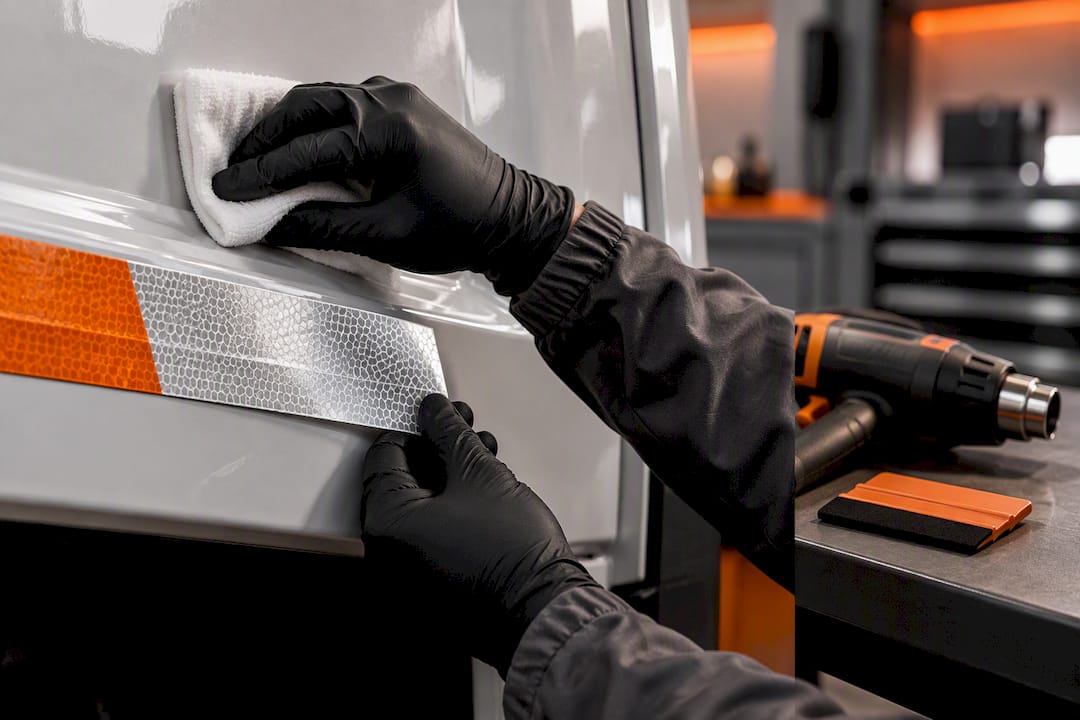
Microprismatic films in particular allow only limited repositioning during application and set within a short window, so installers need to place them right the first time rather than counting on adjustments later. That’s a real skill gap between a shop that wraps reflective film occasionally and one that does it daily.
Maintenance is simpler but easy to neglect:
- Hand wash or use a soft-touch automatic wash; avoid brushes and harsh degreasers that dull the reflective surface over time.
- Inspect edges and seams quarterly for lifting, especially near wheel wells and rear bumpers where road debris hits hardest.
- Plan on replacement or touch-up cycles that match your regular fleet wrap refresh schedule rather than waiting for visible failure.
Pro Tip: If you notice a reflective panel dimming faster than the rest of the wrap, check for road salt buildup first. It dulls prismatic film’s brightness long before it damages the adhesive.
The company installs fleet jobs in a climate-controlled facility and has extensive experience with fleet-specific installation and materials from 3M and Avery Dennison, which helps ensure proper handling of film on various curves. For readers weighing broader durability questions, our guide on durable vinyl printing for fleet visibility covers the material side in more depth, and our protection and maintenance tips walk through the wash and inspection routine that keeps a wrap looking sharp for years. Readers dealing with paint finish questions alongside a wrap project may also find partner guidance on matte paint protection useful for the base vehicle underneath.
Standards and Compliance Fleet Managers Need on Record
ASTM D4956 is the technical standard that defines retroreflective sheeting types, from Type I glass-bead material up through Type IX super-high-intensity prismatic film, each with its own brightness and application profile. Knowing which Type is on your fleet matters when a customer, auditor, or insurer asks what’s actually installed.
Separately, FMVSS 108 and its companion regulation under 49 CFR set conspicuity requirements for many trailers and commercial vehicles, specifying where retroreflective sheeting or tape must appear and in what pattern. FMCSA is the agency to check for the current text of these rules and any updates that affect your vehicle classes.
A quick compliance checklist for fleet managers:
- Confirm required conspicuity patterns (typically alternating red and white striping) on trailers subject to FMVSS 108.
- Maintain roughly three inches of spacing between reflective tape and vehicle lights, following Avery Dennison’s application guidance.
- Keep installation records and material spec sheets on file for insurance and DOT audit purposes.
What Reflective Fleet Graphics Cost and the Return You Should Expect
Cost swings on four factors: material grade, how much of the vehicle gets wrapped, vehicle size, and installation complexity. A reflective accent package (chevrons, door outlines, lettering) on a standard van runs far less than a full reflective rear-door treatment on a box truck or trailer, and microprismatic film costs more per square foot than glass-bead material across the board.
Budget planning usually breaks into two paths:
- Pilot approach: Wrap one or two vehicles first with reflective accents to test material performance and driver feedback before scaling.
- Full-fleet rollout: Standardize placement and film grade across every vehicle at once, which costs more upfront but locks in consistent branding and volume pricing.
The ROI math has two sides. On safety, fewer nighttime collisions mean fewer repair bills, less downtime, and potentially better commercial insurance terms over time. On marketing, industry sources note that reflective graphics can boost impressions by roughly 40 percent since the vehicle stays visible and legible after dark instead of blending into traffic. For fleets logging serious highway miles, that combination of fewer incidents and more visible branding usually closes the gap on material cost within the first year or two.
Lessons From Fleet Installations: What Actually Goes Wrong
The mistake we see most often is a fleet manager ordering the brightest film available without checking it against the vehicle’s curves. Microprismatic sheeting looks great on spec sheets, then cracks along a rivet line on a curved trailer nose because nobody test-cut it first.

Surface prep is the other repeat offender. Skipping a proper degrease before application traps contamination under the film, and within a few months you get bubbling exactly where visibility matters most, the rear door.
The fix is always the same: pilot one vehicle, test the material on your actual fleet’s body style, and only then commit to a rollout. Fleets that skip that step end up repeating work they could have avoided for the cost of one test wrap.
— NJ Vinyl Wrapz
Getting Started With Reflective Fleet Wraps at NJ Vinyl Wrapz
NJ Vinyl Wrapz builds reflective fleet graphics the way this guide recommends: pilot-tested materials, climate-controlled installation, and film sourced through direct 3M and Avery Dennison partnerships rather than whatever generic stock happens to be on hand. That matters most for fleets that got burned before by a shop guessing at cure temperatures or skipping a test cut on a curved panel.

Whether you need full reflective wraps, partial accents like chevrons and door outlines, or custom reflective decals layered onto existing branding, the process starts the same way: one pilot vehicle, honest feedback from your drivers, then a scaled rollout once you know the material holds up on your specific routes. Review current wrap options and pricing structures for partial and full builds, or go straight to the fleet wraps page to start a quote and set a pilot timeline for your vehicles.
Sources
- Differences between three types of reflective sheeting | Reflectop blog
- Shining light on the value of reflective film for fleet | 3M
- Reflective fleet wraps: benefits for night visibility and driver safety | CraftsmenInd
FAQ
Is Reflective Vinyl Worth It for a Small Delivery Fleet?
Yes, if any routes run before sunrise, after dusk, or on unlit roads. A detection distance improvement of at least double applies to any vehicle size, not just tractor-trailers.
What’s the Difference Between Glass-Bead and Microprismatic Film?
Glass-bead film (Type I under ASTM D4956) is more affordable and easier to cut for lettering, while microprismatic film (Types IV to V) delivers roughly five to ten times the brightness. Microprismatic is the better fit for highway and overnight routes.
Does FMVSS 108 Require Reflective Tape on All Commercial Vehicles?
FMVSS 108 and its companion 49 CFR provisions apply specific conspicuity requirements mainly to trailers and certain commercial vehicle classes, not every vehicle on the road. Check current requirements through FMCSA for your exact vehicle type before finalizing a design.
How Long Does Reflective Vinyl Last on a Fleet Vehicle?
Lifespan depends on film grade, climate exposure, and wash habits, but well-installed reflective vinyl typically matches the service life of the rest of a quality fleet wrap. Regular inspection for edge lifting and prompt touch-ups extend that window considerably.
Does NJ Vinyl Wrapz Offer Pilot Programs for Reflective Fleet Graphics?
Yes, testing reflective materials on one or two vehicles before a full rollout is a standard part of the process at NJ Vinyl Wrapz. Visit the fleet wraps page to discuss a pilot vehicle and timeline for your fleet.