
For vehicle wraps on cast vinyl, eco-solvent printing remains the standard because of lower ink cost and proven outdoor performance. For odor-sensitive interior installs and wallpaper, latex wins outright since it laminates immediately with no outgassing wait. For rigid displays, most shops, including NJ Vinyl Wrapz, lean toward UV or hybrid systems built for instant-cure finishing.
TL;DR:
- Eco-solvent printing is more cost-effective for large-volume outdoor vinyl applications due to lower ink prices and 3 to 5 years of outdoor durability.
- Latex printing is ideal for interior, wallpaper, and same-day projects because it can laminate immediately and emits minimal odor requiring little ventilation.
- Eco-solvent inks need 12 to 24 hours of outgassing before lamination, while latex prints can be laminated immediately, affecting workflow timing.
- Equipment costs range from $8,000 to $40,000 for eco-solvent and $15,000 to $60,000 for latex printers, with latex ink costing 20 to 40% more per milliliter.
- Media compatibility heavily influences choice, with cast vinyl for vehicle wraps favoring eco-solvent, and porous or uncoated substrates performing better with latex.
Table of Contents
- Latex vs Solvent Printing: The Side-by-Side Comparison
- How Do Latex and Solvent Inks Actually Cure?
- Which Substrates Work Best With Each Technology?
- What Durability and Lamination Timing Should You Plan For?
- What Do Equipment and Ink Costs Look Like Over Time?
- What Maintenance and Energy Costs Should Shops Expect?
- Which Technology Fits Your Specific Print Job?
- What We’ve Learned Running Both Technologies on Real Fleets
- Ready for a Wrap That’s Built to Last?
- Sources
- FAQ
Latex vs Solvent Printing: The Side-by-Side Comparison
Print buyers rarely need a lecture on ink chemistry. They need to know which machine gets their job out the door correctly, on budget, without a comeback six months later. Here’s how the two technologies stack up across the variables that actually drive a purchase decision.
| Decision factor | Eco-solvent | Latex |
|---|---|---|
| Cure/drying method | Solvent evaporation, softens media coating | Heat-fused water and polymer |
| Substrate compatibility | Strong on cast/calendered vinyl | Broad, including porous and uncoated media |
| Outgassing/lamination wait | 12 to 24 hours before laminating | Immediate lamination |
| VOC/ventilation needs | Reduced vs. old solvent, still needs venting | Minimal odor, low ventilation demand |
| Outdoor durability (unlaminated) | 3 to 5 years | 2 to 3 years |
| Equipment capex range | $8,000 to $40,000 | $15,000 to $60,000 |
| Ink cost (relative, per ml) | Baseline | 20 to 40% higher |
| Best for | High-volume outdoor vinyl runs | Interior installs, wallpaper, same-day jobs |
A few things jump out once you translate that table into shop decisions:
- If your job mix is mostly outdoor vehicle graphics on cast vinyl, eco-solvent’s lower ink cost usually wins on volume alone.
- If you’re printing wallpaper, retail interiors, or anything installed same-day in an occupied space, latex removes the outgassing bottleneck entirely.
- Media choice can flip the recommendation. A laminate rated for only a few years will cap durability regardless of which ink laid down the graphic.
- Rigid substrates (foam board, acrylic, aluminum composite) usually point toward UV or hybrid printers, which neither latex nor eco-solvent handles as well natively.
How Do Latex and Solvent Inks Actually Cure?
Latex ink is water-based, carrying polymer particles suspended in a liquid carrier. Inside the printer, heaters fuse those particles into a continuous film on the media surface. That fusion is what allows immediate lamination straight off the printer, with no waiting period.
Eco-solvent ink works differently. The solvent carrier softens a receiving layer built into the vinyl or media, letting pigment penetrate before the solvent evaporates. That evaporation process needs time and airflow. UV ink skips both mechanisms, curing almost instantly under ultraviolet lamps, which is why UV shows up so often for rigid signage that needs same-hour turnaround.
The downstream effects matter more than the chemistry lesson. Latex’s heat-fusion process draws real electrical load from the printer’s dryers, which shows up on a shop’s energy bill over a full production run. Eco-solvent trades that energy draw for a ventilation requirement, since modern eco-solvent formulas emit fewer VOCs than older hard-solvent inks but still carry measurable odor during the drying window.
Which Substrates Work Best With Each Technology?
Media compatibility decides more purchasing decisions than any spec sheet. Cast vinyl, the go-to for vehicle wraps because it conforms to curves and rivets without lifting, pairs naturally with eco-solvent ink and has done so for years in the wrap industry. Calendered vinyl behaves similarly, though it’s less forgiving on deep contours regardless of ink type.
Latex earns its reputation on porous and uncoated substrates. Uncoated textiles, wallpaper stock, and canvas that would otherwise need a primer coat for solvent ink often run clean on latex without pretreatment. That’s a meaningful difference for shops that split their work between vehicle graphics and interior signage.
A few practical notes worth flagging before you commit a big job to either platform:
- Coated canvas is an exception; it can run well on either ink type, so check the media manufacturer’s certification for your specific printer model.
- Wallcovering and wallpaper installs in occupied buildings almost always favor latex because interior and odor-sensitive spaces are the textbook use case for latex printing.
- Run adhesion and stretch tests on any new media/ink combination before committing to a full production run. Vinyl wrap failures usually trace back to a skipped test panel, not a bad printer.
What Durability and Lamination Timing Should You Plan For?
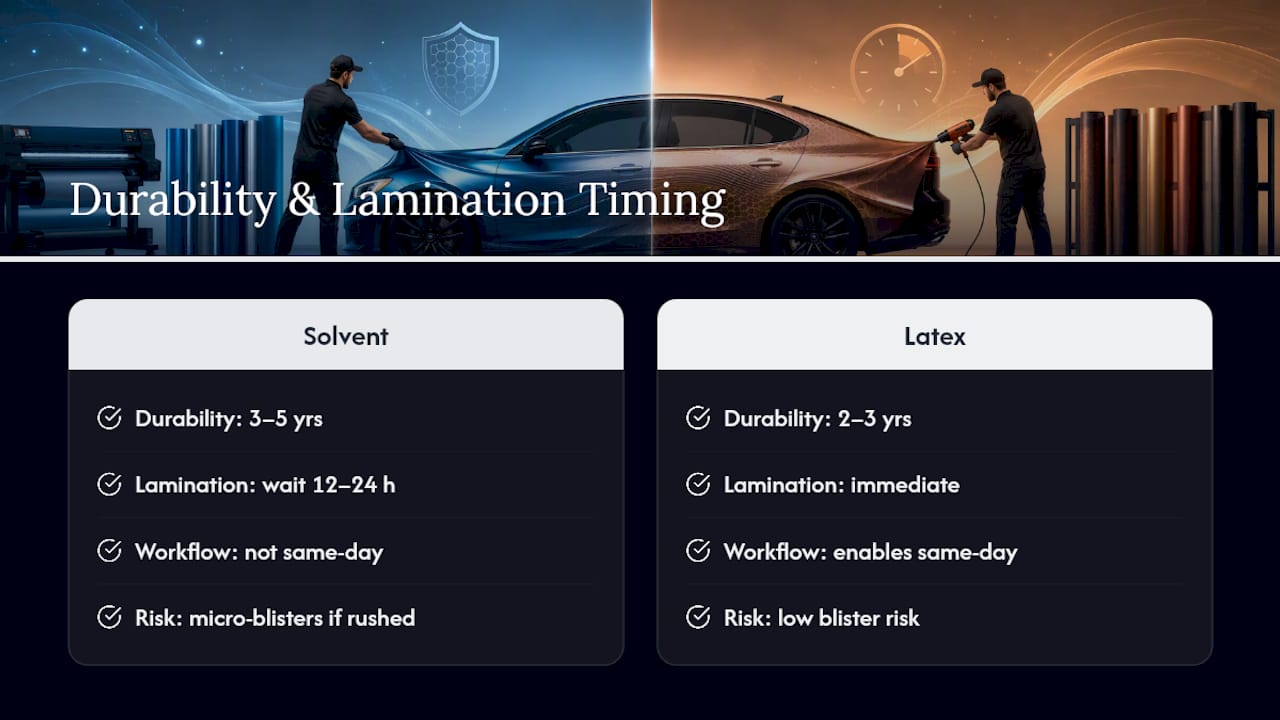
Unlaminated eco-solvent prints on cast vinyl typically hold up 3 to 5 years outdoors; unlaminated latex prints run 2 to 3 years. Lamination extends both, which is why almost no professional vehicle wrap ships without a protective laminate layer regardless of which ink printed it.
Timing is where the two diverge sharply. Solvent prints need roughly 12 to 24 hours of outgassing before lamination to avoid trapped solvent causing micro-blistering under the laminate film. Skip that window on a high-coverage panel and you’ll see bubbles show up days later, after the vehicle has already left the shop. Latex prints laminate immediately, which is the single biggest reason some shops build their entire same-day workflow around latex.
Before any full production run, print a test panel and hold it under the same lamination schedule you plan to use in production. Match laminate type (gloss, matte, or cast) to the vehicle’s exposure and expected install life, not just aesthetics.
What Do Equipment and Ink Costs Look Like Over Time?
Capex and consumables tell two different stories depending on your job mix. Eco-solvent printers typically run $8,000 to $40,000 depending on width and features, while latex machines run $15,000 to $60,000. Latex ink also costs 20 to 40% more per ml than eco-solvent.
Statistic Callout: That ink premium sounds like a dealbreaker until you factor in labor and turnaround. A shop running mostly same-day interior installs recovers that cost difference through eliminated outgas downtime, since no crew sits idle waiting on a panel to off-gas before lamination.
Here’s how the math tends to break for different job mixes:
- High-volume outdoor vinyl runs with predictable lead times: lower eco-solvent capex and ink cost usually wins on pure unit economics.
- Fast-turnaround interior work, wallpaper, or rush jobs: latex’s immediate finishing often pays back the higher equipment and ink cost within a normal production cycle.
- Mixed shops running both categories: many print buyers end up owning or outsourcing to both platforms rather than forcing one technology to cover every job.
For a deeper breakdown of how consumables and throughput affect per-job pricing, PulseMerch’s guide to print cost factors is a useful reference for procurement teams building their own cost models.
What Maintenance and Energy Costs Should Shops Expect?
Printhead lifecycle is the maintenance line item buyers underestimate most. Latex platforms, particularly HP’s thermal-style latex heads, run on scheduled replacement cycles that shops can plan and budget around. Solvent printheads often last longer in raw hours but demand more frequent manual cleaning to prevent nozzle clogs, which eats technician time in smaller, less predictable chunks.
Energy use follows a similar split. Latex’s heaters draw continuous power during every print run, showing up as a steady line on the electric bill. Solvent shops trade that for ventilation infrastructure and the ongoing management of odor in occupied workspaces.
Pro Tip: Stock critical printhead spares before you need them, not after a run goes down mid-job. Shops that schedule head replacements on a calendar, rather than waiting for a failure, consistently report less unplanned downtime than those reacting to clogs or dead nozzles in real time.
Which Technology Fits Your Specific Print Job?
Match the job to the technology first, then let media and warranty specifics confirm the call.
- Fleet wraps on cast vinyl — Eco-solvent. Lower ink cost per ml makes it the economical choice across large fleet volumes.
- Single vehicle wraps needing fast turnaround — Latex, if your shop’s schedule benefits from skipping the outgas wait; eco-solvent still works fine with proper lead time.
- Retail interior graphics and wallpaper — Latex. Odor and occupied-space concerns make this close to a default choice.
- Trade show displays on rigid substrates — Neither. UV or hybrid printers handle rigid media and instant cure better than either latex or solvent.
- Window and floor graphics in active businesses — Latex, for the same odor and immediate-install advantages that apply to interior work.
Whatever you pick, ask your print supplier one direct question before signing off: what media, lamination, and warranty combination backs this specific job? Model-level specs vary enough between printer generations that a general rule can still steer you wrong on a specific machine.
What We’ve Learned Running Both Technologies on Real Fleets
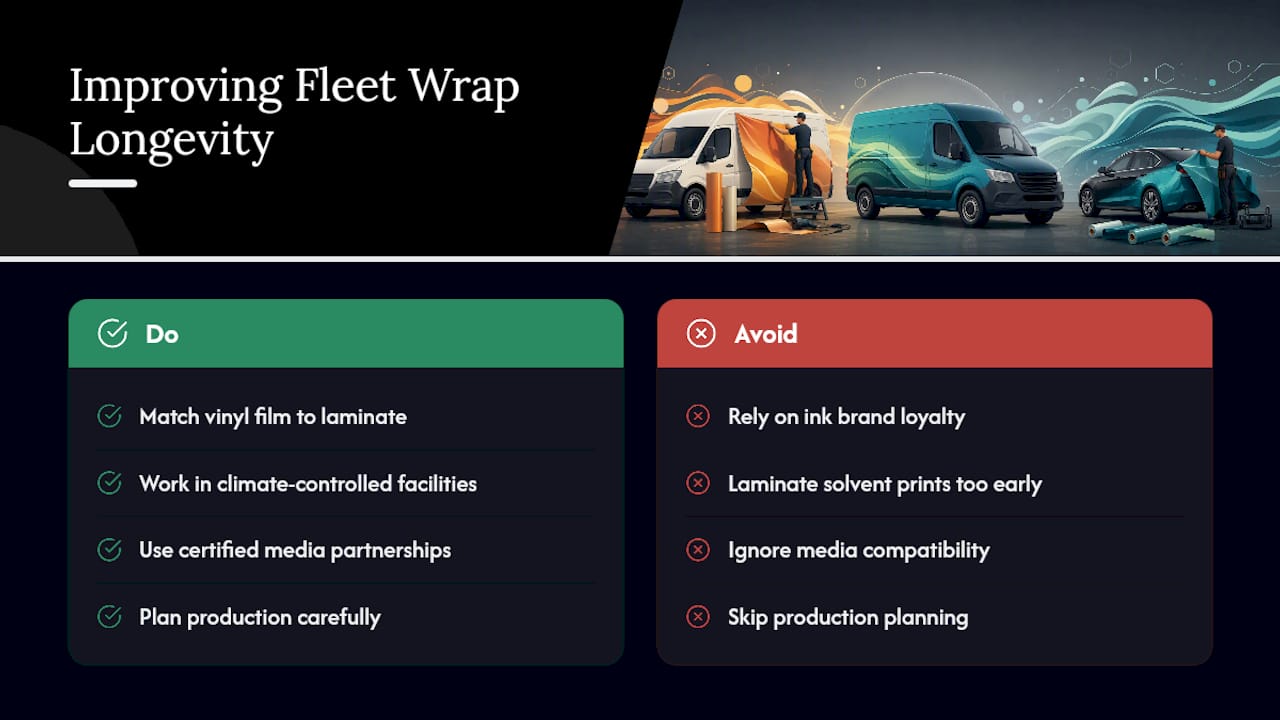
NJ Vinyl Wrapz has spent more than 10 years installing wraps across commercial fleets and personal vehicles throughout the region, and the latex-versus-solvent debate looks different from the install bay than it does on a spec sheet. Media selection matters more than brand loyalty to one ink chemistry. A cast vinyl film paired with the wrong laminate fails the same way regardless of which printer produced the graphic.
Working in climate-controlled facilities changes the calculus too. Consistent temperature and humidity make outgassing timing more predictable and reduce the adhesion failures that show up when solvent prints get laminated too early. Partnerships with 3M and Avery give access to media certified for specific ink platforms, which cuts down on guesswork over which laminate a given wrap needs. None of that replaces careful production planning, but it’s the difference between a wrap that looks sharp for three years and one that bubbles at the six-month mark.
— NJ Vinyl Wrapz
Ready for a Wrap That’s Built to Last?
Choosing between latex and solvent printing matters less than choosing a shop that knows how to execute either one correctly. NJ Vinyl Wrapz installs full vehicle wraps and fleet graphics using premium 3M and Avery materials, printed and finished in climate-controlled facilities where outgassing timing and lamination get handled right the first time, not guessed at on a rush job.

With over 10 years installing wraps for commercial fleets and individual vehicle owners in the region, some providers are licensed, insured, and set up to handle everything from a single vehicle to a full fleet rollout. Whether your project calls for fleet wraps, vehicle lettering, or window graphics, the right ink and media combination gets chosen for your specific job, not applied as a one-size-fits-all default. Ready to see what a properly specced wrap looks like on your vehicles? Request a quote for a full vehicle wrap and get a project timeline built around your fleet’s schedule.
Sources
- Choosing Between Latex, UV, Eco-Solvent, and Aqueous Printers | LexJet blog
- Eco-solvent ink vs latex ink | Roland DGA blog
- When should I change my HP Latex printheads? | Grimco Connect
FAQ
Which Is Better, DTF or Eco-Solvent?
DTF (direct-to-film) and eco-solvent serve different jobs entirely. DTF suits garment decoration, while eco-solvent is the standard for outdoor vinyl and vehicle wrap printing where large-format durability matters more than fabric transfer flexibility.
What Are the Four Types of Printing?
For large-format graphics and vehicle wraps, the four main ink technologies are eco-solvent, latex, UV, and aqueous, each suited to different substrates, cure speeds, and indoor or outdoor use cases.
What Are the Key Differences Between Latex and Eco-Solvent Printers?
Latex cures by heat fusion and laminates immediately with minimal odor, while eco-solvent cures by evaporation, needs 12 to 24 hours before lamination, and typically costs less per ml of ink.
What Is Solvent Printing?
Solvent printing uses a solvent-based ink carrier that softens a coating on the print media, allowing pigment to penetrate the surface before the solvent evaporates and the image cures. Eco-solvent is the modern, lower-VOC version widely used for vehicle wraps and outdoor signage today.
Is Latex or Solvent Printing More Eco-Friendly?
Latex generally produces fewer VOC emissions and requires less ventilation infrastructure than solvent printing, though modern eco-solvent inks are significantly cleaner than older hard-solvent formulas.