
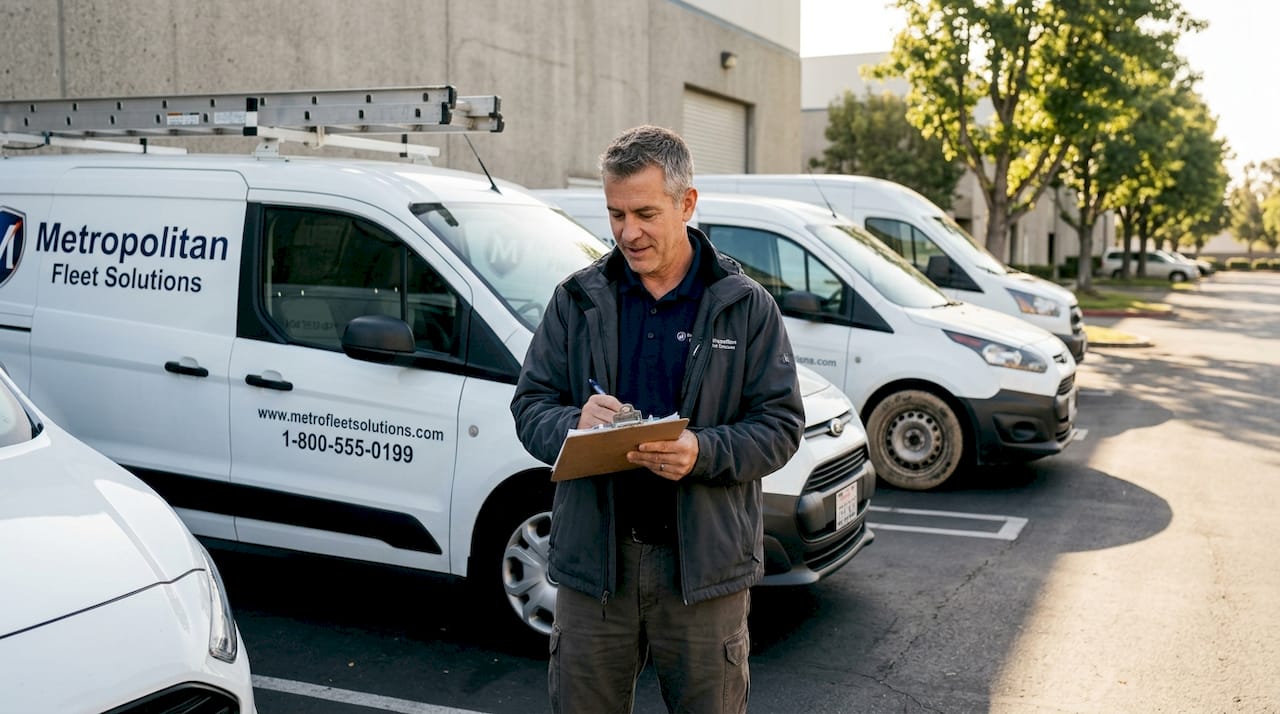
Every day your unbranded fleet vehicles roll through the NJ Turnpike, I-95, and Route 1, you’re leaving free advertising on the table. A single wrapped commercial vehicle generates between 30,000 and 70,000 impressions per day, yet most small and mid-sized businesses in New Jersey still operate plain white vans and trucks. This guide walks you through exactly how to plan, execute, and verify a professional fleet wrap so your vehicles work as hard as your team does. From materials and prep to installation and maintenance, here’s everything you need to know.
Table of Contents
- Why wrap your fleet vehicles?
- What you’ll need: Materials and tools
- Step-by-step: How to wrap your fleet vehicles
- Troubleshooting and common mistakes to avoid
- Verifying wrap quality and next steps
- Expert perspective: What most fleet wrap guides miss
- Get professional fleet vehicle wraps in New Jersey
- Frequently asked questions
Key Takeaways
| Point | Details |
|---|---|
| Brand boost | Fleet wraps dramatically increase brand visibility and professional image. |
| Material matters | Choosing the right vinyl and tools ensures long-lasting, weather-resistant wraps. |
| Expert execution | Preparation and professional installation are key to flawless results. |
| Ongoing care | Regular cleaning and inspection extend the lifespan of your fleet wraps. |
Why wrap your fleet vehicles?
Let’s be direct: your fleet is already paying for itself in fuel, insurance, and maintenance. Wrapping it is the only way to make those vehicles generate revenue beyond their primary function. The benefits of vinyl wraps for commercial fleets go well beyond aesthetics.
First, consider the cost per impression. Traditional billboard advertising in New Jersey can run $1,500 to $5,000 per month for a single location. A fleet wrap is a one-time investment that keeps advertising around the clock, every day the vehicle is on the road. That math adds up fast when you’re running five, ten, or twenty vehicles.
Second, brand consistency matters. When every vehicle in your fleet looks the same, with matching colors, logos, and messaging, customers perceive your business as organized and trustworthy. That consistency signals professionalism before anyone even picks up the phone to call you.
Third, vinyl wraps protect your vehicles. The film acts as a barrier against minor scratches, UV damage, and road debris, which preserves resale value over time.
For NJ-based fleets specifically, the opportunity is enormous. Routes like the NJ Turnpike, I-95, and the Garden State Parkway carry millions of commuters weekly. Wrapping your vehicles means your brand gets seen in some of the most densely traveled corridors in the country.
Here’s a quick breakdown of why wrapping makes strategic sense:
- 24/7 visibility with no recurring media costs
- Consistent branding across every vehicle in your fleet
- Paint protection from weather, UV rays, and minor abrasions
- High local reach on NJ’s busiest commuter routes
- Increased perceived value of your business and services
Stat callout: Brand exposure for commercial fleets is proven to increase significantly through vinyl wraps, making them one of the highest-ROI marketing tools available to local businesses.
Exploring your fleet wrap options early in the planning process helps you align your budget with the right scope of coverage.
What you’ll need: Materials and tools
Before beginning your fleet wrap process, you need the right materials on hand. Using substandard supplies is the fastest way to end up with peeling, fading, or bubbling vinyl within the first year.
Vinyl film is your most important material choice. Cast vinyl is the professional standard for fleet applications because it conforms better to curves and complex panel shapes than calendered vinyl. For New Jersey fleets dealing with hot summers, freezing winters, and salt-heavy road conditions, cast vinyl is the only sensible choice. Brands like 3M and Avery are industry benchmarks for durability and color consistency.
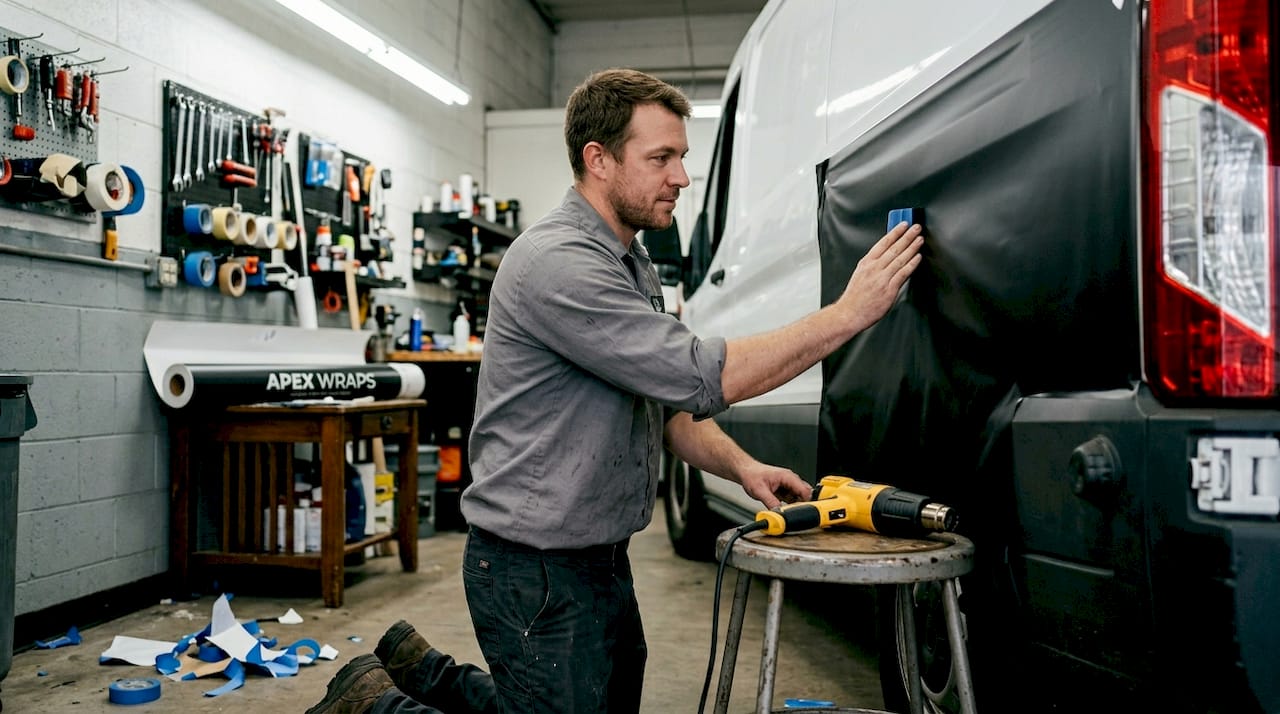
Beyond the vinyl itself, professional fleet wrap materials include a specific set of tools that make the difference between a clean install and a frustrating redo:
| Tool | Purpose |
|---|---|
| Surface cleaner (IPA solution) | Removes wax, grease, and contaminants |
| Squeegee with felt edge | Smooths vinyl and removes air |
| Heat gun | Activates adhesive and stretches vinyl around curves |
| Utility knife | Trims edges cleanly |
| Tape measure and marking tape | Ensures accurate panel alignment |
| Microfiber cloths | Final surface wipe before application |
For branding materials, you’ll also need finalized artwork files, company color swatches matched to Pantone or CMYK standards, and approved logo files in vector format. Sending low-resolution artwork to print is a common mistake that results in blurry graphics on the finished vehicle.
Pro Tip: Always request a printed color proof before committing to a full fleet run. Colors on screen look different than colors on vinyl under sunlight. One proof can save you from reprinting an entire fleet.
You can review available wrap options to determine whether full wraps, partial wraps, or decal packages best fit your fleet’s branding goals and budget.
Step-by-step: How to wrap your fleet vehicles
With materials ready, you’re set to begin the actual wrap process. Rushing any stage here leads to visible flaws that are expensive to fix.
- Clean the vehicle thoroughly. Wash with soap and water, then wipe every panel with an isopropyl alcohol solution. Remove any wax, silicone, or polish residue. Even invisible contamination causes adhesion failure.
- Inspect the paint surface. Look for rust, chips, or peeling clear coat. Vinyl applied over damaged paint will lift prematurely. Address any surface issues before wrapping.
- Measure and plan your layout. Use a tape measure to map out panel dimensions. Plan where seams will fall, ideally along natural body lines, not across flat, visible surfaces.
- Print and laminate your graphics. Work with your print provider to confirm color accuracy and apply a protective laminate layer for UV resistance.
- Apply vinyl to flat panels first. Start with doors and flat body sections. Use your squeegee at a 45-degree angle and work from the center outward to push air toward the edges.
- Tackle curves and recesses with heat. Use a heat gun at a low setting to soften the vinyl and allow it to conform around bumpers, mirrors, and wheel arches. Don’t rush this step.
- Trim edges and tuck seams. Use a utility knife to trim excess vinyl cleanly. Tuck edges into door jambs and panel gaps wherever possible for a finished, professional look.
- Post-application inspection. Run your hand over every panel to feel for air pockets, lifted edges, or wrinkles. Use the heat gun to re-activate adhesive on any problem spots.
“Proper prep and installation ensures the wrap lasts and looks professional.” This is true whether you’re wrapping one van or twenty trucks.
| Approach | Result |
|---|---|
| Skipping surface prep | Early peeling and adhesion failure |
| Proper cleaning and priming | Strong bond and clean finish |
| Rushing curved sections | Bubbles and stretch marks |
| Using heat gun correctly | Smooth, conforming wrap |
Pro Tip: Work in a climate-controlled environment whenever possible. Vinyl applied in cold or humid conditions is far more likely to fail. If you’re doing this in a garage in January in NJ, heat the space first.
For complex installations, reviewing a fleet wrap installation guide or consulting professionals can save you significant time and material costs. For lettering-only applications, vehicle lettering tips can simplify the process considerably.
Troubleshooting and common mistakes to avoid
Effective fleet wraps require attention to detail. Here’s how to steer clear of costly errors that show up after installation.
The most frequent problems fleet managers encounter fall into three categories: surface prep failures, application errors, and environmental mistakes.
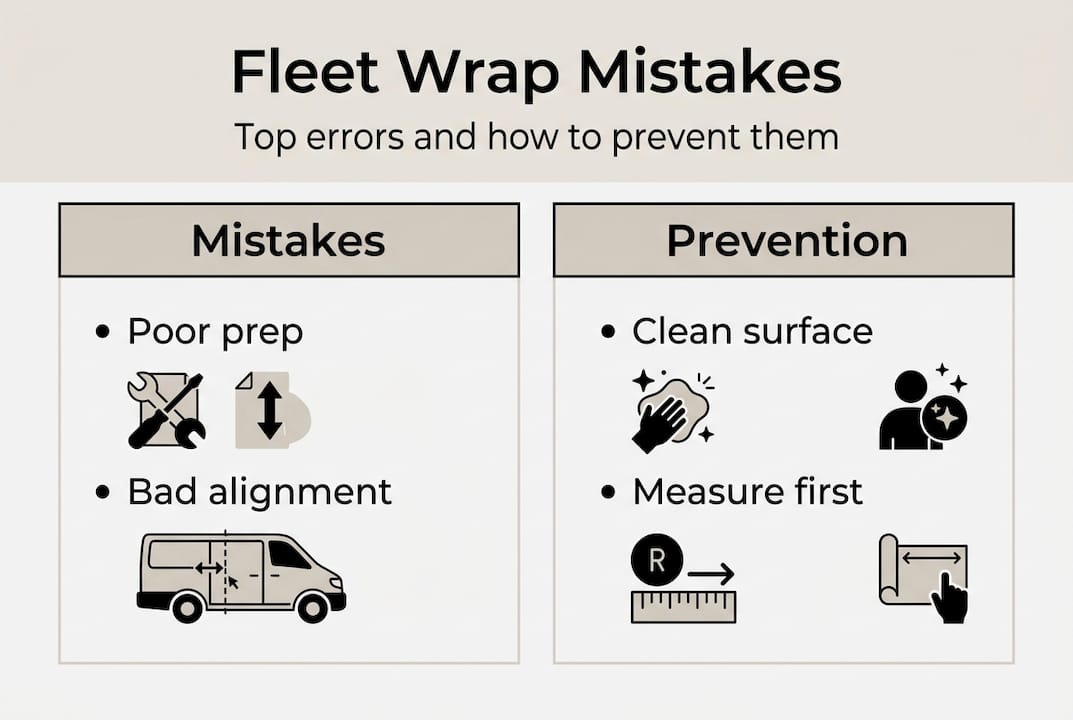
Surface prep failures happen when vehicles aren’t cleaned aggressively enough. Old wax, silicone-based products, and even fingerprints create invisible barriers that prevent adhesion. Moisture trapped under the vinyl is especially damaging in NJ winters when freeze-thaw cycles can cause rapid edge lifting.
Application errors include overusing the heat gun, which can stretch vinyl unevenly and cause color distortion. Air bubbles that aren’t worked out during installation become permanent once the adhesive fully cures. Panel misalignment is harder to spot during installation but obvious once the vehicle is in daylight.
Common mistakes to avoid:
- Applying vinyl in temperatures below 50°F or above 90°F
- Using a heat gun too close to the vinyl surface
- Skipping the IPA wipe-down after washing
- Leaving seams in high-visibility, flat panel areas
- Ignoring small bubbles that grow over time
“Temperature, dirt, and poor technique are the most common issues affecting wrap results.” Fixing these three variables eliminates the majority of installation failures.
Pro Tip: If you notice a bubble within the first 72 hours of installation, you can often fix it with a small pin prick and a squeegee. After the adhesive fully cures, that same bubble requires panel re-wrapping.
For high-value vehicles or large fleet runs, the risk of DIY errors is significant. Reviewing your wrap troubleshooting options with a professional before starting can prevent expensive mistakes.
Verifying wrap quality and next steps
After wrapping your fleet, ongoing attention ensures results and durability. A wrap that looks great on day one but fails in six months is a waste of your investment.
Start with a thorough quality inspection immediately after installation:
- Check all edges and seams for lifting or gaps
- Look for wrinkles or stretch marks on flat panels
- Verify color consistency across all vehicles in the fleet
- Confirm logo placement matches your brand guidelines exactly
- Inspect recessed areas like door handles and mirrors for proper adhesion
Once the fleet passes inspection, establish a cleaning routine. Hand washing with mild soap and water is the safest method. Avoid automated car washes with stiff brushes, high-pressure jets aimed at seam edges, and solvent-based cleaners. These all accelerate wear.
For long-term performance, partial wrap maintenance practices apply equally to full wraps. Consistent care is what separates a five-year wrap from one that looks tired after eighteen months.
Stat callout: Properly maintained wraps can last 5 to 7 years, meaning your one-time investment delivers years of daily brand impressions across New Jersey’s roads.
From a marketing standpoint, track your ROI by monitoring inbound inquiries that reference your vehicles, adding a unique phone number or URL to your fleet graphics, and surveying new customers about how they found you.
Expert perspective: What most fleet wrap guides miss
Having covered the process, here’s what professionals wish more fleet owners knew before they started.
Most guides focus on the how and skip the why behind material quality. We’ve seen businesses choose the cheapest vinyl available to save a few hundred dollars per vehicle, only to spend twice as much on re-wraps within two years. The math never works in their favor. Premium cast vinyl from trusted brands costs more upfront and saves significantly over the life of the wrap.
The second thing most guides miss is design strategy. Generic designs with just a logo and phone number underperform compared to wraps with a clear visual hierarchy, a strong call to action, and imagery that communicates what the business actually does. Your wrap is a billboard moving at 65 miles per hour. You have about three seconds to make an impression.
Finally, NJ fleet operators need to be aware of local advertising regulations. Some municipalities have restrictions on vehicle-based advertising in specific zones. Before finalizing your design, verify compliance with local ordinances. Our team at NJ fleet wrap lessons has navigated these requirements for hundreds of clients across the state.
Get professional fleet vehicle wraps in New Jersey
Ready to maximize your fleet’s visibility? Turning your vehicles into high-impact brand assets is exactly what we do at NJ Vinyl Wrapz, and we’ve been doing it for over 10 years across New Jersey.
Our fleet wrap experts work with fleet managers and business owners to design, print, and install wraps that perform in NJ’s demanding climate. Whether you’re managing three vehicles or thirty, we offer one-on-one consultations to align your branding goals with the right wrap solution. From full vehicle wrap solutions to partial coverage and decal packages, every project is handled in our climate-controlled facility using 3M and Avery materials. Request a quote today and put your fleet to work.
Frequently asked questions
How long does a fleet vehicle wrap last?
A quality vinyl wrap typically lasts 5 to 7 years with proper maintenance, according to full vehicle wrap standards used by professional installers.
Can fleet wraps withstand New Jersey weather?
Professional-grade cast vinyl is specifically engineered to handle NJ’s seasonal extremes, including summer heat, road salt, and freezing temperatures, making it the right choice for NJ fleet applications.
What is the best way to clean a wrapped fleet vehicle?
Hand wash with mild soap and water, avoid high-pressure jets near seams, and follow the wrap care routine recommended by your installer to preserve color and adhesion.
Is vehicle wrapping a good investment for small businesses?
Yes. Vehicle wraps deliver 24/7 advertising reach at a fraction of the cost of traditional media, making them one of the strongest ROI marketing tools for small businesses in NJ.
Can I wrap the fleet myself or should I hire a professional?
DIY is possible for simple applications, but professional installation ensures durability, precise alignment, and compliance with local regulations, especially for high-value vehicles. Review your wrap installation options before deciding.