
Supplier relationships, installer training programs, and material partnerships are the direct drivers of vehicle wrap quality. The role of partnerships in wrap quality is not a soft business concept. It is the operational foundation that determines whether your fleet looks sharp for five years or starts peeling in five months. Njvinylwrapz has built its entire service model around this principle, working with trusted material brands like 3M and Avery to deliver wraps that hold up under real commercial conditions. Fleet managers who understand how these collaborations work gain a measurable advantage in branding consistency and long-term cost control.
How do partnerships impact the quality and durability of vehicle wraps?
The partnership impact on quality begins at the material level. When a wrap provider works directly with manufacturers like 3M or Avery, they gain access to product specifications, application guidance, and early access to new film technologies. That relationship translates into better material selection for your specific fleet vehicles, climate conditions, and branding requirements.
Collaboration in wrap production also shapes installer skill. Certified training programs from material manufacturers set consistent standards for surface preparation, film application, and heat forming around complex vehicle contours. An installer trained and certified through a 3M or Avery program applies film differently than one who learned through trial and error. The gap in output quality is visible.
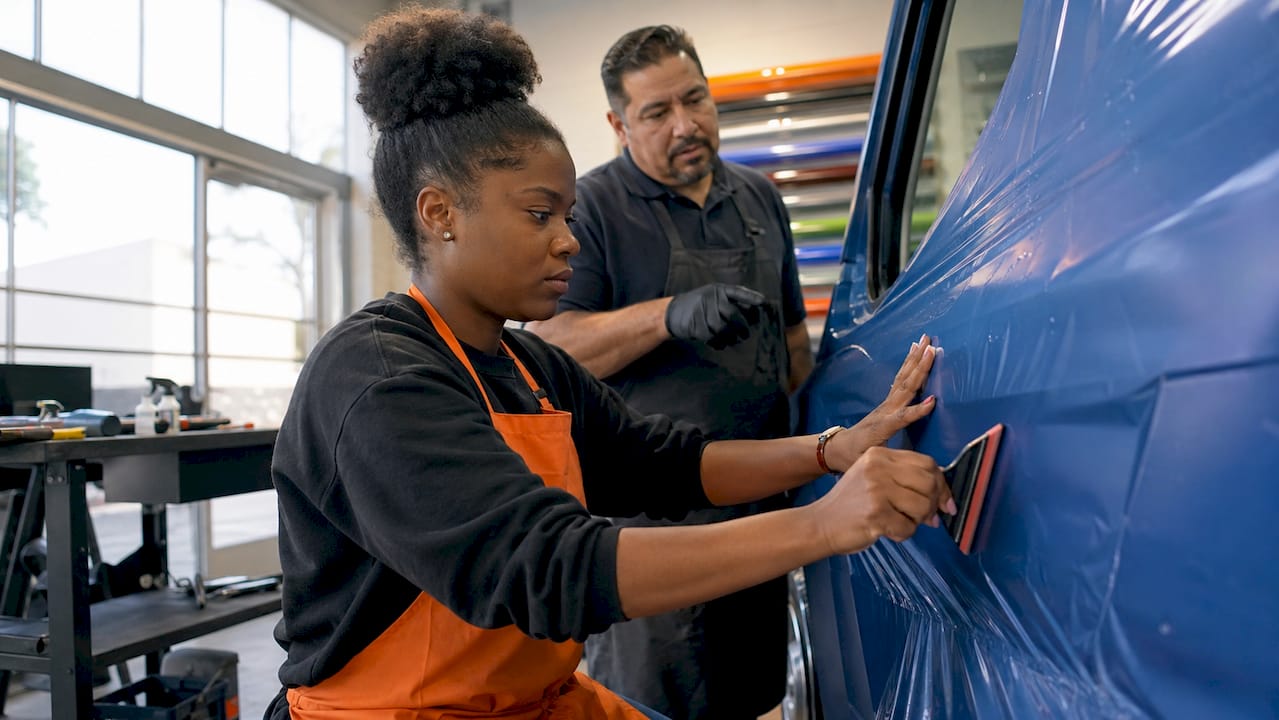
Long-term partnerships also accumulate what practitioners call tribal knowledge. Accumulated brand-specific knowledge through long-term partnerships reduces errors and rework, which directly protects brand image consistency across an entire fleet. That knowledge is not documented in a manual. It lives in the hands and judgment of experienced installers who have wrapped hundreds of vehicles with your brand’s specific colors, fonts, and panel layouts.
The third impact is accountability. Fragmented supplier responsibility increases downtime and quality variability. When your wrap provider, material supplier, and designer operate as separate vendors with no shared accountability, errors fall through the gaps. Consolidating under one wrap partner who owns the full process eliminates that problem.
- Material partnerships give installers access to premium films with verified performance data
- Certified training programs from brands like 3M standardize application technique across crews
- Long-term relationships build brand-specific knowledge that reduces rework
- Single-partner accountability removes the finger-pointing that causes quality failures
Pro Tip: Ask your wrap provider which material manufacturer certifications their installers hold. A certified 3M or Avery installer is not just a marketing claim. It signals a formal training relationship that directly affects how your wrap performs.
What types of partnerships optimize wrap quality and operational efficiency?
Not all partnerships deliver equal results. The structure of the collaboration matters as much as the intent behind it. Loose vendor arrangements, where a wrap shop orders materials from a distributor with no formal relationship, produce inconsistent results. Tight integrations, where the installer, designer, and material supplier share goals and communication channels, produce measurably better outcomes.
Research on tight vertical integration shows it yields significantly better quality outcomes compared to loosely coordinated arrangements. That finding applies directly to wrap production. When your wrap provider has a formal partnership with a material manufacturer, both parties share responsibility for the finished product. That shared responsibility changes how problems get solved.
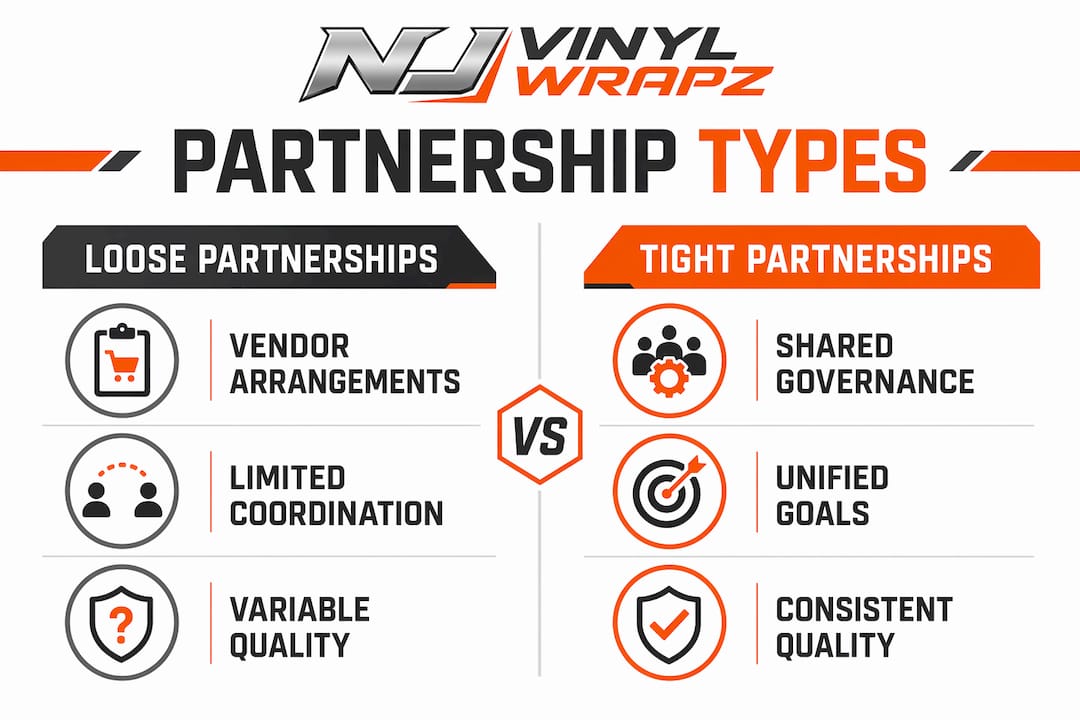
| Partnership type | Structure | Quality outcome | Operational benefit |
|---|---|---|---|
| Loose vendor arrangement | Separate suppliers, no shared goals | Inconsistent film quality, variable results | Low upfront cost, high rework rate |
| Preferred supplier agreement | Defined terms, volume commitments | More consistent materials, better pricing | Moderate efficiency, some accountability |
| Certified installer partnership | Formal training and standards from manufacturer | High consistency, verified application quality | Reduced errors, faster turnaround |
| Tight vertical integration | Shared governance, unified responsibility | Best quality outcomes, fewest defects | Lowest long-term cost, highest accountability |
Shared governance is the differentiator in the top tier. When a wrap provider and material manufacturer share a unified quality standard, communication between them is faster and more direct. A film adhesion issue gets resolved in hours, not weeks. A color match discrepancy gets corrected before it reaches your vehicles.
Mature partnerships exceeding two years show measurable improvements in process consistency and fewer adverse outcomes compared to newer collaborations. For fleet managers, this means the age of your wrap provider’s supplier relationships matters. A shop that has worked with 3M for a decade knows how to navigate material issues that a newer shop has never encountered.
What technological innovations come from strong wrap production partnerships?
Joint development between wrap technology companies and material manufacturers produces advances that a single company cannot achieve alone. The clearest recent example is the collaboration between Aetna Group and Mondi, which produced a paper-based pallet wrapping system using 100% recyclable materials with advanced process control via touch screen and Cube Technology. That system handles up to 750 pallets per reel with precise tension management.
The Aetna and Mondi partnership also demonstrates what happens when both parties commit to a shared goal from the start. Paper-based wrapping innovations extended material use by 10% while improving load stability. One facility moved from 0% paper-based wrapping to 50% within six months, with a target of 80%. That rate of adoption only happens when the technology works reliably from day one.
| Innovation driver | Partnership contribution | Result |
|---|---|---|
| Material development | Manufacturer provides film specs and testing | Higher durability, better adhesion |
| Process automation | Technology partner integrates control systems | Consistent tension, fewer application errors |
| Sustainability goals | Shared circularity vision between partners | Recyclable materials, reduced waste |
| Quality control | Joint standards and feedback loops | Fewer defects, faster issue resolution |
For vehicle wraps, the parallel is direct. When Njvinylwrapz works with 3M, the material data that informs film selection, application temperature, and surface preparation comes from a formal relationship. That data does not exist in a loose vendor arrangement. Early engagement of partners with a shared vision for quality and sustainability is what drives industry-wide improvement. Wrap providers who wait until a problem appears to consult their material supplier are always one step behind.
How can fleet managers leverage partnerships to get better wraps?
Fleet managers who treat wrap procurement as a commodity purchase consistently get commodity results. The wrap quality improvement strategy that actually works starts with evaluating your provider’s partner network before you evaluate their portfolio.
-
Verify material manufacturer certifications. Ask specifically which certifications your installer holds from 3M, Avery, or other major film manufacturers. Certification means the installer has completed formal training and meets the manufacturer’s application standards. A professional wrap installation from a certified shop is not the same product as one from an uncertified shop using the same film.
-
Prioritize end-to-end accountability. Highest quality wrapping results come from engineering discipline and long-term single-partner responsibility, not just advanced machinery. Choose a wrap provider who owns the full process from design through installation and follow-up. Fragmented responsibility creates quality gaps.
-
Build a long-term relationship with one provider. Long-term partnerships build trust and reduce costs and quality fluctuations. A wrap provider who has wrapped your fleet for three years understands your brand standards at a level that a new vendor cannot replicate in a single project.
-
Ask about the provider’s material supplier relationships. A wrap shop that orders film from a distributor with no direct manufacturer relationship has no leverage when a material issue arises. A shop with a formal 3M or Avery partnership can escalate issues directly and get faster resolution.
-
Evaluate sustainability commitments. Partners who invest in premium wrap materials and sustainable sourcing signal a long-term orientation. That orientation aligns with fleet managers who need wraps to perform for five or more years.
Pro Tip: When reviewing wrap proposals, ask each provider to name their primary material manufacturer partner and describe the nature of that relationship. The answer tells you more about likely wrap quality than any portfolio image.
Key takeaways
Strong partnerships between wrap providers, material manufacturers, and installers are the single most reliable predictor of vehicle wrap quality, durability, and brand consistency across a fleet.
| Point | Details |
|---|---|
| Material partnerships drive quality | Formal relationships with 3M or Avery give installers access to verified film data and application standards. |
| Tight integration outperforms loose arrangements | Shared governance and unified accountability reduce defects and speed up issue resolution. |
| Partnership maturity matters | Relationships exceeding two years build brand-specific knowledge that reduces rework and protects brand consistency. |
| Single-partner accountability is critical | Fragmented supplier responsibility creates quality gaps. One partner owning the full process eliminates finger-pointing. |
| Evaluate the partner network first | A provider’s supplier certifications and manufacturer relationships predict wrap quality more reliably than portfolio images alone. |
What I’ve learned about partnerships and wrap quality after a decade in the field
After more than ten years working with fleet managers across New Jersey, the pattern I see most often is this: businesses that struggle with inconsistent wrap quality almost always have fragmented vendor relationships. They buy film from one source, design from another, and installation from a third. Nobody owns the outcome. When a wrap fails at 18 months instead of 60, everyone points at someone else.
The businesses with the most consistent, longest-lasting fleet wraps are the ones who found one partner and stayed. That is not loyalty for its own sake. It is a practical decision. A wrap provider who has worked with your brand for years knows your exact Pantone colors, your preferred finish, and the specific panel challenges on your vehicle models. That knowledge cannot be transferred in a project brief.
The other thing I have observed is that the best wrap results come from providers who have formal relationships with their material manufacturers, not just purchasing accounts. When we work with 3M, we are not just buying film. We are accessing technical support, application data, and a direct line when something unusual comes up. That relationship is what separates a five-year wrap from a two-year wrap.
My honest advice to any fleet manager: stop evaluating wrap providers on price and portfolio alone. Ask about their supplier certifications. Ask how long they have worked with their primary material manufacturer. Ask who owns the outcome if something goes wrong. The answers will tell you everything about the quality you can expect.
— Krunal
How Njvinylwrapz partnerships deliver better fleet wraps
Njvinylwrapz brings over ten years of experience and formal partnerships with 3M and Avery to every fleet wrap project in New Jersey. Those relationships are not marketing language. They are the reason our wraps consistently perform at the five-year mark and beyond.
Every fleet wrap project we take on is backed by certified installation, premium materials sourced through direct manufacturer relationships, and a single point of accountability from design through final inspection. Fleet managers who want consistent branding across every vehicle in their fleet can explore our full vehicle wrap services or contact us directly to discuss your fleet’s specific requirements. The partnership that produces your best wrap starts here.
FAQ
How do partnerships directly affect vehicle wrap durability?
Partnerships with material manufacturers like 3M and Avery give installers access to verified film specifications and application standards. That access produces wraps that adhere correctly, resist UV damage, and last significantly longer than wraps applied without manufacturer guidance.
What is the benefit of a single wrap partner over multiple vendors?
Consolidating under one wrap partner who owns the full process eliminates fragmented responsibility. When one partner controls design, materials, and installation, quality gaps close and accountability is clear.
How long does it take for a wrap partnership to show quality improvements?
Research on mature partnerships shows measurable quality improvements after two or more years of collaboration. That timeline reflects the accumulation of brand-specific knowledge and refined processes that reduce errors over time.
What certifications should I look for in a wrap provider’s partnerships?
Look for formal installer certifications from 3M or Avery. These certifications confirm that the installer has completed manufacturer-approved training and meets defined application standards, which directly affects wrap quality and longevity.
Does a wrap provider’s material supplier relationship affect my fleet’s branding consistency?
A direct manufacturer relationship gives your wrap provider faster access to technical support and consistent film batches. That consistency is what keeps your brand colors and finish uniform across every vehicle in your fleet, regardless of when each vehicle was wrapped.