
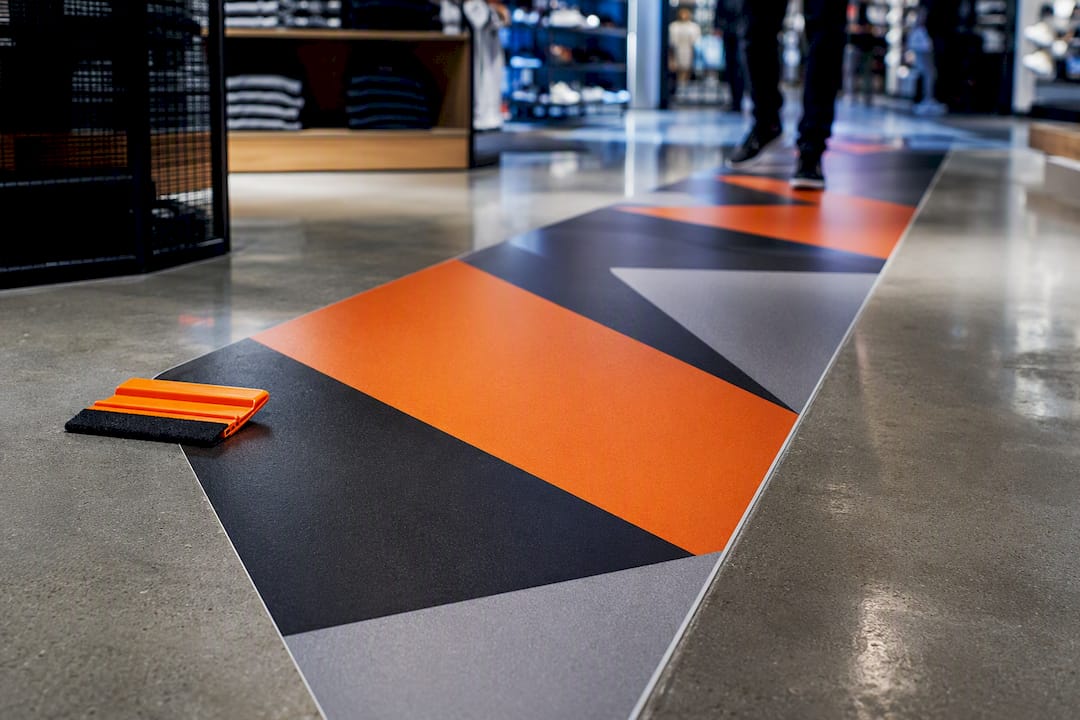
For most retail stores, the right call is textured polymeric vinyl or a printed polymeric film with a certified slip-resistant laminate, installed by a professional for anything over roughly 5 square feet. Give the adhesive a minimum 8-hour dwell time before foot traffic, and ask your vendor for slip-resistance documentation tied to UL 410 or ANSI A326.3. Pick the material based on your surface and how long the campaign needs to run, then get a spec sheet before you sign off.
TL;DR:
- Textured polymeric vinyl or printed film with slip-resistant laminate lasts longer and is safer in high-traffic retail areas, especially when installed professionally.
- Proper surface preparation, including de-waxing and moisture testing, is critical to prevent early adhesion failure, with a curing time of at least 8 hours before foot traffic.
- Certified slip-resistant laminates adhering to UL 410 or ANSI A326.3 are essential to reduce liability, and vendors should provide certification before installation.
- Lifespan varies from two to six weeks for promotional decals on smooth surfaces, and up to a year for well-installed polymeric graphics with certified laminates.
- Professional installation is recommended for graphics larger than five square feet or on textured, uneven, or mixed flooring surfaces to ensure durability and safety.
Table of Contents
- Choosing Floor Graphics Materials for Retail
- How Long Do Floor Graphics Last, and What Safety Standards Apply?
- Floor Graphic Installation: The Prep Work That Actually Matters
- Where Floor Graphics Work Best in a Retail Store
- What Do Floor Graphics Cost, and How Long Does a Project Take?
- Cleaning and Removing Retail Floor Graphics Safely
- Why Retailers Trust NJ Vinyl Wrapz for Large-Format Graphics
- Why We Push Certified Materials Over Cheap Vinyl
- Get Custom Floor Graphics Installed the Right Way
- Sources
- FAQ
Choosing Floor Graphics Materials for Retail
Material choice comes down to two questions: how long does this campaign need to last, and what’s underfoot. Monomeric vinyl is the cheapest option and the least durable, fine for a two-week sale sign but not much else. Polymeric vinyl flexes better, resists shrinkage, and handles months of retail traffic. Cast vinyl, the premium tier, molds to textured or slightly uneven surfaces and lasts longest, but it costs more than most short-run promotions justify.
The bigger decision is textured direct-print film versus printed film with a separate overlaminate. Textured films act as a one-step anti-slip surface, which Avery Dennison’s installation guidance confirms can remove the need for a laminate entirely. Printed film plus a slip-resistant laminate gives you better print clarity for photography-heavy graphics, at the cost of an extra production step.
Adhesive selection matters just as much:
- Removable adhesive for short promotions on finished tile or sealed concrete.
- Permanent adhesive for wayfinding or brand graphics meant to stay for a season or longer.
- High-tack adhesive for textured, rough, or slightly uneven concrete where standard adhesive won’t grip.
As a rule of thumb, Drytac’s material-selection guidance suggests matching adhesive strength and film flexibility to surface texture first, then adjusting for how long the graphic needs to survive.
How Long Do Floor Graphics Last, and What Safety Standards Apply?
Expect a short promotional decal on smooth tile to hold up for two to six weeks under heavy foot traffic. A polymeric graphic with a laminate, installed properly, typically lasts several months to a year in a busy aisle or entrance. Lifespan drops fast in high-abrasion zones like cart paths or loading areas, so match your material grade to the specific spot, not the store average.
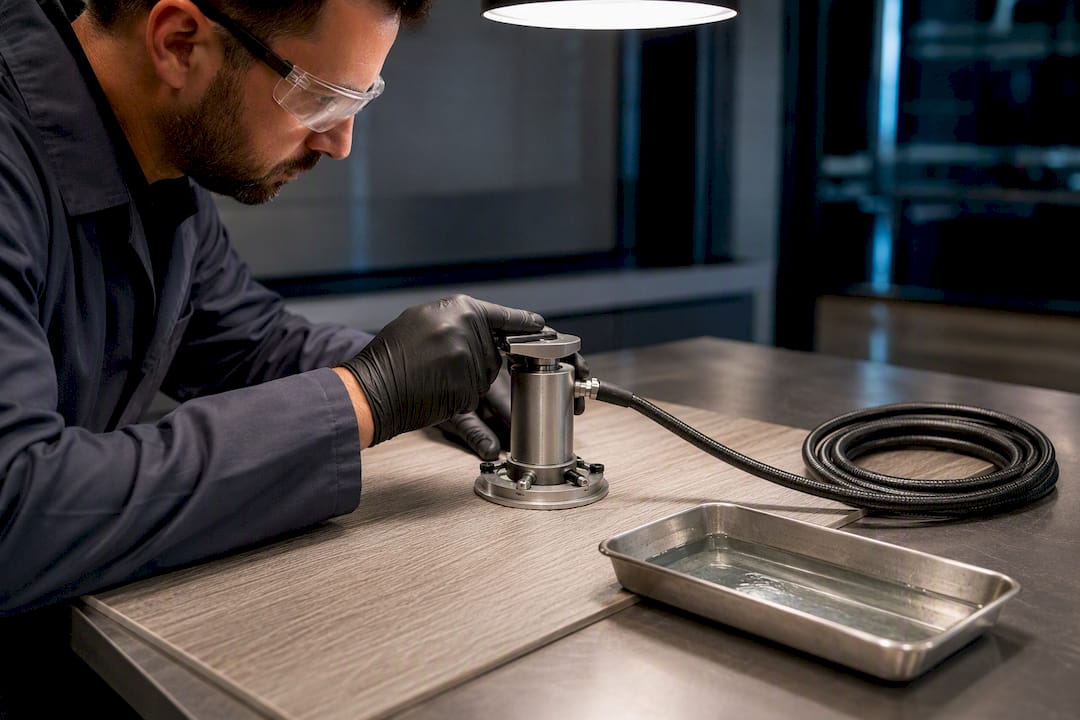
Slip resistance is the number one liability issue with retail floor graphics. DCOF (dynamic coefficient of friction) measures how much traction a surface offers underfoot when wet or dry, and it’s the metric behind ANSI A326.3 and the pendulum test method referenced under ASTM standards. UL 410 is the certification most manufacturers cite for slip-resistant laminates. Before you approve any design, LineMark’s safety-focused installation research makes clear that certified laminates aren’t optional in high-traffic retail. A thicker laminate, generally in the 5 to 10 mid range, adds scuff and chemical resistance without creating a trip hazard at the edge.
Ask every vendor for a written slip-test certificate and the exact laminate spec before installation, not after a customer slips.
Floor Graphic Installation: The Prep Work That Actually Matters
Most floor graphic failures trace back to one thing: the surface wasn’t clean enough. Waxed floors, sealant residue, and moisture trapped in concrete all sabotage adhesion before the vinyl ever goes down.
- Test for moisture and de-wax the surface. Concrete moisture testing catches problems invisible to the eye, and a proper de-waxing pass removes the film that causes bubbling and delamination.
- Wipe with 99% isopropyl alcohol and let it fully evaporate. Skipping this step is the single most common reason installs fail early.
- Dry-position the graphic using the hinge method before any adhesive touches the floor, so you can check alignment against doorways, aisles, or fixtures.
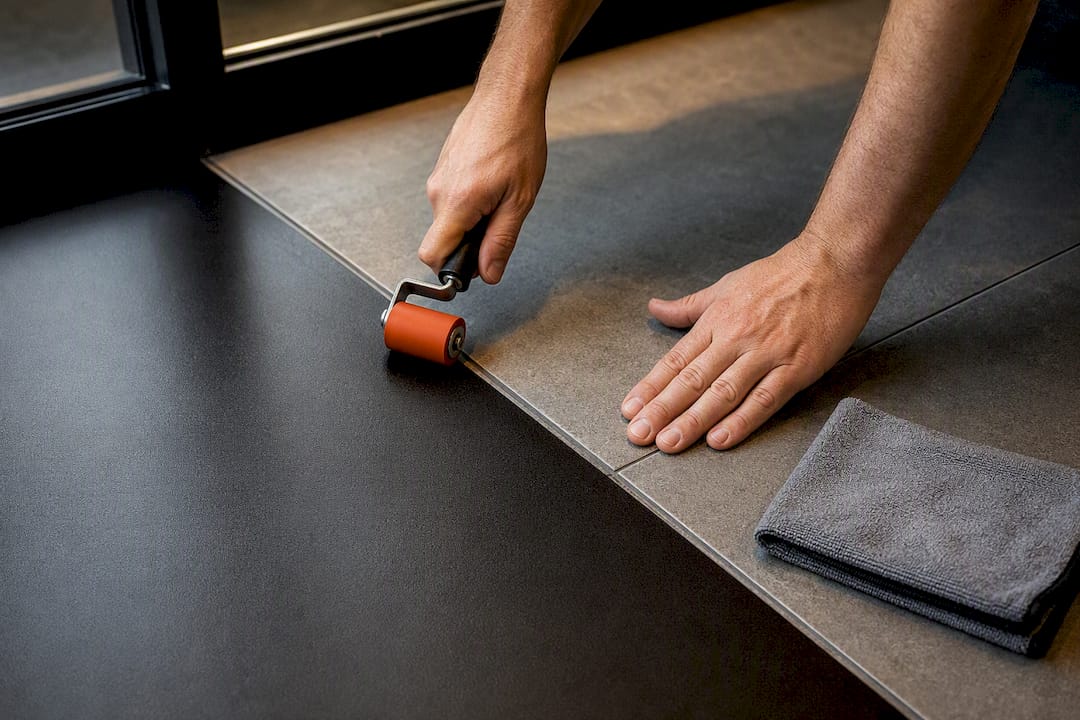
- Apply center-out with firm, even squeegee pressure, working air bubbles toward the edges rather than trapping them in the middle.
- Hold foot traffic for at least 8 hours to let the adhesive cure fully, per Avery Dennison’s application bulletin.
Room temperature matters more than most store managers expect. Arlon’s installation guide recommends installing between 60°F and 90°F; anything below 50°F risks edge lifting within days. Bring in a professional installer once you’re working with multiple panels, mixed flooring types, or anything larger than about 5 square feet. Pros also add safeguards most DIY jobs skip, like edge sealer and rounded corners to keep cleaning crews from catching a lip and peeling it up.
Pro Tip: Never place a seam or graphic edge directly over a grout line or tile joint. It’s the fastest way to get premature lifting, no matter how good the adhesive is.
Where Floor Graphics Work Best in a Retail Store
Floor space is real estate you’re probably underusing. Directional graphics near the entrance pull shoppers toward a featured display; graphics at decision points, like the gap between two competing product bays, can nudge attention exactly where you want it. LineMark’s research on retail engagement points to measurable uplift when floor graphics get placed at genuine decision moments rather than scattered for decoration.
High-impact spots worth testing:
- Entrance mats and the first 10 feet of the path-to-purchase.
- Endcap floor graphics that reinforce an overhead sign.
- Checkout queue lines for spacing or upsell messaging.
- Aisle directional arrows for wayfinding in larger-format stores.
Keep the design rules simple: big and legible beats clever and small, high-contrast color reads faster underfoot than subtle branding, and text should be minimal since most shoppers glance down for under a second. Track footfall near the graphic, dwell time at the associated display, and any lift in conversion for that specific product zone before rolling the design out storewide.
What Do Floor Graphics Cost, and How Long Does a Project Take?
Price swings widely based on a handful of factors:
- Material grade — monomeric costs less than polymeric, which costs less than cast vinyl.
- Laminate type — a certified slip-resistant laminate adds cost but removes liability risk.
- Custom shapes or die-cuts versus standard rectangles or circles.
- Installation labor, which scales with square footage, number of panels, and surface prep needs.
- Quantity — a 50-store rollout earns volume pricing that a single decal never will.
A single small promotional decal can turn around in days once artwork is approved. A full-store brand graphic package, including custom design and professional installation, usually runs one to two weeks. A 50-store rollout needs real lead time, often four to eight weeks, once you factor in production, kitting, and installer scheduling across markets — for guidance on managing these complexities, see Mobile Detail AI for tools on deployment logistics and fleet coordination. Before you commit to any vendor, request their spec sheet, slip-test documentation, and a written installation quote side by side.
Cleaning and Removing Retail Floor Graphics Safely
Daily cleaning is simple: dust mop or a damp mop with a neutral pH cleaner, no harsh chemicals, no wax-based floor polish over the graphic itself. Avoid wet mopping or heavy scrubbing for the first 24 hours after install while the adhesive finishes curing.
- Skip abrasive buffers on the graphic until the manufacturer’s cure window has passed.
- Spot-clean scuffs with the same neutral cleaner used elsewhere on the floor.
- Remove graphics by warming the edge and pulling at a low angle, then clean adhesive residue with isopropyl alcohol.
- Call a professional if the graphic sits on a finished or coated floor where scraping could damage the surface underneath.
- Replace once you see edge-lift, cracking, or scuffing heavy enough to hurt legibility, whichever comes first.
Why Retailers Trust NJ Vinyl Wrapz for Large-Format Graphics
Some professional installers bring premium materials and installation discipline used on commercial fleet wraps to retail floor, wall, and window graphics. Projects may use 3M and Avery materials, be produced and prepped in climate-controlled facilities, and performed by licensed and insured teams with extensive experience in large-format vinyl work. That background covers everything from single-store brand rollouts to multi-location environmental graphic packages.
Why We Push Certified Materials Over Cheap Vinyl
Store managers usually ask about cost first and safety second. That’s backwards. A slip-and-fall claim costs more than the price difference between a generic film and a certified, slip-tested laminate, every time. Spec the material to the standard, then worry about the budget line.
— NJ Vinyl Wrapz
Get Custom Floor Graphics Installed the Right Way
There’s a real gap between a store manager buying a roll of vinyl online and getting a graphic that survives a New Jersey winter’s worth of wet boots and mop buckets. Custom design, premium materials, and professional installation by experienced teams help ensure proper dwell times, temperature ranges, and slip-resistance specifications keep graphics on the floor and out of liability reports.

Beyond floor graphics, the same crew handles window graphics for coordinated entrance and storefront branding, so your whole retail environment reads as one campaign instead of mismatched pieces. If you’re planning a single-store refresh or a multi-location rollout, request a quote through the floor graphics service page and get a spec sheet back before you commit to materials.
Sources
- Avery Dennison — Converting & Applying Floor Graphics (Instructional Bulletin)
- Drytac — How to narrow down material choice for floor graphics projects
- LineMark — The ultimate guide to custom floor graphics: strategy, safety and scaling
- Arlon — Interior floor graphics installation guide
FAQ
How Much Do Floor Decals Cost?
Cost depends on material grade, laminate type, custom shapes, and installation labor, so a single promotional decal costs far less than a certified, laminated graphic sized for heavy retail traffic. Volume discounts kick in fast on multi-store orders.
What Is a Floor Graphic?
A floor graphic is a printed vinyl decal, usually polymeric or cast film with a protective laminate, applied directly to a retail floor for branding, wayfinding, or point-of-purchase messaging.
How Long Do Floor Graphics Last?
A basic promotional decal on smooth tile typically lasts two to six weeks under heavy foot traffic, while a polymeric graphic with a certified laminate can last several months to a year depending on foot traffic and cleaning frequency.
What Material Is Used for Floor Decals?
Retail floor decals typically use monomeric, polymeric, or cast vinyl, often paired with a textured or slip-resistant laminate rated to UL 410 or ANSI A326.3 for safety in high-traffic zones.
When Should I Hire a Professional Installer?
Hire a professional for any floor graphic over roughly 5 square feet, multi-panel designs, or installs on mixed flooring, since improper surface prep and squeegee technique are the leading causes of early failure.