
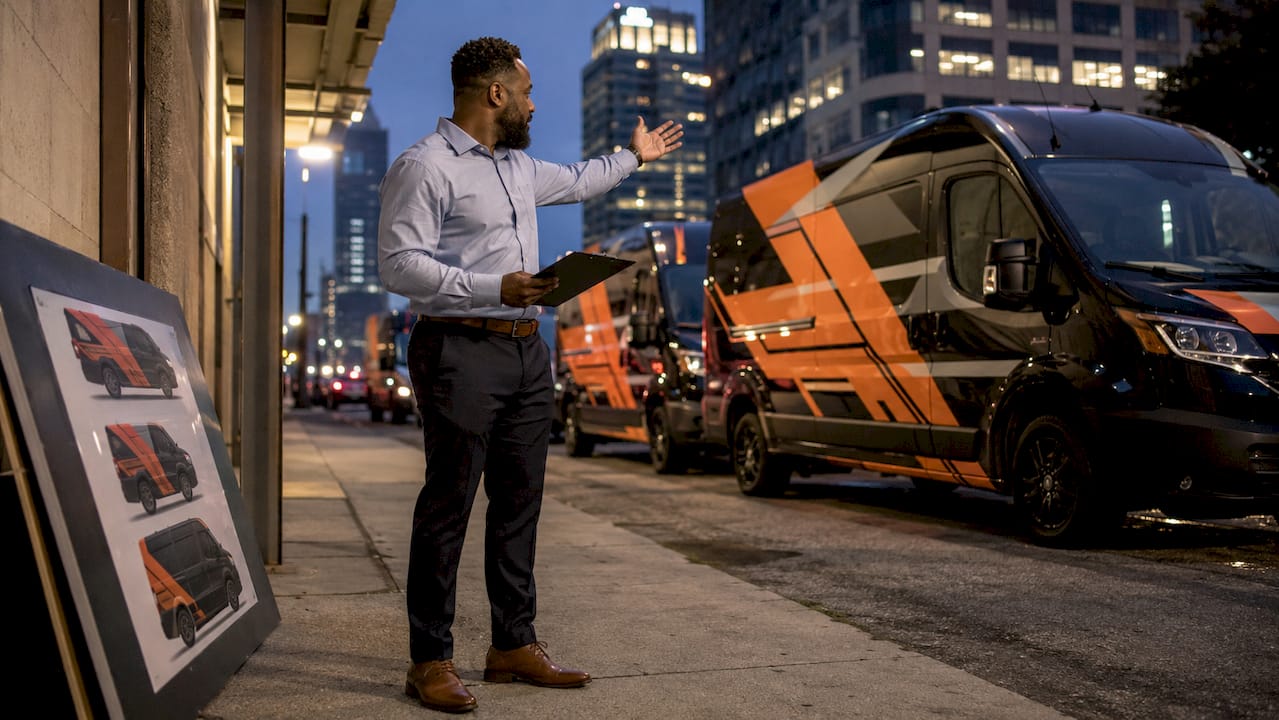
Fleet vehicle branding is the practice of applying consistent logos, graphics, decals, or full vinyl wraps across every vehicle in a company’s fleet to create a unified, mobile advertising presence. The industry term for this practice is fleet livery, though “fleet vehicle branding” and “commercial fleet branding” are the terms most business owners and fleet managers use day to day. Whether you run three delivery vans or 50 service trucks, every vehicle on the road is either building your brand or missing the opportunity to do so.
What is fleet vehicle branding and why does it matter?
Fleet vehicle branding transforms ordinary company vehicles into rolling advertisements that work every mile they travel. The scope ranges from simple vehicle lettering with your company name and phone number to full-coverage vinyl wraps that turn a cargo van into a moving billboard.
The core principle is consistency. A single branded truck makes an impression. Ten trucks with identical graphics, colors, and logo placement build recognition. That repetition is what separates a professional fleet from a collection of vehicles that happen to share an owner.

Branded fleet design also signals credibility. When your technician pulls up in a clearly marked, professionally wrapped vehicle, the customer’s trust level rises before anyone knocks on the door. That first impression has real business value, especially in service industries where you are entering someone’s home or property.
What are the marketing benefits of fleet vehicle branding?
The marketing case for branded fleet vehicles is straightforward and backed by hard numbers. A single wrapped vehicle generates 40,000–70,000 daily impressions. That figure means your brand appears in front of tens of thousands of people every day without any recurring ad spend.
Fleet livery boosts brand recall by 15–20% over non-branded vehicles. The reason is repetition. When the same color scheme and logo appear on multiple vehicles across a service area, the human brain starts to recognize the pattern automatically. That recognition converts to trust, and trust converts to calls.
“Fleet branding functions as a rolling marketing system where repetition and uniform design help customers rapidly recognize brand patterns.” — BlinkSigns Fleet Branding Strategy
Compare that reach to other advertising channels:
- Digital ads require ongoing budget and disappear the moment you stop paying.
- Print ads reach a fixed audience in a fixed location.
- Vehicle wraps last 5–7 years with a low cost per impression that no digital channel can match.
The math is simple. A quality fleet wrap amortized over five years costs a fraction of what you would spend on equivalent digital impressions. For small and mid-size businesses, it is often the highest-ROI advertising investment available.
What compliance rules apply to commercial fleet branding?
This is where many fleet managers get caught off guard. If your vehicles are regulated commercial motor vehicles, federal law governs what must appear on the exterior, and your branding design must work around those requirements, not over them.
Under 49 CFR 390.21, every regulated commercial motor vehicle must display the operator’s legal name and USDOT number on both sides of the vehicle. Those markings must be legible from 50 feet in daylight. Your wrap design cannot obscure, cover, or visually compete with those identifiers.
Here is what the rules require in practice:
- Legal name and USDOT number must appear on both sides of the vehicle in a color that contrasts with the background.
- Legibility from 50 feet is the standard. The FMCSA does not mandate a specific font size, but contrasting colors and clear visibility are non-negotiable.
- Magnetic signs are permitted for USDOT markings on leased or rented vehicles, but they must meet legibility requirements while the vehicle is in operation and cannot be damaged or obscured.
- Driveaway and leased vehicles follow slightly different rules, so confirm the specific requirements with your compliance officer before wrapping those units.
- Non-compliance consequences include inspection failures, fines, and potential out-of-service orders that pull vehicles off the road.
The smart move is to map compliance zones before design begins. Reserve space on both sides of each vehicle for the required identifiers before your designer touches the creative layout. This prevents costly rework and keeps your branding and your compliance requirements working together instead of against each other.
Pro Tip: Ask your wrap installer to provide a vehicle template with pre-marked compliance zones. Any professional shop working with commercial fleets should have these on file for common vehicle models.
What materials and design options work best for fleet wraps?
Branded fleet design is not one-size-fits-all. The right material and coverage level depend on your budget, your branding goals, and how long you need the wrap to last.
| Option | Coverage | Best For | Typical Lifespan |
|---|---|---|---|
| Vehicle lettering | Minimal | Simple contact info, logo | 3–5 years |
| Partial wrap | 25–75% of vehicle | Budget-conscious branding | 4–6 years |
| Full wrap | 100% of vehicle | Maximum visual impact | 5–7 years |
Material quality matters more than most buyers expect. Premium vinyl films like 3M deliver better color retention, resist fading under UV exposure, and conform more cleanly to complex vehicle contours. Cheaper films may look identical on day one but start peeling or fading within two years, which means you are rebranding your fleet ahead of schedule.
3M vinyl and comparable premium materials also protect the vehicle’s original paint. That protection preserves resale value, which lowers the total cost of fleet ownership over time. For a fleet manager tracking total cost of ownership, that is a real financial benefit, not just a marketing claim.
A few design principles that separate effective fleet graphics from forgettable ones:
- Use no more than two or three colors to keep the design readable at highway speeds.
- Place your logo and phone number where they are visible from the side and rear.
- Maintain identical placement logic across every vehicle in the fleet.
- Choose colors that contrast sharply with your compliance marking zones.
Pro Tip: Work from durable material guides specific to your region’s climate. New Jersey winters and summer heat cycles affect vinyl differently than a dry southwestern climate.
How to brand fleet vehicles step by step
Branding your fleet step by step requires a process, not just a design. Here is how to move from concept to road-ready vehicles without disrupting your operations.
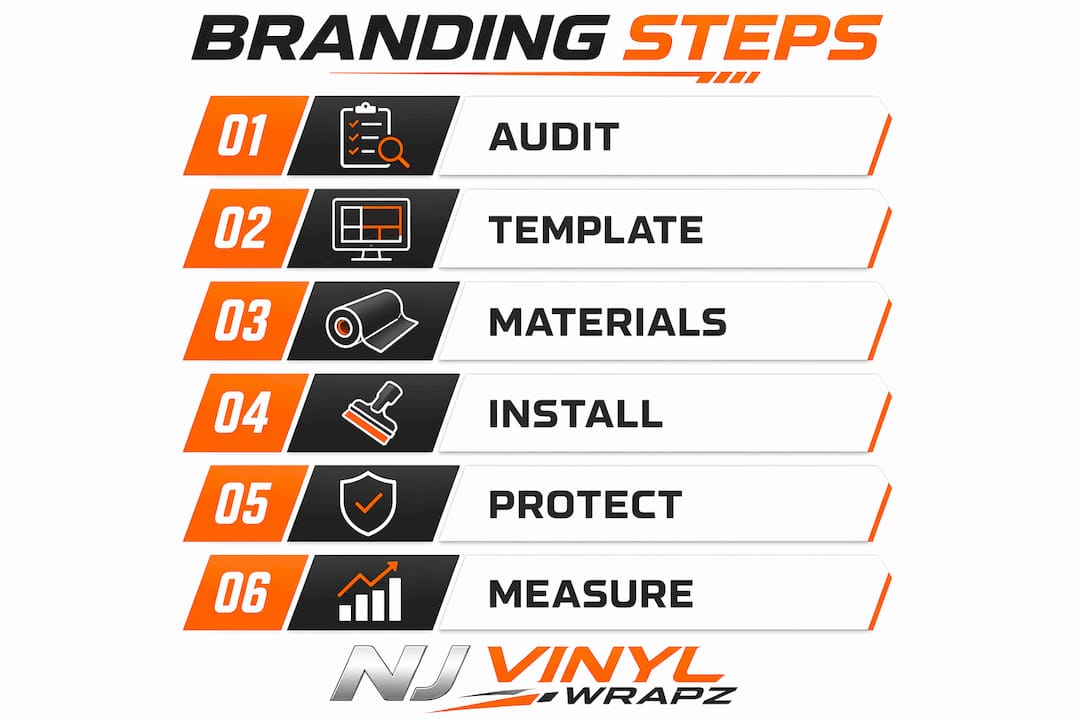
Step 1: Conduct a brand audit. Confirm your current logo files are vector format, your brand colors have defined Pantone or CMYK values, and your messaging is finalized. Wrapping vehicles with an outdated logo is an expensive mistake.
Step 2: Develop a vehicle template. Work with your installer to create a master design template for each vehicle type in your fleet. This template should include compliance zones, logo placement, color fields, and contact information. Every vehicle gets wrapped from the same template.
Step 3: Select your materials and installer. Choose a shop with documented experience in commercial fleet work. Verify they use premium materials, work in a climate-controlled facility, and offer a written warranty. Review their portfolio for fleet projects specifically, not just single-vehicle wraps.
Step 4: Schedule installations to minimize downtime. Stagger wrap installations so your fleet stays operational. A professional shop can typically complete a standard van wrap in one to two days. Plan around your busiest service periods.
Step 5: Protect the investment. Apply a clear protective coat where possible, and train drivers on basic wrap care. Avoid high-pressure washing directly on seams and edges. Follow the guidance in resources like protecting vinyl wraps to extend wrap life.
Step 6: Measure results. Track inbound calls and ask new customers how they heard about you. Many service businesses report a measurable uptick in calls after completing a fleet wrap program. That data justifies the investment and informs future branding decisions.
To ensure consistent fleet branding across a growing fleet, document your design standards in a one-page brand guide that travels with every work order. When you add vehicles, the guide removes guesswork and keeps every new unit on-brand from day one.
Key takeaways
Fleet vehicle branding delivers the highest return when consistent design, premium materials, and compliance planning work together from the start.
| Point | Details |
|---|---|
| Define before you design | Lock in vector logos, brand colors, and messaging before any wrap work begins. |
| Compliance is non-negotiable | Map USDOT and legal name zones on vehicle templates before creative design starts. |
| Material quality drives longevity | Premium films like 3M last 5–7 years and protect vehicle paint, lowering total fleet costs. |
| Consistency builds recognition | Uniform design across every vehicle accelerates brand recall far faster than a single standout wrap. |
| Measure the marketing impact | Track call sources after wrapping to quantify ROI and justify future fleet branding investments. |
What i’ve learned after years of fleet branding projects
Most business owners come to us focused entirely on how the wrap looks. That is understandable. But the fleet managers who get the best long-term results are the ones who think about the system first and the aesthetics second.
The biggest mistake I see is treating each vehicle as a separate project. When a company wraps one truck at a time over three years with slightly different logo sizes or color shades, the fleet ends up looking like five different companies sharing a parking lot. That inconsistency actually undermines trust rather than building it. Customers notice when your branding does not match across vehicles, even if they cannot articulate why.
The compliance piece catches people off guard more than anything else. I have seen beautifully designed wraps fail DOT inspections because the designer did not know about the 50-foot legibility rule or placed a graphic element directly over the USDOT number zone. Fixing that after installation means cutting and reapplying sections of the wrap, which costs time and money that could have been avoided entirely with 20 minutes of pre-planning.
My honest recommendation: treat your fleet wrap program the way you would treat any capital investment. Get the design right once, document it, use premium materials, and protect the wrap properly. A fleet wrapped with 3M film and maintained correctly will look sharp for five to seven years. That is five to seven years of 40,000-plus daily impressions per vehicle, compounding across your entire fleet. No other advertising channel gives you that kind of sustained, local visibility for the same cost.
The businesses that win with fleet branding are not the ones with the flashiest designs. They are the ones with the most consistent, well-maintained, and legally compliant vehicles on the road.
— Krunal
How Njvinylwrapz handles fleet branding for NJ businesses
Njvinylwrapz has spent over 10 years wrapping commercial fleets across New Jersey, and the process is built around getting your vehicles road-ready without pulling them out of service longer than necessary.
Every fleet project starts with a consultation where we map your vehicle types, compliance requirements, and brand standards before a single panel is designed. We use 3M and Avery premium films installed in a climate-controlled facility, and every project comes with a written warranty. Whether you need full vehicle wraps for maximum coverage or lettering for a budget-conscious start, Njvinylwrapz builds a program that scales with your fleet. Contact us to get a quote and see how quickly your vehicles can start working harder for your brand.
FAQ
What is fleet vehicle branding?
Fleet vehicle branding is the process of applying consistent logos, graphics, or vinyl wraps across all company vehicles to create a unified mobile advertising presence. It ranges from simple lettering to full-coverage wraps.
How long does a fleet vehicle wrap last?
A quality fleet wrap using premium vinyl materials lasts 5–7 years with proper maintenance. Material quality and installation environment are the two biggest factors affecting lifespan.
Do commercial fleet wraps need to comply with FMCSA rules?
Yes. Under 49 CFR 390.21, regulated commercial vehicles must display the legal name and USDOT number on both sides, legible from 50 feet. Wrap designs must not cover or obscure those markings.
What is the difference between a partial wrap and a full wrap?
A partial wrap covers 25–75% of the vehicle surface and costs less while still delivering strong brand visibility. A full wrap covers the entire vehicle and provides maximum visual impact and paint protection.
How many impressions does a branded fleet vehicle generate?
A single wrapped vehicle generates 40,000–70,000 daily impressions. Multiply that across a multi-vehicle fleet and the cumulative daily reach rivals mid-size digital ad campaigns at a fraction of the ongoing cost.
Recommended
- Top Fleet Vehicle Customization Ideas for Standout Branding | NJ Vinyl Wrapz
- Fleet Wraps NJ | Commercial Vehicle Advertising | NJ Vinyl Wrapz | NJ Vinyl Wrapz
- Vehicle Branding Trends 2026: What Marketers Must Know | NJ Vinyl Wrapz
- Why Decals for Fleets: Benefits, Compliance, and ROI | NJ Vinyl Wrapz