
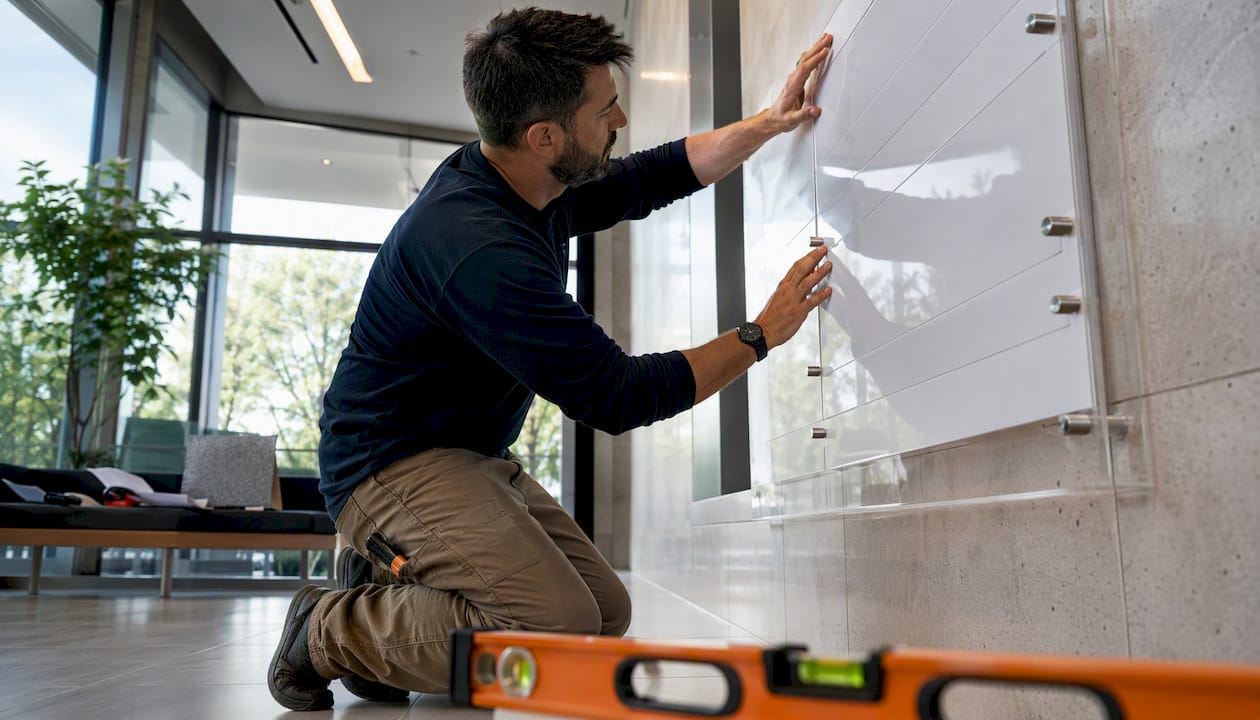
When your building’s tenant list changes quarterly or less, printed vinyl directory panels are the right call. They cost less than electronic displays, install without power or software, and look sharp when fabricated with 3M or Avery Dennison materials. The ADA compliance picture is also simpler: a well-designed printed panel with adequate contrast and font size covers most lobby directory requirements without networked hardware.
Before you call a fabricator, pull together one page of specs: panel dimensions, viewing distance, a finalized tenant list, your preferred substrate, and the mounting surface type. If you need to add your property to a comprehensive directory, you can start by submitting a request to be listed to expand its visibility. Hand that to NJ Vinyl Wrapz or another qualified fabricator and you can have a proof in hand within days.
Quick decision cues:
- Tenant turnover: Quarterly or less? Printed panels win on cost. Monthly churn? Consider modular inserts.
- Building size: Under 30 tenants, a single printed panel usually covers it. Larger buildings benefit from modular or two-column layouts.
- ADA basics: High-contrast text and minimum font sizes are required; tactile/Braille is a separate requirement for permanent room identification signs.
- Preferred finish: Matte laminate for glare-heavy lobbies; gloss for high-impact visual presence.
Pro Tip: Gather your tenant list as a spreadsheet before contacting any fabricator. Incomplete lists are the single most common cause of proof delays and change orders.
| Decision Factor | Printed/Vinyl Panel | Modular Insert System |
|---|---|---|
| Upfront cost | Lower | Moderate |
| Update cost | Reprint required | Insert swap only |
| Best for | Low-churn buildings | Moderate-churn buildings |
| Installation | Simple, no power | Simple, no power |
Key Takeaways
Printed vinyl directory panels are the right choice for most multi-tenant buildings with stable tenant lists, low upfront cost, and no power or software requirements.
| Point | Details |
|---|---|
| When to choose printed panels | Tenant list changes quarterly or less; no power or software budget available. |
| Best substrates to request | Expanded PVC for budget builds; acrylic for premium lobbies; aluminum composite for high-traffic entries. |
| Essential ordering items | Panel dimensions, tenant spreadsheet, vector logos, PANTONE colors, site photos, and mounting surface type. |
| Typical cost and lead time | Single panels run $150 in 3–5 days; modular systems run $500 in 5–10 days. |
| NJ Vinyl Wrapz | Produces printed directory panels with 3M/Avery Dennison materials, licensed installation, and proof rounds included. |
Table of Contents
- What “digital building directory signs” means in this guide
- Where do printed directory signs work best?
- What materials should you specify?
- Design and content best practices for lobby directories
- Vendor-ready ordering checklist
- What does a printed directory sign cost, and how long does it take?
- Installation checklist and compliance notes
- Why use a professional fabricator for your directory signs?
- What fabricators wish clients knew before the project starts
- Ready to get a quote for your lobby directory?
- Sources
- FAQ
What “digital building directory signs” means in this guide
The phrase “digital building directory signs” circulates widely online, but in this guide it refers to printed, static lobby directory panels made from large-format vinyl, acrylic, expanded PVC, or laminated printed substrates. No electronic screens, touch kiosks, software platforms, or networked displays are covered here.
Static signage encompasses non-electronic, printed solutions used for fixed messages, and large-format vinyl and printed panels allow durable, brandable directory displays without networked hardware. That is the category this guide addresses.
Key references throughout:
- NJ Vinyl Wrapz: fabricator for printed directory panels and large-format vinyl graphics
- 3M and Avery Dennison: the material brands whose film families set the standard for indoor vinyl and laminate quality
- ADA: the Americans with Disabilities Act, which sets minimum contrast and legibility requirements for public signage
Pro Tip: If a vendor quotes you on “digital directory signage” and immediately mentions screens or software, they are solving a different problem. Clarify upfront that you want a printed, static panel.
Where do printed directory signs work best?
A printed panel fits any building where the tenant list is stable and visitors need a quick, at-a-glance reference. A clear lobby signage system includes identification, direction, and information layers, and the directory is the information layer — the navigation starting point that tells visitors which floor or suite to head to.
Building types where printed directories excel:
- Small-to-medium multi-tenant office buildings (under 50 tenants)
- Medical and professional centers with low tenant churn
- Schools with static room or department assignments
- Government or municipal buildings with fixed department listings
Placement guidance: Mount the panel at a lobby focal point — adjacent to the elevator bank or near the main reception desk. Standard mounting height centers the panel at a height readable by most adults without crouching. For high-foot-traffic lobbies, position the directory so it does not block egress paths.
Portrait orientation suits shorter tenant lists viewed at moderate distances. Landscape orientation works better for longer lists or when wall space is wider than tall.
Pro Tip: Stand at the actual viewing distance in your lobby before finalizing dimensions. A panel that looks large in a vendor’s mockup can read small from 12 feet away in a bright, high-ceiling lobby.
What materials should you specify?
Acrylic and expanded PVC are the two most popular indoor substrates. Acrylic gives a premium, glass-like finish; expanded PVC foam is lightweight, cost-effective, and easy to cut and mount. Polycarbonate is worth specifying only where impact resistance is a real concern, such as a high-traffic corridor.
Directory signage commonly mounts in high-visibility entrance areas, and acrylic directories pair well with standoffs, layered graphics, or modular inserts for a premium finish.
| Substrate | Cost Tier | Durability | Best Use Case |
|---|---|---|---|
| Expanded PVC foam | Low | Good (indoor) | Budget lobbies, frequent reprints |
| Acrylic | Moderate–High | Excellent | Premium lobbies, long-term installs |
| Aluminum composite | Moderate | Excellent | High-traffic or semi-outdoor entries |
| Polycarbonate | Moderate–High | Superior impact | High-traffic corridors |
Surface finishes: UV-resistant laminates from 3M or Avery Dennison protect printed graphics from fading and scratching. Matte laminate cuts glare in bright lobbies; gloss adds visual punch in lower-light spaces. For indoor environments where scratching and glare are concerns, request matte laminate with an anti-scratch coating and a sample panel before full production.
Construction options: Single printed panels are cheapest upfront. Modular insert or magnetic-strip systems cost more initially but make tenant updates a swap rather than a reprint, which pays off when turnover is moderate.
Pro Tip: Always ask for a physical sample panel before approving full production on an acrylic or laminated build. Color and finish read differently on screen than on the actual substrate under lobby lighting.
Design and content best practices for lobby directories
Readability is the only job a directory has. Start with a clean sans-serif typeface — something like Helvetica, Arial, or a geometric sans — sized appropriately for clear readability at typical viewing distances. Scale up for longer viewing distances.
Content hierarchy to follow:
- Floor or zone number (largest, boldest)
- Suite number
- Tenant or department name
- Optional: phone number or hours in a smaller weight
Default to alphabetical order within each floor. For buildings with longer tenant lists, a two-column layout helps keep the panel compact and maintains legible text size.
ADA basics: The ADA requires high contrast between text and background (a light-on-dark or dark-on-light pairing, not mid-tone on mid-tone). Permanent room identification signs require tactile lettering and Braille — that is a separate sign type from a lobby directory, but worth flagging to your fabricator early so they can coordinate both.
Matte laminate does double duty here: it controls glare and satisfies the ADA’s non-glare surface recommendation for signage in public spaces.
Pro Tip: A left-aligned single column reads faster than centered text for lists. Reserve centered layouts for headers and building names only.
Vendor-ready ordering checklist
Hand this list to your fabricator before requesting a quote:
- Exact panel dimensions (width × height in inches)
- Finished viewing distance from the panel face
- Tenant list as a spreadsheet, alphabetized by floor
- Preferred substrate (expanded PVC, acrylic, aluminum composite)
- Preferred finish (matte or gloss laminate, anti-scratch coating)
- Mounting method (standoffs, flush mount, adhesive) and wall substrate type
- Site photos showing the mounting wall and surrounding space
- Logo files in vector format (AI, EPS, or outlined PDF)
- PANTONE or CMYK color references for brand colors
- Deadline and any phased installation requirements
File requirements: Submit print-ready files as PDF/X-1a with text outlined, CMYK color mode, and a minimum of 300 DPI at final print size. Include a 0.125-inch bleed on all sides. Fabricators commonly request a tenant spreadsheet, high-resolution logo files, and photos of the mounting wall before issuing an install-ready proof to avoid scope gaps.
Process to expect: One PDF proof round, followed by a physical sample for large or premium builds. Confirm warranty terms and on-site update service availability before signing off.
What does a printed directory sign cost, and how long does it take?
Cost depends on substrate, finish, size, and whether installation is included.
Modular insert systems or magnetic overlays carry the lowest long-term update cost when tenant turnover is moderate; single-piece printed panels are cheapest upfront but cost more to update over time.
Update strategies:
- Magnetic or slot-in inserts: Swap individual tenant strips without reprinting the full panel.
- Vinyl overlays: Apply a new printed vinyl layer over the existing panel for minor updates.
- Full reprint: Most cost-effective for major tenant changes or a full redesign.
Expected lifespan: expanded PVC panels with laminate last 5–7 years indoors; acrylic builds with quality laminate can exceed 10 years under normal conditions.
Installation checklist and compliance notes
Before installation day:
- Verify wall substrate (drywall, concrete, masonry) and locate studs or anchors.
- Confirm mounting hardware matches the substrate weight and panel size.
- Check that the chosen location does not obstruct egress signage or exit paths.
- Obtain written approval from the building owner or facilities manager.
Stakeholders to notify: building owner, facilities or maintenance team, tenant association (if applicable), and your insurance carrier for any work requiring wall penetration.
Code caution: Directories must not cover or obscure exit signs, fire extinguisher locations, or egress path markings. For edge cases, consult your local code officer before installation.
ADA reminder: Permanent room identification signs requiring tactile lettering and Braille are a separate category from lobby directories. Coordinate with your fabricator if both are needed.
Pro Tip: A professional fabricator like NJ Vinyl Wrapz typically provides site photos, a mounting plan diagram, and proof of liability insurance to satisfy landlord documentation requirements. Request these before scheduling the install.
Why use a professional fabricator for your directory signs?
A professional fabricator brings color accuracy, material consistency, and installation accountability that a print-shop-and-mount-it-yourself approach rarely matches. NJ Vinyl Wrapz uses premium 3M and Avery Dennison materials and operates climate-controlled production for consistent large-format print quality, which matters when your directory needs to match brand colors precisely.
What to expect from a qualified vendor:
- Portfolio of installed lobby and indoor directory projects
- Licensed and insured installation crews
- PDF proof and physical sample before production
- Documented lead times and warranty terms
- Material spec sheets and sample swatches on request
| Vendor Signal | Why It Matters |
|---|---|
| 3M / Avery Dennison materials | Consistent color, durability, and laminate performance |
| Licensed & insured installation | Protects you from liability during wall work |
| Proof rounds included | Catches errors before production, not after |
| Portfolio of prior installs | Confirms real-world experience with similar projects |
NJ Vinyl Wrapz’s signage experience spans commercial graphic installations with fast turnaround and documented proof processes, making it a practical choice for property managers who need a reliable vendor with a paper trail.
Pro Tip: Ask any vendor for photos of a completed lobby or indoor directory install, not just vehicle or window graphics. Indoor directory work has its own tolerances for color consistency and mounting precision.
What fabricators wish clients knew before the project starts
The most common delay in a directory project is an incomplete or still-changing tenant list. Clients often submit a draft list, approve a proof, then add two tenants the day before production. That triggers a change order, resets the timeline, and adds cost. Lock the list before you request a proof, not after.
The second most common issue: unclear mounting specs. “Drywall” covers a wide range of wall constructions, and the difference between a hollow-wall anchor and a stud mount matters for a panel over 10 pounds. Send site photos and let the fabricator specify the hardware.
Small investments that consistently pay off: a physical sample panel before full production, and matte laminate even when gloss looks better in a mockup. Glare in a bright lobby makes a directory unreadable from 10 feet away, regardless of how good the design is. Schedule installations during off-hours for busy lobbies — a 30-minute install in an empty lobby beats a 90-minute one with foot traffic to manage.
Ready to get a quote for your lobby directory?
Property managers across New Jersey, New York, Pennsylvania, and Delaware get printed lobby directory panels faster and with less back-and-forth when they work with a fabricator who handles design, production, and installation under one roof.
NJ Vinyl Wrapz produces large-format printed directory panels using 3M and Avery Dennison materials, with climate-controlled printing for color consistency and licensed, insured on-site installation. The process starts with a free estimate: submit your panel dimensions, tenant list, and site photos, and you get a PDF proof before anything goes to production. Request a quote and ask to see portfolio examples of completed indoor installs. Sample swatches are available on request.
Sources
- Lobby Signage: How to Plan a Clear and Professional Entrance | Vista System
- Directory Signage 101: Functions, Materials, and Installation Insights - Jet Loong
- Digital Wayfinding vs Static Signage: When to Use Each | Plotstuff
FAQ
What are digital building directory signs?
In most property management contexts, the term refers to printed, static lobby directory panels made from vinyl, acrylic, or expanded PVC — not electronic screens or software. They display tenant names, suite numbers, and floor information without power or network connections.
How often can a printed directory panel be updated?
Modular insert or magnetic-strip systems allow individual tenant swaps at any time. Full printed panels are most cost-effective to reprint when three or more tenants change at once, rather than updating one name at a time.
What file format should I send to my fabricator?
Submit PDF/X-1a files with text outlined, CMYK color mode, 300 DPI at final print size, and a 0.125-inch bleed. Include vector logo files and PANTONE or CMYK color references for brand accuracy.
Does a lobby directory need to comply with ADA?
A lobby directory needs high-contrast text and legible font sizes to meet ADA guidelines. Permanent room identification signs — the plaques mounted beside individual doors — require tactile lettering and Braille, which is a separate product from a lobby directory panel.
How do I get a quote from NJ Vinyl Wrapz for a printed directory?
Submit your panel dimensions, a finalized tenant list, site photos, and preferred substrate to NJ Vinyl Wrapz for a free initial estimate. A PDF proof is included before production begins.