
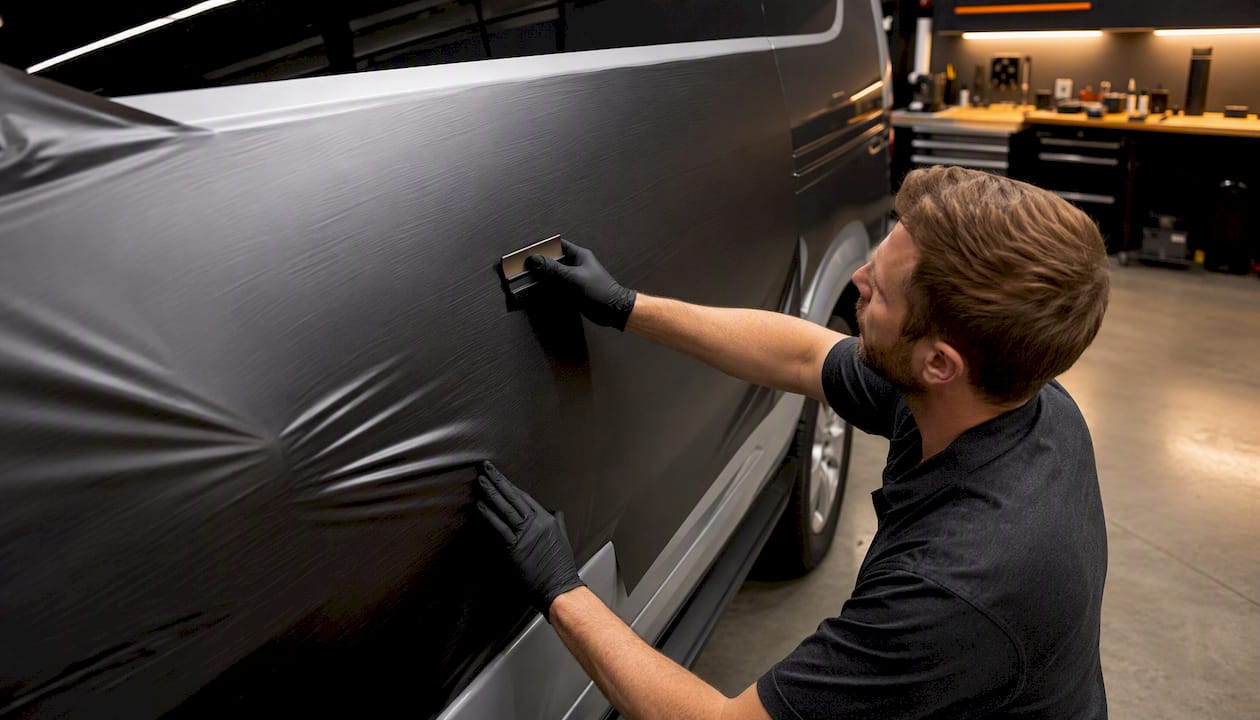
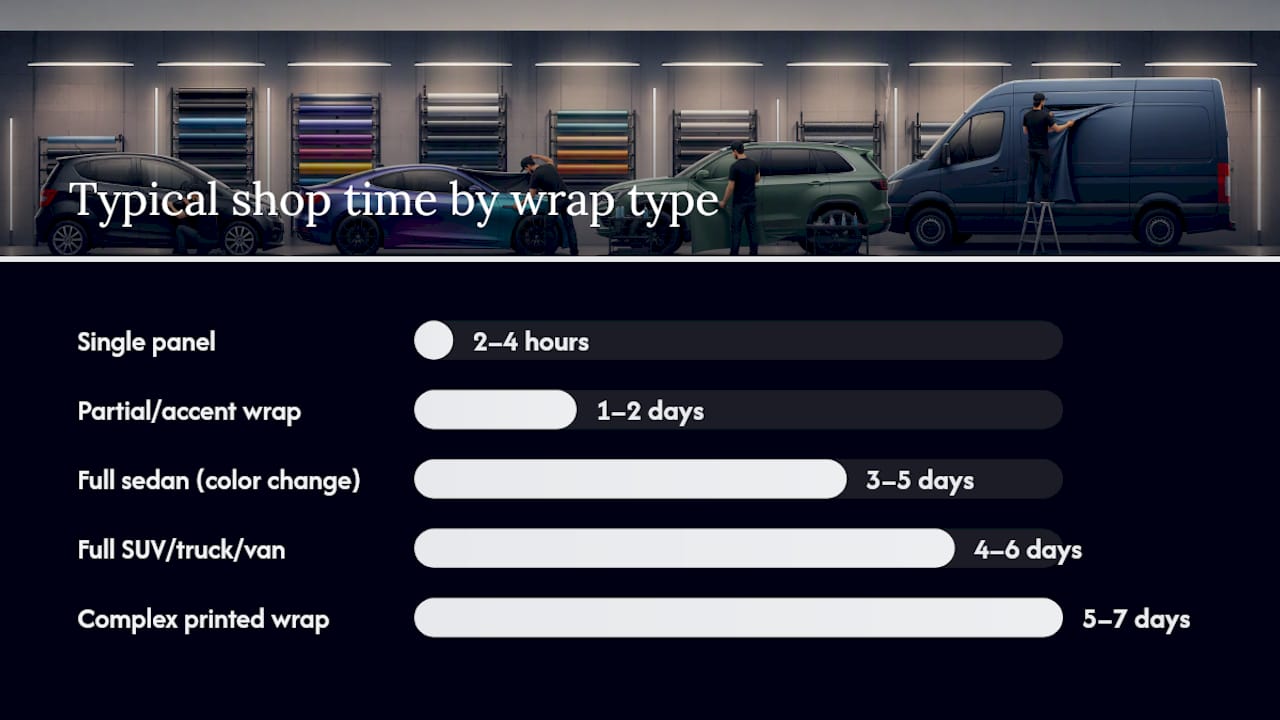
A full car wrap takes 1–5 shop days from drop-off to pickup, depending on vehicle size, coverage, and whether your job involves printed graphics. Partial wraps and accent panels can be done in a single day. Complex printed fleet graphics on a large van can stretch to a week. Here’s the quick breakdown so you can plan transportation and work schedules before you even call a shop:
- Single panel (hood, roof, bumper): 2–4 hours
- Partial wrap (accent sections, stripes, door graphics): 1–2 days
- Full color-change sedan: 3–5 days
- Full SUV, truck, or van: 4–6 days
- Complex printed or multi-panel commercial graphics: 5–7 days
Those ranges come from vehicle-class timelines documented by Gilroy Blackout and align with what shops using premium films from 3M, Avery Dennison, and XPEL routinely schedule. UPPF confirms that installation alone on a full wrap runs 1–3 working days, with total project time longer when design or printing is involved. NJ Vinyl Wrapz, which has handled fleet and personal vehicle wraps across New Jersey, Pennsylvania, New York, and Delaware for over 10 years, schedules jobs on the same framework.
Key Takeaways
A full professional car wrap takes 1–5 shop days depending on vehicle size, coverage, and whether printed graphics are involved, with a 24–48 hour cure window added before pickup.
| Point | Details |
|---|---|
| Full wrap timeline | Full sedans take 3–5 days; SUVs and trucks run 4–6 days; partial wraps finish in 1–2 days. |
| Biggest schedule risk | Paint correction adds 1–2 days and is the most common source of delays. |
| Owner actions that save time | Approve artwork early, deliver a clean car, and disclose recent paintwork before drop-off. |
| Cure before washing | Wait 48 hours for a gentle rinse; hold off on a full hand wash for 1–2 weeks. |
| NJ Vinyl Wrapz | Offers written quotes, 3M/Avery Dennison materials, and bundled scheduling across NJ, PA, NY, and DE. |
Table of Contents
- How long does a car wrap take by vehicle type?
- What factors make a wrap take longer?
- What does the wrap process look like, step by step?
- How can you speed up your wrap appointment?
- When can you drive and wash the car after wrapping?
- What should you expect from a professional wrap shop?
- Why shops give conservative time estimates
- Ready for a wrap with a clear timeline?
- Sources
- FAQ
How long does a car wrap take by vehicle type?
The table below maps vehicle class and coverage type to realistic shop days and owner downtime. Every range assumes a clean vehicle with no paint correction needed. Add time if your paint has defects (more on that below).
| Wrap Type | Typical Shop Time | What’s Included | Owner Downtime |
|---|---|---|---|
| Single panel | 2–4 hours | Prep, application, edge seal, QC | Half day |
| Partial/accent wrap | 1–2 days | Prep, partial disassembly, application, QC | 1–2 days |
| Full sedan (color change) | 3–5 days | Full prep, disassembly, application, cure, QC | 3–5 days |
| Full SUV/truck/van | 4–6 days | Same as sedan plus extended surface area | 4–6 days |
| Commercial fleet graphics | 2–5 days per vehicle | Print production, alignment, full install | 2–5 days per unit |
| Complex printed wrap | 5–7 days | Print lead time, alignment, multi-panel install | 5–7 days |
Perfection Wraps reports that full vehicle installs typically require 2–5 days, partial wraps run 4 hours to 1 day, and a 24–48 hour curing window follows installation before final inspection. A two-person crew can often finish a standard sedan in 2–3 days, while large SUVs and trucks commonly need 3–5 days because of the added surface area, per AutoDetailPedia’s installation timeline guide.
High-variance cases to know:
- Exotic and low-clearance vehicles (Lamborghinis, wide-body builds) require slower panel-by-panel work and can add a full day or more.
- Paint protection film (PPF) installs are slower than vinyl color-change wraps because the film is thicker and requires more precise edge tucking. A full PPF install on a sedan commonly runs 3–5 days on its own.
- Heavy paint correction before wrapping adds 1–2 days regardless of vehicle size.
- Freshly repainted vehicles may need a 30–90 day cure window before any film goes on, to prevent solvent off-gassing from breaking the adhesive bond.
What factors make a wrap take longer?
Most schedule overruns trace back to one of six variables. Knowing which ones apply to your vehicle tells you whether you’ll land at the short or long end of any quoted range.
Vehicle size and surface complexity. More square footage means more film, more seams, and more time. A full-size cargo van has roughly twice the wrappable surface of a compact sedan. Curved panels, deep recesses, and body kit add-ons all slow the installer down.
Coverage amount. A partial wrap covering two doors and a hood is a fundamentally different job than a full color-change. Vantage Wraps notes that partial accent jobs and fleet lettering typically finish in 1–2 days, while large vans with full coverage can occupy the bay for 3–5 days.
Finish type and film material. Standard cast vinyl in a solid color is the fastest to install. Specialty finishes like satin chrome, color-shift, or brushed metal require slower, more deliberate application to avoid stretch marks and inconsistent sheen. Material-brand choice matters too: certain specialty films from 3M, Avery Dennison, and XPEL require extra heating steps or slower edge-tuck methods that add labor hours. The finish type you choose directly affects how long your installer needs in the bay.
Paint condition. This is the single biggest wildcard. ClearPro warns that paint-condition issues commonly add 1–2 days because shops must correct or treat damaged clear coat before applying vinyl. Wrapping over failing paint also risks pulling it off at removal time, so no reputable shop will skip this step.
Printed graphic wraps take longer to schedule than solid-color jobs because they involve artwork approval, file preparation, and printing steps that add several business days before installation begins.
The shop’s workload and staffing impact the timeline; more installers and availability usually speed up the process, while busy periods can cause delays.
Pro Tip: Before drop-off, look at your paint in direct sunlight. Run your hand across the surface. If you feel rough texture, see orange peel, or notice chips and scratches, tell the shop upfront. Catching paint issues at the initial inspection prevents a surprise phone call mid-job and keeps the schedule intact.
What does the wrap process look like, step by step?
Here’s the full workflow from quote to pickup, with realistic time estimates at each stage. Knowing who owns each step helps you plan approvals and alternate transportation.
-
Quote, design, and artwork approval (1–5 business days, owner-driven). The shop measures the vehicle, quotes the job, and sends design proofs. For solid-color jobs, this can be same-day. Printed graphics require file preparation and back-and-forth approval. Delays here are almost always on the owner’s side. Approve artwork fast and you save days.
-
Vehicle intake and inspection (1–2 hours, shop). The installer does a documented walk-around, photographs existing damage, and flags paint issues. This is where paint correction gets added to the schedule.
-
Decontamination and prep (2–6 hours, shop). The car is washed, clay-barred, and degreased. Any adhesive residue or wax is stripped. Skipping this step causes film failure within months, so professional shops never rush it.
-
Paint correction, if needed (1–2 days, shop). Scratches, oxidation, and clear-coat damage are addressed before any film goes on. This is the most common source of schedule slippage.
-
Partial disassembly (1–3 hours, shop). Mirrors, door handles, trim pieces, and sometimes bumpers are removed so film can wrap cleanly behind edges rather than terminating on top of them.
-
Film application, panel by panel (1–4 days, shop). This is the core installation. Hood and roof panels each take 1–2 hours for a skilled installer. Bumpers run 1–3 hours depending on complexity. Mirror caps are 20–45 minutes each. A full sedan has 15–25 distinct panels, which is why even a fast crew needs multiple days. Printed wraps add alignment time on top of raw application time.
-
Edge sealing and reassembly (2–4 hours, shop). Edges are heat-set and tucked. Trim and hardware go back on. The installer checks every seam.
-
Post-install cure and quality check (24–48 hours, shop). The vehicle sits in a warm bay while the adhesive fully bonds. The shop does a final inspection before calling you for pickup. In cool conditions, this window can extend beyond 48 hours.
Note on print lead times: If your job involves printed graphics, the print vendor may insert 1–3 business days into the schedule between artwork approval and the car entering the bay. Ask your shop whether they print in-house or outsource, because that answer changes your total project timeline.
How can you speed up your wrap appointment?
A surprising amount of schedule delay comes from the owner’s side, not the shop’s. These actions before drop-off can shave a day or more off your total car wrap installation time.
Before drop-off:
- Wash the car thoroughly, including wheel wells and door jambs.
- Remove all personal items, parking passes, and aftermarket accessories.
- Disclose any recent paintwork, touch-ups, or body repairs upfront.
- Gather your VIN and a set of clear vehicle photos from multiple angles.
- Approve artwork and pay the deposit before your scheduled drop-off date.
- Note the fuel level (shops prefer at least a quarter tank for moving the vehicle).
The NJ Vinyl Wrapz prep guide covers the full checklist in detail.
Scheduling tips:
- Book during slower seasons (November through February in New Jersey) when bay availability is higher.
- Offer flexible drop-off days rather than demanding a specific date. A shop that can take your car Monday instead of Wednesday often finishes faster because the crew isn’t juggling a tight handoff.
- Respond to design proof emails within hours, not days. Artwork approval is the most common single-day delay on printed jobs.
Pro Tip: Send the shop exact vehicle specs (year, make, model, trim) and high-resolution photos before your appointment. Shops that template from photos rather than measuring in-person can pre-cut panels before your car arrives, cutting bay time by several hours.
When can you drive and wash the car after wrapping?
You can drive the car immediately after pickup in most cases, but the first 24–48 hours carry real risk if you push the vehicle hard. The adhesive is still bonding, and high-speed highway driving can lift edges before they’ve fully set.
First 48–72 hours:
- Avoid sustained highway speeds above 65 mph if possible.
- Skip power washing entirely.
- Park in a garage or covered space to protect edges from temperature swings.
- Do not run the car through an automated car wash.
- Avoid parking under trees where sap or bird droppings can sit on fresh film.
Cleaning timeline:
- After 48 hours: a gentle rinse with low-pressure water is fine.
- After 1–2 weeks: first hand wash with a pH-neutral soap is safe.
- Ongoing: avoid abrasive cleaners, wax with carnauba, or anything not rated for vinyl film.
Cure time is temperature-dependent. AutoDetailPedia notes that in warm shop conditions around 70°F, adhesive bonding largely completes in about 48 hours. In cooler shops or cold weather, full cure can take up to a week. Ask your installer what temperature the bay was during your install.
Pro Tip: Window vinyl (tinted or printed) on rear glass cures slower than body panels because glass holds less heat. Give rear window graphics an extra 24–48 hours before any washing, even if the body panels feel fully set.
What should you expect from a professional wrap shop?
A professional shop gives you more than just film on a car. The process should include a written quote that names the film brand and lists every step, a scheduled bay time with a realistic completion window, and a climate-controlled install environment. Temperature and humidity control matter because vinyl adhesive behaves differently in cold or humid air.
A shop that promises a full wrap in one day is a red flag. Professional installation on a full vehicle requires prep, disassembly, panel-by-panel application, edge sealing, and a cure window. Rushing any of those steps produces lifting edges, bubbles, and seam failures within months. A confident shop explains the timeline and builds in contingency for paint correction or print rework.
Material-brand partnerships signal quality and accountability. Shops certified or partnered with 3M, Avery Dennison, or XPEL have access to technical training and installation guidelines specific to those films. That matters because specialty films from these brands require precise heat and tension during application. Using the right technique for the specific film is what separates a wrap that lasts 5–7 years from one that starts peeling in year two.
NJ Vinyl Wrapz brings over 10 years of licensed, insured installation experience to every job, with fleet work across New Jersey, Pennsylvania, New York, and Delaware. The shop works with 3M and Avery Dennison materials and offers bundled scheduling for full vehicle wraps, PPF, ceramic coating, and window tinting so fleet managers can consolidate downtime into a single drop-off. A written care sheet goes home with every vehicle. Professional installation quality directly affects how long the wrap performs and how the brand looks on the road.
Pro Tip: Ask any shop for a written workmanship warranty before signing. A shop confident in its work will put the guarantee in writing. If they hesitate, that tells you something.
Why shops give conservative time estimates
Shops pad schedules for good reason, and understanding that reasoning helps you work with your installer instead of against them.
Paint correction is the most common source of schedule slippage, and it’s almost always invisible until the car is in the bay under shop lighting. A vehicle that looks fine in a parking lot can reveal oxidation, micro-scratches, and clear-coat failure the moment a trained eye examines it under fluorescent light. Shops that have seen this enough times build a buffer into every quote rather than call you on day two with bad news.
Print queues create a second pressure point. When a shop outsources printing, they’re working around a vendor’s schedule. A file that goes to print Monday morning might not come back until Thursday. Shops absorb that uncertainty by quoting the longer end of the range upfront.
Late artwork approval is the one delay that’s entirely on the owner. A shop can’t cut film or enter the bay until the design is locked. Owners who treat proof emails as low priority routinely push their own jobs back by two or three days without realizing it. Approve fast, and you’ll almost always get your car back faster than the quoted window.
Ready for a wrap with a clear timeline?
Knowing your vehicle class and coverage type means you can walk into a shop with a realistic schedule already in mind. NJ Vinyl Wrapz takes that further: every job starts with a documented inspection, a written quote that names the film brand and lists every step, and a scheduled bay time you can plan around.
Fleet managers can stage multiple vehicles to minimize downtime, and personal vehicle owners can bundle a full wrap with PPF or ceramic coating in a single drop-off to save time. With 3M and Avery Dennison materials, climate-controlled bays, and over 10 years of licensed installation experience across New Jersey, Pennsylvania, New York, and Delaware, NJ Vinyl Wrapz delivers on the quoted timeline. Request a quote, approve your artwork before drop-off, and you’ll have a firm pickup window before your car ever enters the bay.
Sources
- How Long Does It Take to Wrap a Car? Full Timeline — Gilroy Blackout
- How Long Does It Take to Wrap a Car? — ClearPro
- How Long Does a Car Wrap Really Take? Your Installation Timeline Guide - AutoDetailPedia
FAQ
How long should it take to wrap a car?
A full color-change wrap on a standard sedan takes 3–5 days in the shop; SUVs and trucks run 4–6 days. Partial wraps and accent panels typically finish in 1–2 days.
Can I drive my car immediately after wrapping it?
Yes, but avoid sustained highway speeds above 65 mph and skip any car wash for the first 48–72 hours. The adhesive needs time to fully bond, and edge lift is a real risk during that window.
Is it cheaper to paint or wrap a car?
A professional wrap typically costs less than a full quality repaint and is reversible, making it the preferred choice for color changes and commercial branding. Paint is permanent and better suited to long-term ownership without branding needs.
How long does a car wrap last?
A professionally installed wrap using premium film from brands like 3M or Avery Dennison typically lasts 5–7 years with proper care, including hand washing and avoiding abrasive cleaners.