
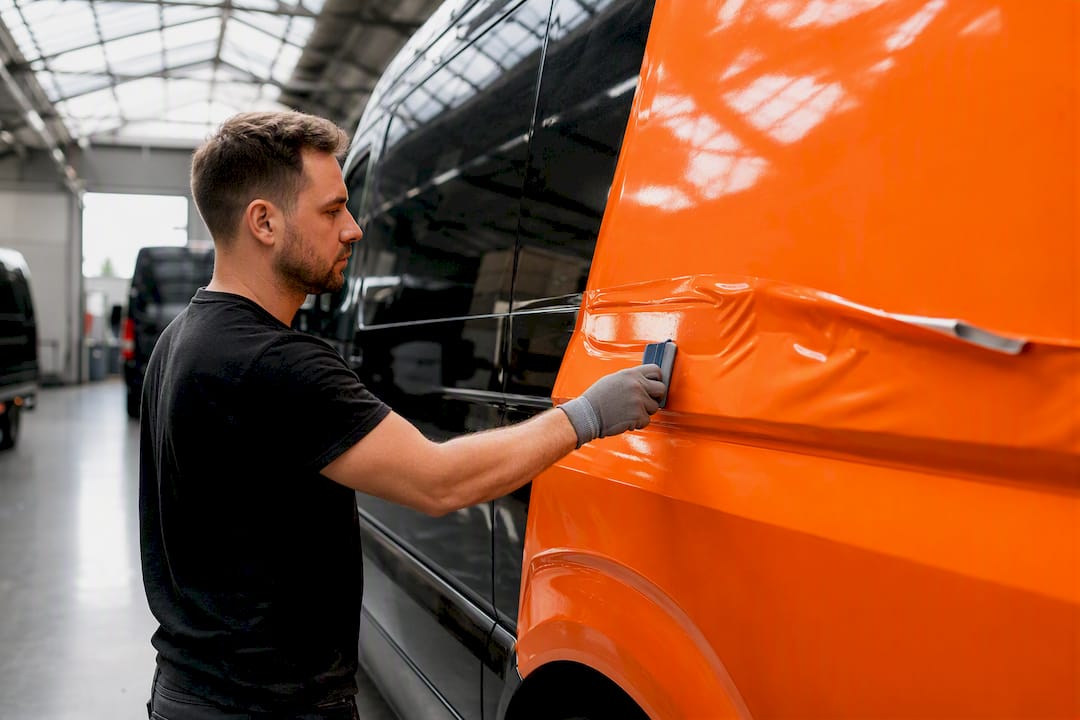
Yes, a wrap can be covered, but only if you disclosed it to your insurer and the damage falls under collision, comprehensive, or a custom parts and equipment endorsement. A wrap you never mentioned to your carrier is the kind of thing that gets a claim denied outright, or paid out at a fraction of what the vinyl cost. Three moves protect you: tell your insurer about the wrap now, save the installer’s invoice and photos, and ask specifically whether your policy needs a scheduled item or endorsement to cover the wrap’s value. The rest of this guide walks through how each coverage type applies, what drives your premium, and how claims for a wrapped vehicle actually get paid.
Key Takeaways
Car wrap coverage depends on disclosure, the right endorsement, and documentation, not on the wrap itself being expensive or elaborate.
| Point | Details |
|---|---|
| Disclose before or right after install | Undisclosed wraps risk denied claims; get written confirmation from your insurer. |
| Ask about a CPE endorsement | Scheduling the wrap as an itemized item is usually required to insure its full value. |
| Expect modest premium changes | Full wraps can raise premiums roughly 5% to 15%, while small or protective wraps often don’t. |
| Fleet wraps need commercial review | Advertising logos can trigger a shift from personal to commercial auto coverage. |
| Documentation decides claims | Keep the itemized invoice, material specs, and VIN photos ready for any repair or total-loss claim. |
Table of Contents
- What Car Wrap Insurance Coverage Actually Includes
- Will Wrapping My Car Raise My Insurance Premium?
- When Does a Wrap Turn Your Vehicle Into a Commercial Asset?
- How Do I Notify My Insurer and What Should I Send Them?
- How Insurers Handle Claims on Wrapped Vehicles
- Maintenance Habits That Strengthen Your Coverage
- What Installers Provide That Actually Helps Your Claim
- Get Your Wrap Installed With Insurance-Ready Documentation
- Helpful Resources for Wrap Owners and Fleet Managers
- An Editorial Take on Wrap Coverage Done Right
- Sources
- FAQ
What Car Wrap Insurance Coverage Actually Includes
No standalone “car wrap insurance” product exists. Coverage comes from parts of your existing auto policy working together, and which parts apply depends on how the damage happened.
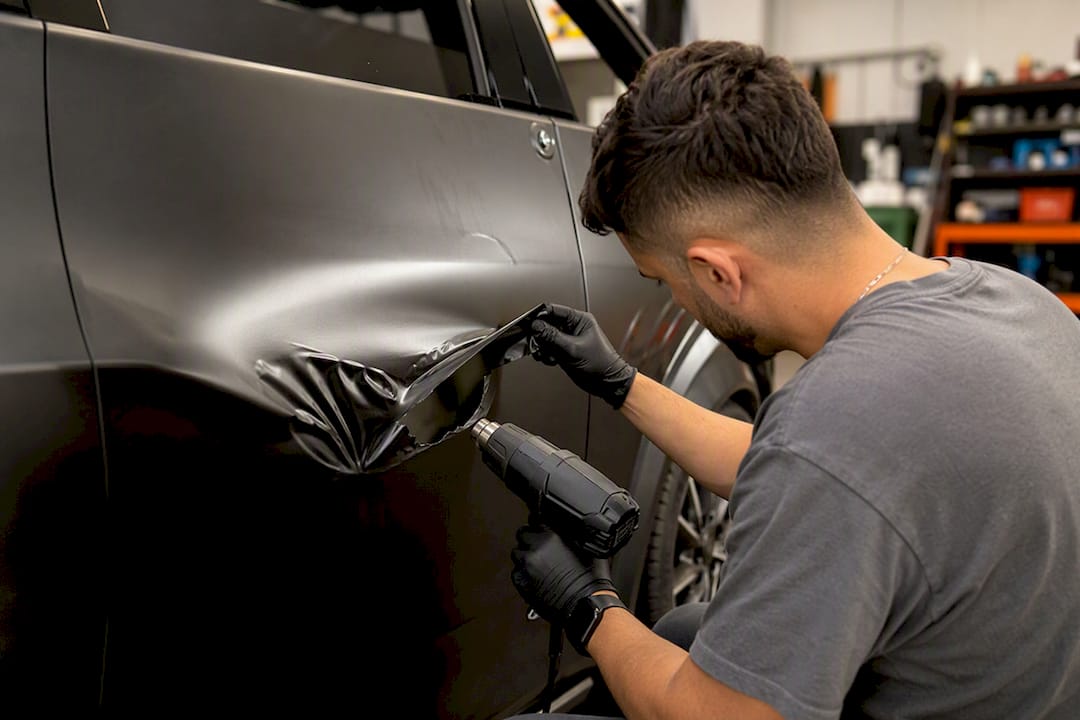
Collision coverage responds when your wrapped panel gets damaged in an accident, regardless of fault. Comprehensive covers non-collision events: vandalism, hail, a shopping cart scratch, a tree branch. Neither one automatically pays for wrap value on top of the vehicle’s value, though. For that, you typically need a custom parts and equipment (CPE) endorsement, or you schedule the wrap as an itemized addition to your policy. Once scheduled, wraps generally fall under the same perils as the rest of the vehicle, including collision, comprehensive, and vandalism.
Adjusters typically handle wrap damage panel by panel rather than replacing the entire wrap. A dented door gets that door section rewrapped and matched to the surrounding graphics, not a full re-skin of the vehicle. On a total loss, the insurer may add your declared wrap value to the payout, but expect depreciation to shrink that number over time.
None of this happens automatically. Insurers need an itemized invoice and photo documentation before they’ll honor a wrap’s value in a settlement.
Will Wrapping My Car Raise My Insurance Premium?
Sometimes, but not always, and the size of the wrap matters less than what it represents to an underwriter. A full color-change wrap on a personal vehicle adds insured value, and insurers price that risk into your premium. Industry estimates suggest full wraps can push premiums up in the range of 5% to 15%, though the exact number depends heavily on your carrier and state.
Small or protective wraps rarely move the needle. A partial wrap, a chrome delete, or a clear protective film on your hood usually reads to an underwriter as maintenance rather than added value, so premiums often stay flat.
Full commercial wraps carry more weight because they signal advertising use, and advertising use signals higher mileage, more public exposure, and costlier repair work if a panel gets damaged. A basic partial wrap might run a few hundred dollars, while a full commercial wrap with premium 3M or Avery film and custom printing can run into the thousands. The best way to keep your premium increase modest: get an accurate valuation from your installer, disclose that figure precisely, and avoid over declaring the wrap’s replacement cost.
When Does a Wrap Turn Your Vehicle Into a Commercial Asset?
Adding a company logo, a phone number, or any advertising copy to a vehicle changes how insurers classify it. Branding signals business use, and business use can trigger a broader policy review that a personal auto policy was never built to handle. One overlooked wrinkle here: insurance professionals note that this reclassification isn’t just about the vehicle itself. It reflects a shift in the entire risk profile, since a branded van parked at job sites all day behaves differently than a commuter car.
Fleet managers should treat wrap decisions as insurance decisions from day one. A few steps prevent coverage gaps:
- Confirm with your carrier whether the wrapped vehicle needs to move from a personal to a commercial auto policy.
- Ask whether a single commercial policy can schedule the wrap value across every vehicle in the fleet, rather than filing separate endorsements one by one.
- Centralize documentation, invoices, photos, and installer contacts, so any vehicle in the fleet has the same paper trail if a claim comes up.
- Revisit coverage annually as vehicles are added, wrapped, or retired.
Scheduling wrap value at the fleet level also means consistent claims treatment across every vehicle, instead of a patchwork of individual policies with different terms.
How Do I Notify My Insurer and What Should I Send Them?
Call or email your agent before installation if you can, and no later than immediately after. Waiting until you file a claim is the scenario that gets wraps excluded, since most insurers treat wraps as aftermarket modifications that must be declared to be covered at all.
Get written confirmation back, not just a verbal “sounds fine” from whoever answers the phone. A short email works: state the vehicle’s VIN, the wrap’s installed cost, the installer’s name, and ask directly whether you need a CPE endorsement or a scheduled item to cover that value. Request their answer in writing.
Before you send that email, gather:
- An itemized invoice from your installer showing labor and material costs separately.
- Material specs, brand and product line (3M or Avery, for example).
- Before and after photos that clearly show the VIN.
- Your installer’s business contact information and any relevant license number.
- The wrap’s written warranty, if one was provided.
Pro Tip: Save every document to a cloud folder labeled with the job number your installer assigns. If you ever switch insurers or file a claim two years from now, you want that folder ready in under a minute, not scattered across old email threads.
How Insurers Handle Claims on Wrapped Vehicles
Most wrap damage gets treated as a repair, not a total re-wrap. If a side panel gets keyed in a parking lot, the adjuster typically approves rewrapping that panel and matching it to the surrounding graphics, with your standard deductible applying just as it would for paint damage.
Total loss changes the math. The insurer calculates the vehicle’s actual cash value, then adds your declared and documented wrap value on top, though depreciation on the wrap itself often reduces that add on. A wrap installed three years ago won’t be valued at its original invoice price.
Common adjustments show up when documentation is thin. An adjuster who can’t verify material cost or installation date will often default to a low estimate, sometimes treating the wrap as negligible cosmetic value rather than a real asset. That’s the practical cost of skipping the paperwork.
Non-disclosure is the sharpest risk here. If you never told your insurer about the wrap and it factors into a claim, from a bigger repair estimate to a liability question about visibility or distraction, the insurer can deny the claim entirely or reduce the payout, treating the undisclosed modification as a misrepresentation on your policy.
Maintenance Habits That Strengthen Your Coverage
Keep your installer’s invoice and material specs on file the day the job finishes, not months later when you actually need them. A shop working with recognized brands like 3M or Avery gives you documentation that adjusters recognize and trust.
- Store the itemized invoice and warranty together in one place.
- Photograph the wrap immediately after install, with the VIN visible in at least one shot.
- Consider paint protection film on high-wear areas like the front bumper and side mirrors, and keep that installation documented separately.
- Wash the wrap by hand or with soft-touch methods to avoid premature fading, which helps preserve both its appearance and its insured value.
- Remove or plan to remove the wrap before selling or returning a leased vehicle, and get that removal documented too, since a fresh factory paint job under an old wrap can affect resale valuation either way.
Insurers don’t offer guaranteed discounts for protective film, but a documented history of protective wrapping can work in your favor if a claim ever gets disputed.
What Installers Provide That Actually Helps Your Claim
A professional installer’s paperwork is often the deciding factor in whether an adjuster approves full wrap value or knocks it down. That means an itemized invoice broken out by labor and materials, the specific film brand and product line, dated before and after photos showing the VIN, a warranty document, and a licensed, reachable installer who can confirm the job if the insurer calls.
Adjusters lean on exactly this kind of paper trail when deciding between a low estimate and a fair one. NJ Vinyl Wrapz builds these deliverables into every job for fleet and personal clients across the New Jersey, Pennsylvania, New York, and Delaware region, so the documentation exists before you ever need it for a claim.
Get Your Wrap Installed With Insurance-Ready Documentation
A wrap is only as protected as the paperwork behind it. NJ Vinyl Wrapz installs full vehicle wraps using premium 3M and Avery materials in a climate-controlled facility, and every job comes with the itemized invoice, material specs, and dated photos your insurer will want to see. Whether you’re wrapping a single company van or scheduling a whole fleet, our team hands you the documentation before you need it, not after a claim gets denied. Explore wrap options for personal and commercial vehicles, or reach out through NJ Vinyl Wrapz to get your project scheduled.
Helpful Resources for Wrap Owners and Fleet Managers
Review aftermarket parts coverage rules, local sign permit requirements for advertising wraps, and NJ Vinyl Wrapz’s wrap protection guidance.
An Editorial Take on Wrap Coverage Done Right
Most advice on this topic treats insurance as an afterthought, something to sort out only after a claim gets filed. That’s backward. The research here points to a clear priority order: disclosure first, documentation second, endorsement details third. Skip the first step and nothing else matters, because an undisclosed wrap can sink a claim regardless of how good your paperwork is.
What’s overrated is worrying about whether a wrap will spike your premium. For most personal vehicles, the increase is modest, and for protective or partial wraps, it’s often nothing at all. What’s underrated is how many owners never ask their insurer the endorsement question at all, then discover during a claim that their wrap was never actually scheduled.
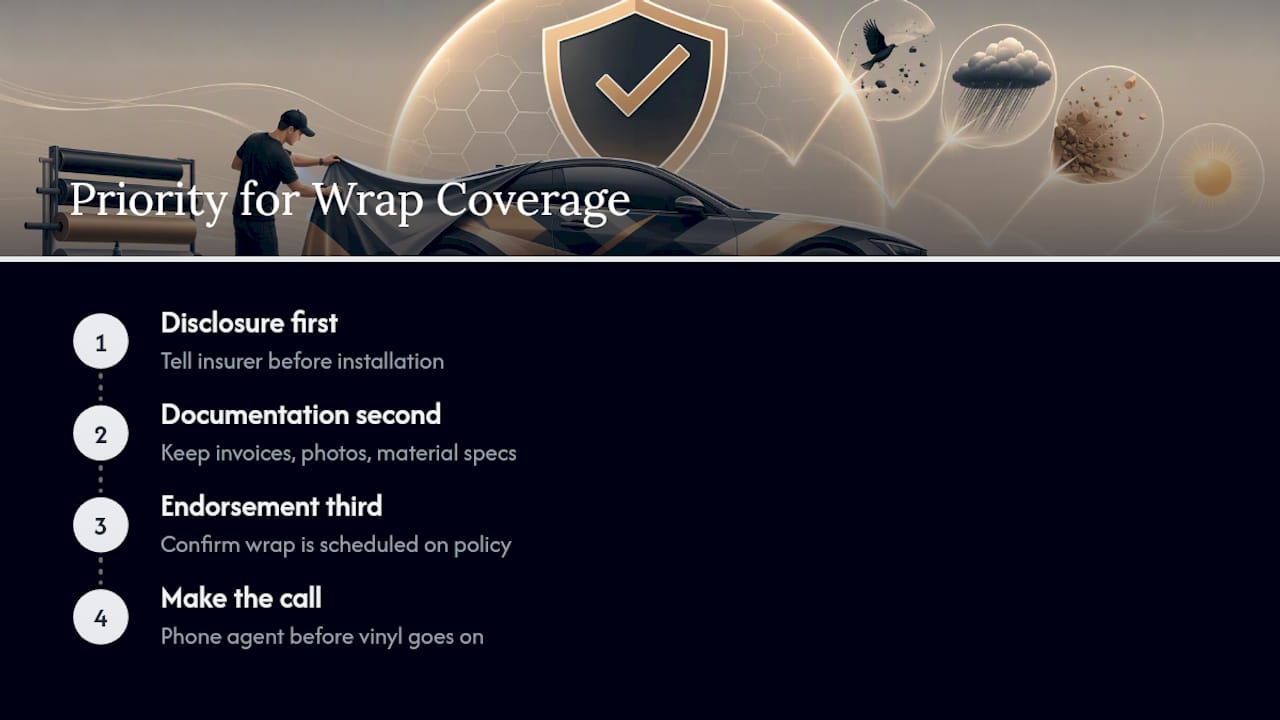
Fleet managers face a sharper version of this problem, because one missed conversation with an agent can leave an entire branded fleet under personal-use policies that were never designed for advertising vehicles. Businesses that treat wrap branding as a partial policy of protected transportation rather than a cosmetic upgrade tend to avoid the worst surprises. If you take one thing from this guide, make it the phone call to your agent before the vinyl goes on the vehicle, not after something happens to it.
Sources
- Are vehicle wraps covered by insurance? What you need to know
- Do cosmetic modifications (like wraps and custom paint) impact your rates?
- Does car insurance cover aftermarket parts on your vehicle?
FAQ
Do I Need to Tell My Insurance Company I Wrapped My Car?
Yes. Most insurers require you to disclose a wrap because they classify it as an aftermarket modification, and failing to report it can lead to denied claims or reduced payouts.
Does Wrapping My Car Raise My Insurance Rate?
What Is Wrap Car Insurance?
There’s no separate “wrap insurance” product. Coverage comes from your existing collision, comprehensive, and custom parts and equipment endorsement working together to protect the wrap’s value.
What Is a Scheduled Item or Endorsement in a Wrap Policy?
It’s an addition to your auto policy that itemizes the wrap’s declared value, so it’s protected under the same perils, like collision, comprehensive, and vandalism, that cover the rest of your vehicle.
Does Car Insurance Cover Aftermarket Wraps Automatically?
No. Standard policies typically offer minimal automatic coverage for aftermarket additions like wraps unless you add a custom parts and equipment endorsement and provide documentation such as receipts and photos.