
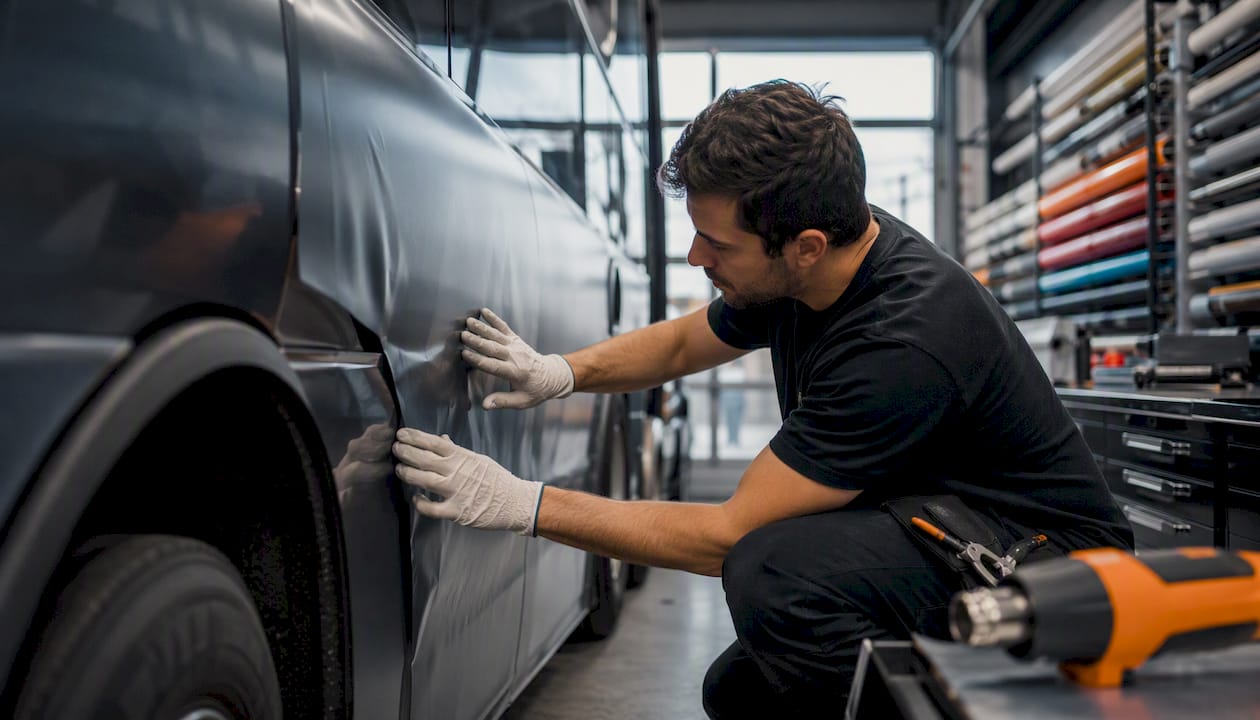
A full bus wrap typically runs $6,500 to $20,000, with most jobs settling between $10,000 and $15,000. Spot graphics start around $500 to $2,500, partial wraps land between $2,500 and $7,000, and a full wrap with roof coverage pushes toward the top of that range. If you’re budgeting today, the single most useful number to remember is the per-square-foot rate: expect $6 to $15 per square foot depending on bus size and film grade.
That’s the answer. The rest comes down to variables that shift your quote up or down within that band, and getting a vendor-ready number means understanding what drives the difference between a $7,000 quote and an $18,000 one for what looks like a similar bus.
| Coverage Type | Typical Price Range | Per Sq. Ft. Equivalent |
|---|---|---|
| Spot graphics | $500 – $2,500 | $3 – $8 |
| Partial wrap | $2,500 – $7,000 | $6 – $12 |
| Full wrap | $6,500 – $20,000 | $6 – $15 |
A few variables move the needle more than anything else:
- Bus size and roof coverage — a 40-foot coach with a full roof wrap costs meaningfully more than a 25-foot shuttle with side panels only.
- Vehicle condition — dents, rust, and old adhesive residue add prep hours before a single sheet of vinyl goes down.
- Design complexity — a two-color logo wrap prints and installs faster than a photo-realistic, multi-panel graphic.
- Material grade — cast vinyl costs more upfront than calendared film but holds color and edges longer.
Key Takeaways
Bus wrap pricing runs from roughly $500 for spot graphics to $20,000 for a full wrap with roof coverage, and the biggest cost swings come from bus size, material grade, and vehicle prep.
| Point | Details |
|---|---|
| Know your price band | Full wraps run $6,500–$20,000, partial wraps $2,500–$7,000, and spot graphics $500–$2,500. |
| Control the controllable drivers | Vehicle condition, coverage scope, and material grade move your quote more than any other factor. |
| Standardize what you send vendors | Photos, measurements, coverage scope, and timeline let you compare quotes apples to apples. |
| Budget for upkeep, not just install | Laminated cast vinyl lasts 5–7 years but still needs a small annual maintenance budget. |
| Get a line-item quote | NJ Vinyl Wrapz builds itemized quotes covering material, labor, design, and prep so you know exactly what you’re paying for. |
Table of Contents
- How Much Does a Bus Wrap Cost to Plan For?
- What Does Each Type of Bus Wrap Cost?
- How Does Bus Size Affect Wrap Pricing?
- Cast Vinyl, Calendared Film, and Premium Finishes: What’s Worth Paying For?
- How Long Does It Take to Get a Bus Wrapped?
- What Does a Real Bus Wrap Quote Look Like?
- What to Send Vendors for an Accurate Bus Wrap Quote
- How Can You Reduce Bus Wrap Costs Without Cutting Corners?
- How Long Does a Bus Wrap Last and What Does Upkeep Cost?
- Why Do Bus Wrap Quotes Vary So Much?
- An Installer’s Take on Where Bus Wrap Budgets Go Wrong
- Ready to Get Your Bus Wrap Quote?
- Sources
- FAQ
How Much Does a Bus Wrap Cost to Plan For?
Every bus wrap quote is built from the same five ingredients: material, labor, design, prep, and overhead markup. Knowing which one is inflating your number lets you negotiate with an actual lever instead of just asking a shop to “do better on price.”
Bus size drives material yardage more than any other factor. A 40 foot transit bus has roughly double the wrap surface of a 25 foot shuttle, and material cost scales close to linearly with square footage even when labor doesn’t.
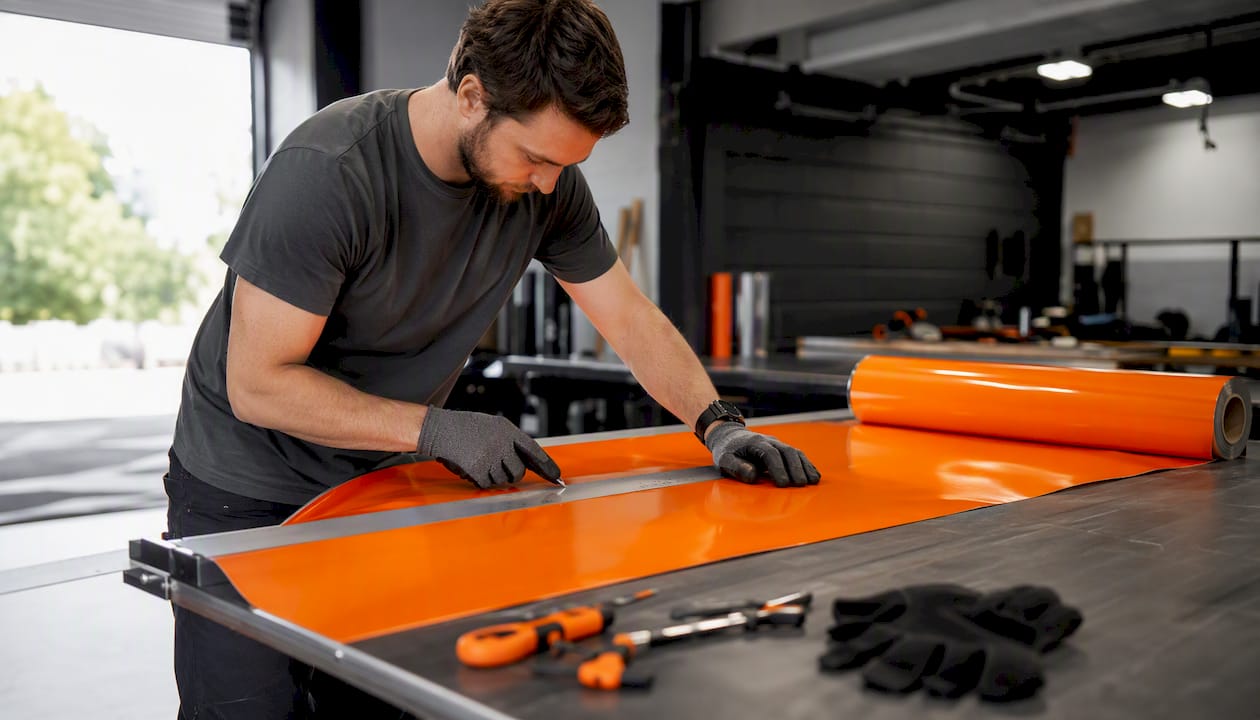
Wrap coverage matters almost as much. Going from partial to full coverage doesn’t just add vinyl. It adds panel transitions, more window masking decisions, and often roof work that requires lift equipment.
Material grade and lamination stack on top of base film cost. A laminated cast vinyl wrap protects against UV fade and road grime far better than an unlaminated calendared film, but that protection typically adds several hundred to over a thousand dollars to a full bus job.
Design complexity shows up in the print stage. Gradient artwork, complex photography, and precise brand color matching (especially Pantone-matched corporate colors) take longer to proof and print than flat vector graphics.
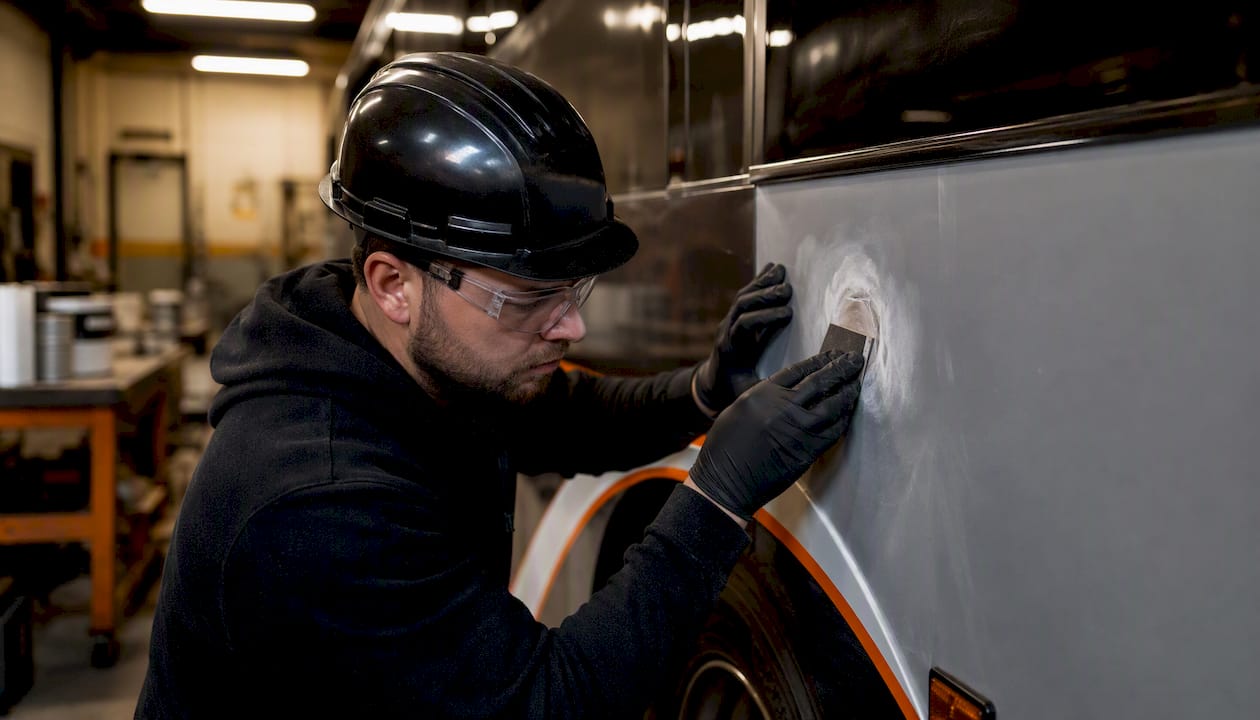
Surface prep and repairs are the line item most buyers underestimate. Vinyl doesn’t hide dents, rust bubbles, or peeling paint. It highlights them. A bus that needs bodywork before wrapping can add $500 to $2,000 to the job before the design phase even starts.
Windows and roof require decisions on perforated vinyl (see-through from inside, branded from outside) versus full opacity, and roof wraps demand extra labor time and sometimes specialized equipment.
Removal of old graphics is its own cost center. Stripping years-old vinyl and adhesive residue off a fleet bus can take hours per vehicle, and that labor gets billed whether or not it’s mentioned upfront.
Local labor rates vary by region and shop overhead. A shop with a climate-controlled facility and certified installers charges differently than a garage doing wraps as a side service.
A few less obvious drivers catch buyers off guard:
- Fleet logistics — coordinating pickup/drop-off for multiple buses, or wrapping on-site, adds scheduling complexity and sometimes travel fees.
- Permit fees — some municipalities require permits for large-format vehicle graphics, particularly for advertising content.
- Disposal — old vinyl removal generates waste that has to be handled, and some shops itemize this separately.
- Rush scheduling — compressing a two-week timeline into three days almost always carries a premium.
Pro Tip: Ask your installer to inspect the bus in person or via detailed photos before quoting. A phone-quoted price based on “it’s a 35-foot bus” almost always changes once someone sees the actual paint condition, and catching that upfront avoids an awkward change order mid-project.
What Does Each Type of Bus Wrap Cost?
Not every branding job needs a full wrap. Matching coverage to budget and goals starts with understanding what each tier actually includes.
Spot graphics cover a targeted area, like a logo on the door or a phone number along the rear panel. This is the cheapest entry point and works well for buses that just need contact information or a small brand mark rather than a full advertising surface.
Partial or half-side wraps cover roughly 25% to 50% of the bus, typically the lower panels or one full side. This tier balances visibility with cost and suits businesses that want strong curbside presence without committing to full coverage.
Full side wraps cover both sides top to bottom, excluding the roof. This is the most common choice for advertising-focused fleets since it maximizes visible branding at eye level and above, where pedestrians and drivers actually look.
Full bus wraps (including roof) extend coverage over the top of the vehicle, which matters for buses viewed from elevated positions, like from office windows or overpasses in urban corridors. Roof wraps add labor time and sometimes require the bus to be pulled off active routes longer.
Window masking or perforated window wraps apply vinyl over glass, either fully opaque for advertising space or perforated so passengers can still see out. This is priced separately in most quotes because it requires different material and a different install technique.
If your goal is brand recognition on a budget, a partial wrap on the driver-side panel often delivers strong return without the full-wrap price tag. If the bus is a rolling billboard for a campaign launch, full coverage including roof makes more sense. You can review the different wrap options to see how coverage scope changes both look and cost.
How Does Bus Size Affect Wrap Pricing?
Installers price by surface area, not by “bus” as a flat unit, which is why a 25-foot shuttle and a 45-foot coach can have wildly different quotes even for the same coverage type. Measuring wrap area involves calculating length times height for each visible panel, then subtracting windows, doors, and other non-wrapped surfaces.
Example 1: A 30-foot shuttle bus is about 8.5 feet tall.
Those per-square-foot figures represent material and print cost alone. Labor, design, and prep stack on top, which is why the full-wrap totals in the earlier table run higher than the raw square-footage math suggests. A per-square-foot pricing breakdown is useful context if you want to see how this scales across other vehicle types too. One caveat worth knowing before you lock in a number from a square-footage calculator: per-square-foot pricing is a useful starting estimate, but installers ultimately charge by the job because seams, window cutouts, and panel curves create labor that doesn’t scale in a straight line with area.
Cast Vinyl, Calendared Film, and Premium Finishes: What’s Worth Paying For?
Material choice is where buyers either save money short-term or save money long-term, and rarely both. Cast vinyl is manufactured as a thin, flexible film that conforms tightly to compound curves like wheel wells and mirror housings without shrinking back over time. Calendared vinyl is produced through a different manufacturing process, comes in thicker sheets, and works fine on flat panels but tends to lift at edges and fade faster on a vehicle that sits outdoors year-round.
For a bus in daily service, exposed to sun and highway driving five or six days a week, that durability gap matters. Cast vinyl commonly holds up 5 to 7 years with lamination and proper care, while calendared film often shows visible wear in 2 to 4 years.
Brand-level choices also shape the quote. Material from 3M and Avery, the two names most professional installers treat as the quality benchmark, generally costs more per roll than off-brand film, but both come with manufacturer warranties and consistent color matching across large jobs. That consistency matters more than it sounds: a fleet of six buses wrapped with unreliable film can end up with visibly different color tones from vehicle to vehicle.
Lamination is the clear coat applied over the printed graphic, and it’s not optional for a wrap that needs to survive years of UV exposure and road grime. Specialty finishes, metallic, matte, textured, or color-shift films, cost more still and are typically reserved for premium branding campaigns or flagship vehicles rather than an entire fleet.
- Cast vinyl: higher upfront cost, 5 to 7 year lifespan, best for full wraps and complex curves.
- Calendared vinyl: lower upfront cost, 2 to 4 year lifespan, best for short-term campaigns or flat-panel spot graphics.
- Lamination: adds UV and abrasion protection, typically extends usable life by a year or more.
- Specialty finishes: metallic and textured options add visual impact but come at a premium and are less common for full fleets.
A wrap is only as good as the film underneath the print. Buyers who chase the lowest quote by accepting unlaminated calendared vinyl on a bus that runs five days a week often end up paying for a second wrap two years sooner than they would have with the right material the first time.
Reading up on what car wrap film is actually made of helps make sense of why two quotes with identical coverage can differ by thousands of dollars.
How Long Does It Take to Get a Bus Wrapped?
A bus wrap project moves through six stages, and skipping steps to save time almost always costs more later in rework.
- Measurement and vehicle assessment — the installer measures panels, photographs the vehicle, and flags any prep needs.
- Design proofs — your brief or artwork gets converted into a print-ready template mapped to the actual bus dimensions, with at least one revision round.
- Print production — approved artwork is printed on the chosen film, which can take a day or more depending on print queue and complexity.
- Surface prep — the bus is cleaned, decontaminated, and any dents or paint issues are addressed before vinyl goes down.
- Installation — installation itself commonly takes 2 to 5 days for a full wrap, longer for intricate artwork or larger coaches.
- Inspection and quality check — edges, seams, and window trims get a final review before the vehicle goes back into service.
Prep tasks add cost in ways that are easy to underestimate going in:
- Deep cleaning and decontamination to remove wax, oil, and road film that would otherwise stop vinyl from bonding.
- Dent and paint repair, since vinyl telegraphs surface imperfections instead of hiding them.
- Removal of old graphics or decals, which can take several hours per vehicle depending on age and adhesive type.
- Masking or removing mirrors, handles, and trim pieces before install begins.
For a single bus, expect the full process from initial measurement to final inspection to run 1 to 2 weeks. Fleet batches take longer overall but often move faster per vehicle once the design template and prep workflow are established, sometimes stretching 3 to 6 weeks for a full fleet depending on how many buses are staged at once.
What Does a Real Bus Wrap Quote Look Like?
Numbers in a range are useful for budgeting, but a line-item quote shows you where the money actually goes. NJ Vinyl Wrapz builds quotes around the same core categories every legitimate shop uses: material, labor, design, prep, lamination, and delivery.
These figures echo the cost structure other industry pricing guides use, where wrap material typically runs $4,000 to $9,000 and labor $3,000 to $12,000 for a full wrap job.
Three realistic scenarios show how this plays out:
- A simple brand refresh — one or two flat colors and a logo on a shuttle bus, minimal prep needed. Lands near the low end of the full-wrap range.
- A multi-color advertising wrap — full-color photography and gradient artwork across a transit bus with moderate prep. Sits comfortably in the middle of the range.
- A premium campaign wrap — metallic or specialty finish across a coach bus with full roof coverage and dent repair beforehand. Pushes toward the top of the market.
NJ Vinyl Wrapz has completed fleet and single-vehicle bus wraps across New Jersey, Pennsylvania, New York, and Delaware using 3M and Avery materials, and can share portfolio examples and before-and-after photos from comparable jobs on request.
What to Send Vendors for an Accurate Bus Wrap Quote
Two shops looking at the same bus can hand you very different numbers, and often both are “right” once you understand what’s included in each one. Standardizing what you send every vendor is the fastest way to make quotes genuinely comparable.
Before requesting quotes, gather:
- Clear photos of the bus from all four sides, plus close-ups of any dents, rust, or paint damage.
- Vehicle make, model, length, and VIN if available.
- Desired coverage level (spot, partial, full, with or without roof).
- Target launch or completion date.
- Artwork files or a creative brief if you already have branding assets.
- Fleet count, if wrapping more than one vehicle.
- Expected maintenance plans, including whether this is a one-time job or part of an ongoing fleet program.
- Vehicle location, since some shops charge mobilization fees for off-site work.
Once you have that packet ready, ask every vendor these ten questions:
- What warranty comes with the material and the installation labor?
- What vinyl brand do you use, and is it cast or calendared?
- Is lamination included, or is it a separate line item?
- What specifically voids the warranty (parking under trees, automated car washes, etc.)?
- What prep work do you assume is included, and what counts as extra?
- Do you charge separately for removing existing graphics?
- What’s your realistic turnaround time from approval to a finished vehicle?
- How many design proof revisions are included before extra charges apply?
- Are you licensed and insured, and can you provide proof?
- Is there a mobilization or travel fee if the bus stays on-site?
Comparing answers side by side, not just the bottom-line number, is what actually reveals which quote is the better deal.
How Can You Reduce Bus Wrap Costs Without Cutting Corners?
Cost control on a bus wrap comes down to smart scope decisions, not cheap materials. A few tactics consistently save real money:
- Choose partial or spot graphics when full brand saturation isn’t the goal. A well-placed half-side wrap often achieves 70% of the visual impact at 40% of the cost.
- Reuse a single design across a fleet. Design and proofing fees get charged once instead of per vehicle, which can save hundreds to low thousands depending on fleet size.
- Batch installs across multiple buses. Scheduling five vehicles in one week is more efficient for a shop than five separate one-off appointments, and that efficiency sometimes translates into a better rate.
- Pick a durable mid-grade cast film over the cheapest available option. A wrap that needs replacing in two years instead of six costs more in total, even if the sticker price looked better upfront.
For fleets specifically, volume discounts of roughly 5% to 15% are common once you’re wrapping several vehicles with a shared or similar design, since design and setup costs get spread across the whole order.
On the ROI side, a simple back-of-envelope method works: estimate daily impressions the bus generates (based on route traffic and stops), multiply by your typical conversion rate for outdoor advertising, then multiply by average order value to estimate revenue generated per day. Compare that daily figure against your total wrap cost to estimate a rough payback period. This won’t be exact, but it gives you a defensible number for a budget conversation. Reviewing ROI expectations for fleet wrap designs can help sharpen those assumptions further.
Pro Tip: If you’re wrapping more than three vehicles, ask about a design-and-setup fee structure separate from per-vehicle installation costs. This lets you negotiate volume pricing on install labor without asking the shop to discount the creative work, which tends to get a better response than a blanket “can you do better on price” request.
How Long Does a Bus Wrap Last and What Does Upkeep Cost?
A properly installed, laminated cast vinyl wrap typically lasts 5 to 7 years with reasonable care. Calendared film without lamination often falls short of that, showing fading and edge lifting well before the five-year mark. Lamination is the single biggest factor separating a wrap that looks sharp in year five from one that looks tired by year two.
Maintenance is straightforward but matters. Hand washing or touchless car washes, avoiding brush-style automated washes, keeps seams and edges intact. UV exposure is unavoidable on a vehicle that lives outdoors, which is exactly why lamination and film grade matter more than most buyers initially assume. Spot repairs for scratches or peeling corners, caught early, are inexpensive compared to letting damage spread across a full panel.
- Wash by hand or touchless system rather than brush car washes.
- Address peeling edges or scratches within weeks, not months.
- Budget roughly a few hundred dollars a year per vehicle for minor spot repairs and touch-ups.
- Keep the bus garaged or shaded when possible to slow UV fade.
Warranties typically cover material defects and adhesion failure for a set period, often tied to the film manufacturer’s own warranty terms. Common exclusions include damage from improper washing, incidents like collisions or vandalism, and fading caused by neglecting recommended care. Reading the expected lifespan guidance for your specific material before signing off on a quote clarifies exactly what’s covered and what isn’t.
Why Do Bus Wrap Quotes Vary So Much?
Every legitimate quote is built the same way: material cost, plus labor, plus overhead, plus a markup. Shops commonly apply a cost-plus multiplier in the 1.8x to 2.5x range over their direct costs, and where a shop sits in that range depends on positioning, facility overhead, and how they source film.
Region affects pricing too, since labor rates and facility costs differ by market, and job complexity (roof coverage, window perforation, intricate artwork) pushes quotes upward independent of bus size. Scheduling also plays a role: rush jobs compressed into a tight timeline often carry a premium because they disrupt a shop’s normal production queue.
Expect quotes above this guide’s ranges for buses with heavy body damage, unusually complex artwork, or extremely tight deadlines. Treat every figure in this guide as a planning estimate, not a binding quote. Get vehicle-specific pricing from a licensed installer before finalizing a budget.
Two shops can quote the exact same bus $4,000 apart and both be pricing it honestly. The difference usually comes down to film sourcing, overhead structure, and what each shop bakes into their prep assumptions rather than one of them padding the number.
An Installer’s Take on Where Bus Wrap Budgets Go Wrong
The costliest mistake we see at NJ Vinyl Wrapz, after more than a decade wrapping commercial fleets across New Jersey, isn’t picking the wrong film or the wrong shop. It’s skipping the pre-wrap inspection and assuming a bus is “ready to wrap” without checking for hidden paint issues.
A bus that looks clean from ten feet away can have clear-coat failure, old adhesive residue from a previous decal, or hairline rust starting at seams, and none of that shows up until the vinyl goes on and telegraphs every flaw underneath. Fleet managers who send us photos before quoting, rather than after arriving for install day, consistently get more accurate quotes and avoid the awkward mid-project conversation about an unplanned repair bill.
NJ Vinyl Wrapz is licensed and insured, and works exclusively with 3M and Avery materials on every fleet job, which is part of why we push clients to confirm prep expectations upfront rather than discover them halfway through installation.
Ready to Get Your Bus Wrap Quote?
NJ Vinyl Wrapz gives you something a national franchise or a one-truck operator usually can’t: climate-controlled installation, in-house design, and 3M and Avery materials backed by more than a decade wrapping commercial fleets across New Jersey, Pennsylvania, New York, and Delaware. That means one point of contact from first measurement to final inspection instead of juggling separate designers, printers, and installers.
If you’re ready to move from budgeting to an actual number, visit the full vehicle wraps page to see completed fleet examples, or browse wrap options if you’re still deciding between partial and full coverage. Send over vehicle photos, your desired coverage level, and a target timeline, and NJ Vinyl Wrapz will put together a line-item quote built the same way as the sample breakdown above, typically with a response within a couple of business days.
Sources
- Vinyl Wrap Pricing Guide for Shops: Charge More, Earn More – HighCool
- Commercial Fleet Wrap Pricing Guide | Wrap Quotes
FAQ
How much does it cost to wrap a coach bus?
A coach bus wrap commonly falls between $8,000 and $12,500 for standard full coverage, though premium finishes and roof wraps can push that toward $20,000 or more.
How much does it cost to wrap a vehicle in general?
Cost depends entirely on vehicle size and coverage: spot graphics start around $500, while a full commercial vehicle wrap typically runs from a few thousand dollars for a small van up to $20,000 for a full-size bus.
How much does it cost to wrap a transit bus?
A transit bus wrap typically costs between $7,000 and $14,000 for full side coverage, or $10,000 to $20,000 with roof wrap included, depending on size, material grade, and design complexity.
What is the average price to wrap a van?
A van wrap generally costs less than a bus wrap due to smaller surface area, often landing in the $2,500 to $6,000 range for full coverage depending on van size and material choice. NJ Vinyl Wrapz can provide a specific quote based on van model and desired coverage.
Recommended
- Vehicle Wraps Cost per Square Foot: 2026 Pricing Guide | NJ Vinyl Wrapz
- Fleet wrap costs explained: value, savings, and ROI for NJ fleets | NJ Vinyl Wrapz
- Pickup Truck Wrap Cost: What Owners and Fleets Should Budget | NJ Vinyl Wrapz
- How to wrap fleet vehicles for max brand impact in NJ | NJ Vinyl Wrapz